
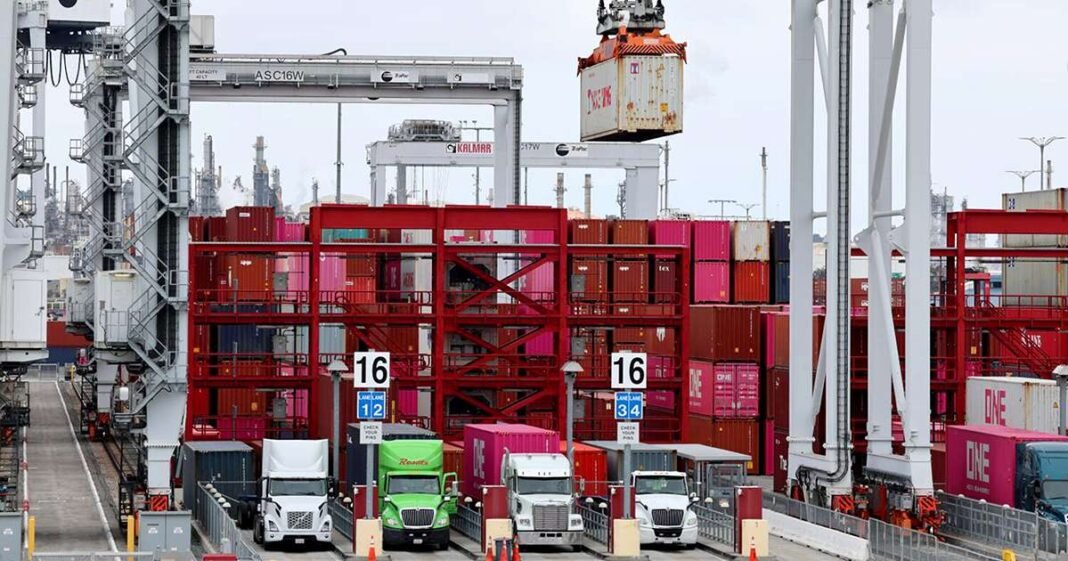

Activity at the Port of Los Angeles. (Allen J. Schaben/Los Angeles Times/TNS)
February 18, 2026 11:10 AM, EST
National Economic Council Director Kevin Hassett said a study from the Federal Reserve Bank of New York showing U.S. companies bear most of the tariff burden “is an embarrassment” and the people associated with it should be “disciplined.”
“What they’ve done is they put out a conclusion which has created a lot of news that’s highly partisan, based on analysis that wouldn’t be accepted in a first semester econ class,” Hassett said Feb. 18 on CNBC. He added U.S. consumers will be made better off by tariffs.
Hasset’s remarks fit into a series of incidents in which President Donald Trump has attacked economic analysis he dislikes.
In a social media post in August, Trump told Goldman Sachs Group Inc. CEO David Solomon he should “get himself a new economist.” It came shortly after Goldman researchers led by Jan Hatzius, the bank’s chief economist, published a note saying U.S. consumers would eventually absorb a majority of tariff costs.
That came less than two weeks after Trump fired Erika McEntarfer, then the head of the Bureau of Labor Statistics, hours after a BLS report showed weak job growth.
The New York Fed study, published last week, found that nearly 90% of the economic burden from tariffs in 2025 was borne by U.S. companies and consumers.
Spokespeople for the New York Fed and the Fed’s Board of Governors in Washington declined to comment.
Some 94% of the tariff costs were passed through to U.S. firms and consumers in the first eight months of the year, according to the study. By November, foreign exporters were absorbing slightly more — a 10% tariff was associated with a 1.4% decline in export prices — but pass-through still stood at 86%.
“Our results show that the bulk of the tariff incidence continues to fall on U.S. firms and consumers,” Mary Amiti, Chris Flanagan, Sebastian Heise and David E. Weinstein wrote in the report. It included a standard disclaimer that “the views expressed in this post are those of the author(s)” and do not necessarily reflect the position of the Fed.
Additional Research
The New York Fed’s findings were similar to the conclusions made by other researchers. Harvard University’s Gita Gopinath and Brent Neiman of the University of Chicago found “tariff pass-through to U.S. import prices is almost 100%, so the United States is bearing a large share of the costs.”
The Congressional Budget Office also published estimates of the impact of tariffs. It found 5% of the cost of tariffs would be absorbed by foreign exporters. Of the amount borne in the U.S., 30% would be absorbed by businesses and 70% passed on to consumers, the CBO said.
Another study, from researchers at Germany’s Kiel Institute, called the 2025 tariffs an “own goal” for the U.S.: “American importers and consumers bear nearly the entire cost,” the authors concluded. “Foreign exporters absorb only about 4% of the tariff burden — the remaining 96% is passed through to U.S. buyers.”
Transport Topics reporters Eugene Mulero and Keiron Greenhalgh examine the critical trends that will define freight transportation in the year ahead. Tune in above or by going to RoadSigns.ttnews.com.
Hassett criticized the New York Fed research for focusing on prices and not factoring in changes in quantities of imports.
“If we bring the stuff home, create the demand at home, then that will hurt China and drive up wages of the U.S., and American consumers will be better off,” Hassett said.
Hassett was a top contender to be the next Fed chair until Trump announced on Jan. 30 he had selected former Fed Governor Kevin Warsh for the post. Warsh must be confirmed by the U.S. Senate.

