
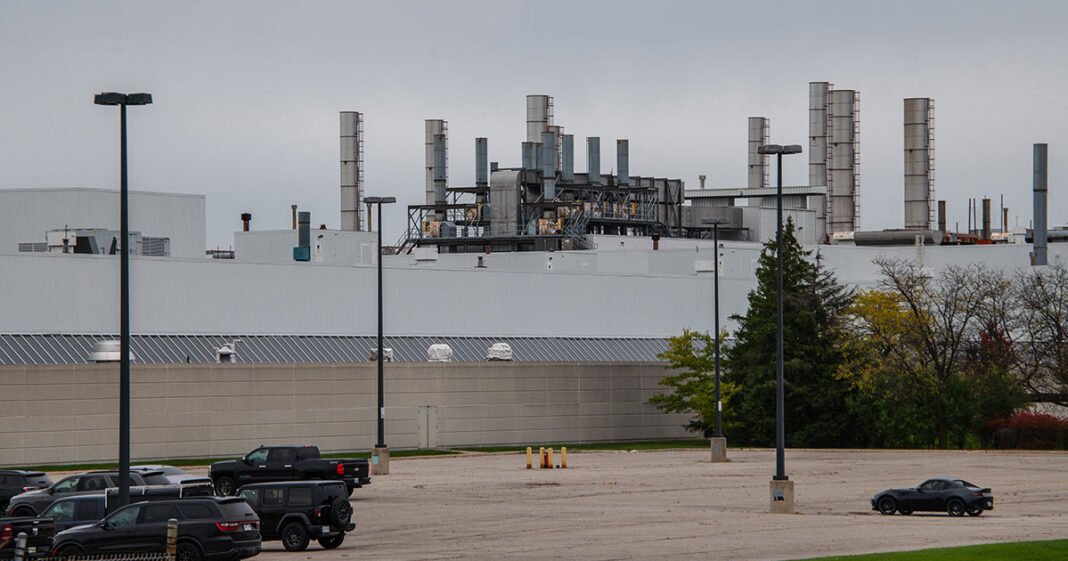

The Stellantis assembly plant in Brampton, Ontario. (Laura Proctor/Bloomberg)
April 1, 2026 5:30 PM, EDT
Stellantis NV is discussing options for building electric vehicles in Canada with its Chinese partner, Zhejiang Leapmotor Technology Co., according to people familiar with the matter, a sign of how quickly the auto industry is being reshaped after Canada opened the door to companies from the world’s largest car market.
The talks are in an early stage, said the people, who asked not to be identified discussing information that’s not public. If the companies proceed, it would be the first major Chinese auto investment in Canada since Prime Minister Mark Carney reached an agreement with President Xi Jinping in January to reduce tariffs on Chinese-made EVs.
As part of that deal, Carney’s government said it wanted to attract new Chinese joint-venture investment “with trusted partners” in the Canadian auto sector within three years.
But the potential for Chinese-led vehicle production in one of the U.S.’s closest allies and trading partners shows the ripple effects of President Donald Trump’s tariffs on foreign-made cars and trucks, which have disrupted the integrated North American auto sector and cost automakers billions of dollars.
Officials in the U.S. administration have repeatedly warned Carney about the risk of retaliation if Canada is used as a back door to export Chinese vehicles into the U.S. In January, Trump threatened to put 100% tariffs on all Canadian goods “if Canada makes a deal with China.”
The Canadian discussions are focused on an idled Stellantis assembly plant in Brampton, Ontario, a suburb of Toronto. Thousands of workers there have been laid off for years but were supposed to get a new Jeep sport-utility vehicle to produce.
Last year, after Trump announced tariffs, Stellantis canceled those plans and moved the SUV to a U.S. factory instead. The decision prompted fury from Carney’s government, which threatened to claw back millions of dollars of taxpayer-backed subsidies from Stellantis.
A Leapmotor vehicle on display at the Turin Motor Show in Italy in 2025. (Giuliano Berti/Bloomberg)
The company has since been in discussions with Canadian Industry Minister Melanie Joly over future plans for the plant.
Those talks now include the possibility of building cars in partnership with Leapmotor, a fast-growing Chinese manufacturer. Stellantis bought a 20% stake in Leapmotor in 2023, and a year later the two companies formed a joint venture called Leapmotor International, focused on global production and sale of the electric vehicles.
The joint venture plans to start producing Leapmotor electric SUVs later this year at a Stellantis factory in Spain, near a massive battery factory Stellantis is building with another Chinese firm, Contemporary Amperex Technology Co. Other parts for the car will be made by yet another joint venture, called Lieder Automotive, between Spanish and Chinese firms.
Leapmotor and Stellantis also plan to produce EVs in Brazil and Malaysia, but those projects will rely, at least at first, on the use of “knockdown kits,” where the cars are largely built in China and then shipped overseas for final assembly.
It’s unclear at this point what conditions might be placed on any Leapmotor-Stellantis venture in Canada, according to people with knowledge of the discussions, who said the talks are still preliminary and no decisions have been made.
Fresh from TMC, ATA President Chris Spear takes a candid look at what today’s fleet maintenance trends reveal about the broader state of trucking. Tune in above or by going to RoadSigns.ttnews.com.
Carney’s government would face delicate negotiations with labor unions and parts suppliers that are wary of Chinese firms entering the Canadian auto sector. The Brampton plant has about 3,000 unionized workers.
Flavio Volpe, president of Canada’s Automotive Parts Manufacturers’ Association, said any Leapmotor production in Brampton “must be full vehicle assembly with local suppliers as has been the case since 1962 in that plant.”
“Chinese knockdown kits may be fine for Brazil, but they aren’t for the hundreds of Canadian auto parts suppliers who are waiting for that plant to reopen,” Volpe said in a text message. “We don’t need a bad deal, and we shouldn’t settle for one.”
A Stellantis spokeswoman stressed all options are still on the table for Brampton, and it’s still very early in the process.
“Stellantis remains focused on a strong Canadian footprint and is actively evaluating future programs for Brampton, with the objective to ensure that any investment decision is sustainable and a long-term commitment that supports workers and suppliers,” LouAnn Gosselin, North America spokesperson for Stellantis, said in an emailed statement.
“We are in active discussions with government officials and key stakeholders to ensure that the conditions for success are in place to support continued investment in Canada,” she added.
A Leapmotor representative declined to comment. Joly’s office did not respond to a request for comment by deadline.
Stellantis had originally considered putting a future Chrysler product in Brampton, but that will likely now be produced in Illinois, said Sam Fiorani, AutoForecast’s vice president of global vehicle forecasting.
“Stellantis will either partner with a company like Leapmotor to build vehicles in that plant or sell it to an aspiring new manufacturer from China. Those are the two most likely outcomes,” Fiorani said.
The industry minister has previously said she wants to see Chinese auto production in Canada, but in a joint venture, using Canadian parts and software.
“We believe that these great Canadian champions can partner with Chinese EV companies to make a Canadian-Chinese car to export it around the world,” Joly told Bloomberg News in February.
But it’s still unclear whether a car built in Canada by a Chinese manufacturer would even be allowed to cross the Canada-U.S. border. The U.S. government is enacting regulations to restrict the sale or import of connected vehicles using technology from China and Russia.
Chinese-made EVs that will soon start being imported to Canada under the lower tariff may be blocked at U.S. ports of entry, Pete Hoekstra, the U.S. ambassador to Canada, suggested in a recent interview.
“Those cars can come in from China, come into Canada, but they’re not going to cross the border into the U.S.,” Hoekstra told Canada’s Rebel News. “That ain’t gonna happen.”
It was unclear whether he meant that Chinese cars legally imported into Canada would be denied the U.S. paperwork needed for resale in the U.S., barred entirely from going across the border, or subjected to other administrative hurdles.

