
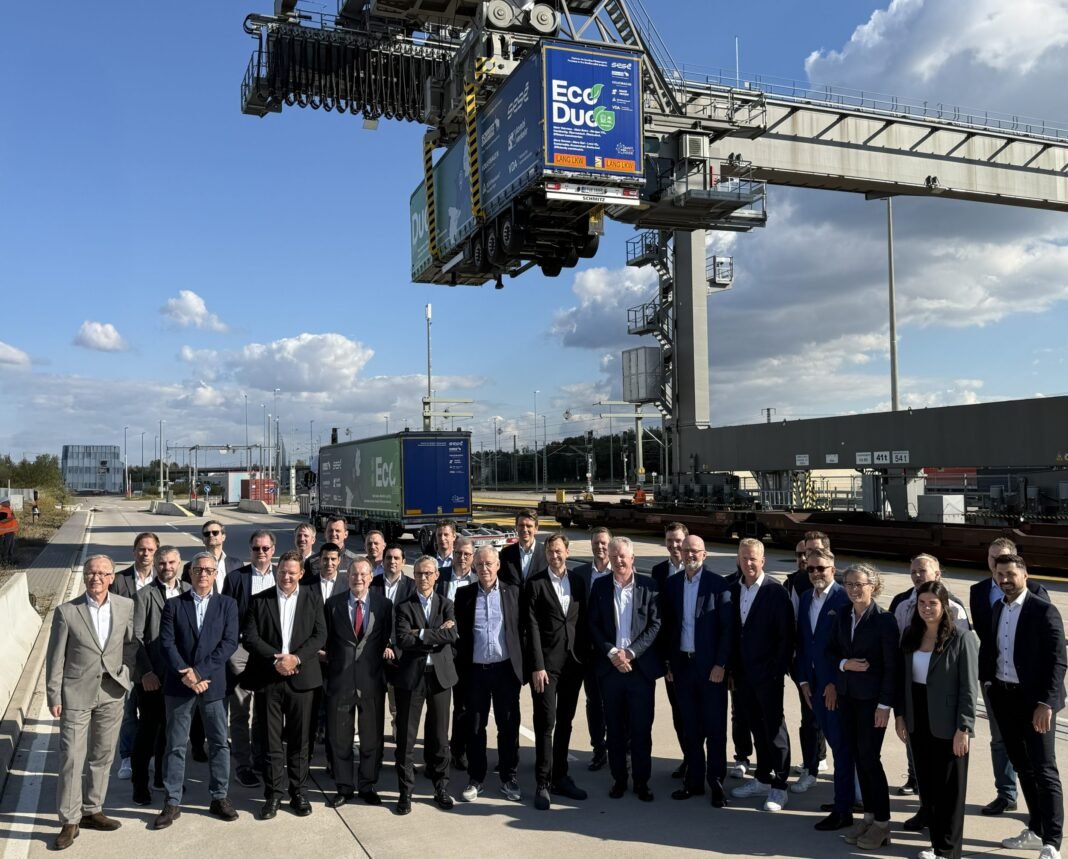

While eco-combis in Belgium remain subject to regulations that limit their potential, other countries continue to encourage innovations that can reduce the environmental impact of road transport. This also applies to the EcuDuo concept, the latest tests of which have proven positive.
As a reminder, the EcoDuo is a road combination consisting of a tractor unit and two standard three-axle semi-trailers connected by a non-steerable dolly. The total length is 31.7 meters and the permitted total weight varies per country: 44 tons in the German pilot project, but up to 72 tons in Spain and up to 76 tons in the Scandinavian countries. This weight is distributed over ten axles.
The concept was tested for a year between Wolfsburg, Lehrte and Barcelona. Schmitz Cargobull supplied the semi-trailers and the dolly, TÜV Rheinland provided the scientific support and the logistics partners were the Spanish transporter Sesé, Kombiverkehr and Volkswagen Group Logistics as the client.
TÜV Rheinland confirms the savings potential and efficiency gains that can be achieved. Compared to using two tractor units, each with a standard trailer, the EcoDuo has reduced diesel consumption and associated carbon footprint by 27.6%. In addition, because the semi-trailers are standard, they are fully compatible with combined transport. TÜV Rheinland also confirms the theory that such a combination, thanks to its ten axles, causes less damage to the road surface than two traditional tractor-trailers.
Andreas Schmitz, CEO of Schmitz Cargobull, therefore advocates that this concept can be further developed beyond a pilot project: “Schmitz Cargobull will continue to work to integrate the EcoDuo concept into the positive network for long trucks in Germany and cross-border transport in Europe. I urge policymakers to pave the way for this development. We urgently need create preconditions that actively promote the transition to climate-friendly freight transport, without additional burdens. Only in this way can we strengthen the competitiveness and innovation capacity of Europe as an economic region.”

