
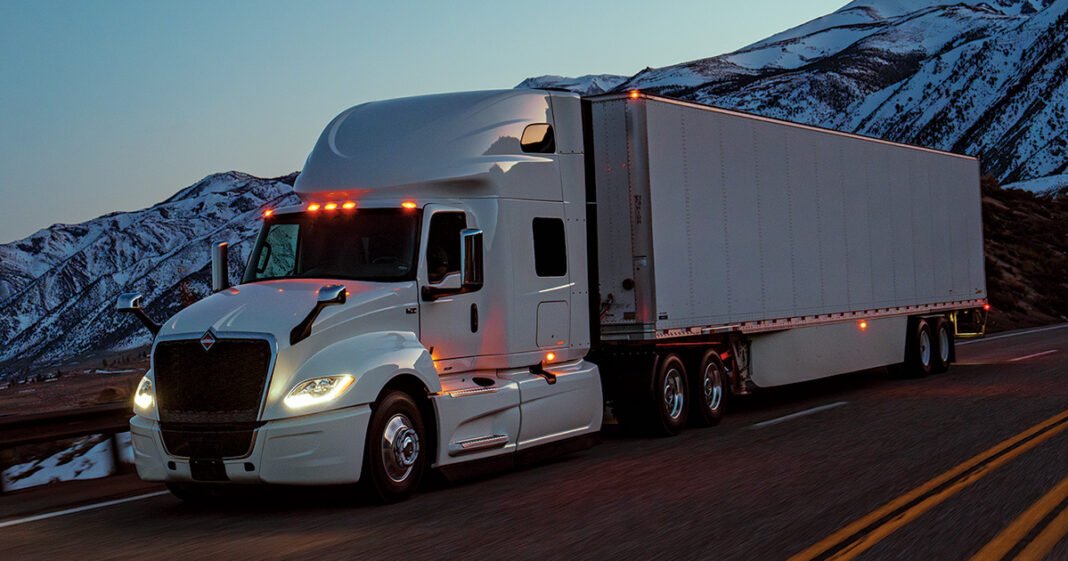

International posted a loss of $129.1 million in Q4 2025 compared with a $238.5 million profit a year earlier. (International Motors)
March 4, 2026 4:29 PM, EST
Key Takeaways:
- International Motors reported steep declines in sales and revenue in Q4 2025 while tariffs added significant extra costs.
- Executives said order activity strengthened in early 2026 due to replacement needs, better transport rates and pre-buy interest.
- International made cuts and canceled programs in response to market weakness but expects benefits from upcoming EPA 2027 products.
International Motors posted a second consecutive quarterly loss in the fourth quarter of 2025 as the Traton Group division’s truck sales dropped 40% year over year and tariffs bit harder.
However, orders are on the rise and Traton CEO Christian Levin told analysts March 4 during the company’s earnings call that February orders were the best since September 2022.
International posted a loss of $129.13 million in the most recent quarter, compared with a $238.5 million profit in Q4 2024. Traton reports all earnings in euros, and currency conversions to dollars were correct as of March 4.
The division posted an operating loss of $166.37 million overall in 2025, compared with a profit of $842.33 million in 2024. In the third quarter of 2025, International reported its first quarterly loss since Traton bought the company in 2021.
Profits were hurt by the ongoing truck market weakness as well as low-capacity plant utilization and low fixed cost absorption, Traton said.
Truck sales at International fell 40% year over year in Q4 to 12,029 vehicles from 20,202 a year earlier. Revenue fell 31% year on year to $2.29 billion from $3.32 billion.
International also took a pounding from tariffs imposed by the Trump administration.
TRATON GROUP 2025 Annual Report
Lisle, Ill.-based International took a more than $58 million hit in Q4 from tariffs on imported steel and aluminum plus a nearly $70 million hit from Section 232 tariffs on imports of medium- and heavy-duty trucks and parts. The truck and parts levies only came into force Nov. 1.
That said, International expects to recover a receivable for about half the Section 232 truck and parts levies, Traton Chief Financial Officer Michael Jackstein told analysts.
Optimism for the Year Ahead
Looking forward, International’s truck and bus orders totaled 14,266 vehicles in Q4, a 3% increase compared with 13,842 in the same period 12 months earlier, but prospects are improving in the first three months of 2026.
International Motors is the parent company of IC Bus, one of the three largest school bus manufacturers in the United States, as well as the eponymous truck brand.
International Q4 truck orders totaled 10,880, a 3% decrease from 11,175 orders in the year-ago period.
“So, first of all, the positive order intake momentum for the whole industry, as you have noticed, started in December already and then has continued to improve throughout January, and February came in really, really strong,” Levin said during the analyst call.
“I think it’s the highest figure we’ve seen since back in September ’22. Why is that? Well, there are, of course, several factors. One is the replacement need. We have been running below replacement need in the U.S. now for quite some time,” he said. “Secondly, we feel that there’s a bit more optimism coming back to our customer base, thanks to improved transport rates. We are actually in a recession in the U.S.,which has hit the market pretty hard.”
Shrinking Capacity
Carrier capacity has already decreased and is expected to continue to do so, which, Levin said, may be a factor in the strength of orders.
Bankruptcies are starting to be a factor, the executive said, as is the possibility of orders by fleets to beat the introduction of emissions regulations at the start of 2027; the concept colloquially known as the “pre-buy.”
FTR Transportation Intelligence preliminary data released March 4 showed North American truck orders soared 159% year over year to 47,200 vehicles and increased 47% compared with January.
Patrick Brennan of Cox Fleet talks about the common missteps that fleets make in planning for future maintenance and operational needs. Tune in above or by going to RoadSigns.ttnews.com.
“Customers … know that there will be a price increase related to EPA27 products. They probably understand that many — or all of the OEMs — have had to adjust their production capacity downwards and that there is a certain reaction time as there always is in the swings in the U.S. that are typically the biggest in the world,” said Levin. “So, to position themselves, it is wise to start to place orders. And I guess there is also a portion of that into the really good figures of January and February.”
Traton posited the introduction of an EPA 2027-compliant S13 powertrain as a major positive for International in its earnings after what has been a rough 2025 for the Volkswagen unit’s North American division.
International laid off 300 employees in January as truck orders and purchases remained underwhelming. The roles comprised 300 corporate, salaried positions. No hourly production plant staff departed. That came after the company axed a second shift at its Escobedo plant in Mexico in April.
The truck maker also canceled plans for an eRH Series battery-electric tractor. International’s Q3 balance sheet included $149.3 million in expenses related to the termination of the eRH program, which only emerged publicly in April 2025. Serial production of the eRH was scheduled to begin in the first half of 2026, the company said at the time.
International’s truck and bus sales fell 30% to 63,732 vehicles in 2025 from 90,562 in 2024. Truck sales declined 37% to 50,112 from 79,300.
The company’s truck and bus orders fell 18% to 46,177 vehicles from 56,616 in 2024. Truck orders decreased 17% to 36,747 vehicles from 44,397.
Overall, Traton sold 80,971 trucks and buses worldwide in Q4, down 9% compared with 88,831 in the same period in 2024 as a result of strong quarters in Europe for its Scania and MAN divisions.

