
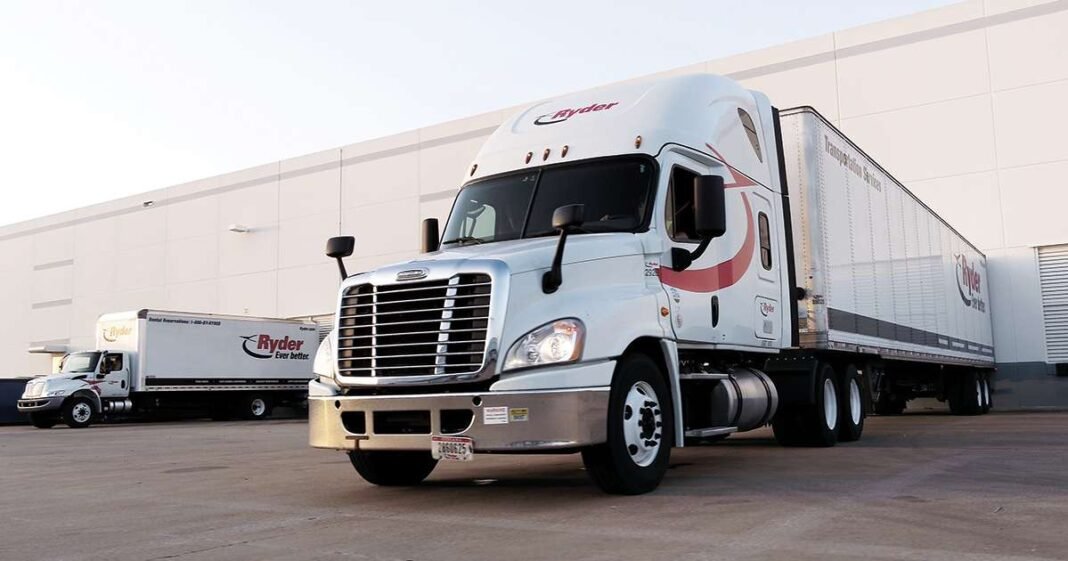

Ryder sold 3,600 trucks and tractors in Q4 2025, a decrease of 23.4% compared with 4,700 vehicles in 2024. (Ryder System Inc.)
February 12, 2026 5:08 PM, EST
Key Takeaways:
- Ryder said Feb. 11 that U.S. freight conditions showed no meaningful improvement as it reported slightly lower Q4 2025 profit and revenue.
- Executives attributed the prolonged downturn to weak used vehicle sales, soft rental trends and flat lease miles despite some early market-tightening signals.
- Incoming CEO John Diez said used vehicle pricing may improve later in 2026 as capacity exits the market but expects Q1 to mirror Q4 trends.
Ryder System Inc. has yet to see meaningful near-term change in the U.S. freight market, incoming CEO John Diez said Feb. 11, prolonging the longest rate recession in industry memory.
Diez, who will replace current CEO Robert Sanchez on April 1, made the comments as Ryder released fourth-quarter 2025 earnings headlined by profit and revenue nudging lower and failing to meet analyst expectations.
While truckload market conditions, especially in the spot segment, are indicating to some observers that the tide is turning, Diez and Sanchez said Ryder’s operations had yet to provide similar harbingers.
Sanchez noted that Ryder’s three leading indicators are used vehicle sales, rental and leased power miles.
“We haven’t really seen a meaningful move in those yet. Our used vehicle retail pricing was actually sequentially down a bit [in Q4]. Rental utilization’s stable, but really not improving so far. Our lease miles were flattish,” said Sanchez, who has been CEO and chairman since 2013.
“So, that kinda gives you a bit of color on what we’re seeing today. Obviously, with some of the early indicators around [the Purchasing Managers Index], and the tightening of the for-hire market, you could see some improvement later on in the year, but that’s where we are now,” the company’s top executive said.
Ryder sold 3,600 trucks and tractors in the most recent quarter, a decrease of 23.4% compared with 4,700 vehicles a year earlier.
Rental demand increased, but only in line with historical seasonal trends and there was no indication of an improvement in market conditions, Chief Financial Officer Cristina Gallo-Aquino told analysts.
Looking forward, Diez added: “We do see the environment on the used vehicle sales side kind of gradually improving as we get through the year. We … expect Q1 to be kind of consistent with what we saw in Q4. We are expecting tractor pricing to improve as a lot of capacity keeps coming out of the market, and that will bode well for tractor pricing going into the second half of the year.”
Demand for trucks, which accounts for 60% of Ryder’s rental rolling stock, is expected to “continue to be kind of depressed at the current fourth-quarter levels,” Diez said.
Overall, Ryder’s profit in the final three months of 2025 nudged 1.5% lower to $133 million from $135 million in the 2024 period.
The company posted revenue of $3.175 billion in the most recent quarter, a 0.4% decrease from $3.189 billion in the year-ago period.
Ryder’s revenue total missed consensus analyst expectations of $3.25 billion, according to Zacks Equity Research.
The fleet management solutions division posted a 1% decline in revenue in Q4 to $1.466 billion from $1.485 billion a year earlier.
Ryder ChoiceLease Portfolio
Ryder’s ChoiceLease, rental and used vehicle sales operations are all part of the unit. ChoiceLease is the company’s leasing program.
Gallo-Aquino said during the call that the decline was due to the weaker market conditions in rental and used vehicle sales.
The company said strategic initiatives continue to benefit ChoiceLease’s performance.
ChoiceLease posted an average fleet count of 141,700 vehicles in Q4, compared with 145,300 in the year-ago period.
Used tractor pricing increased 1% and truck pricing decreased 9% from 2024. However, compared with the third quarter of 2025, used tractor and truck pricing increased 6% and 4%, respectively, reflecting a higher retail sales mix, Ryder said, while not providing outright median prices.
Transport Topics reporters Eugene Mulero and Keiron Greenhalgh examine the critical trends that will define freight transportation in the year ahead. Tune in above or by going to RoadSigns.ttnews.com.
“Sequential pricing benefited from a higher retail mix as we realized better proceeds using the retail sales channel versus the wholesale channel. In the fourth quarter, 69% of our sales volume went through our retail sales channel, up from 54% in the third quarter. Our retail mix was also above prior-year levels of 64%,” Gallo-Aquino said during the call.
Rental power-fleet utilization was 72% compared with 73% in the prior year, on an 8% smaller average fleet, the company said.
Ryder’s supply chain solutions unit saw a 3% increase in revenue to $1.382 billion in Q4 from $1.34 billion in the 2024 period.
An increase in operating revenue was primarily driven by new business and volumes in omnichannel retail, but this was more than offset by lost business and extended customer production shutdowns in automotive, the company said.
Revenue at Ryder’s dedicated transportation solutions arm fell 8% to $565 million from $615 million.
Operating revenue decreased due to lower fleet count reflecting prolonged freight market downturn, the company said.
Ryder ranks No. 6 on the Transport Topics Top 100 list of the largest for-hire carriers in North America, with Ryder Dedicated Transportation Solutions ranking No. 5 among truckload/dedicated carriers. The company also ranks No. 7 on the TT Top 100 list of the largest logistics companies.

