
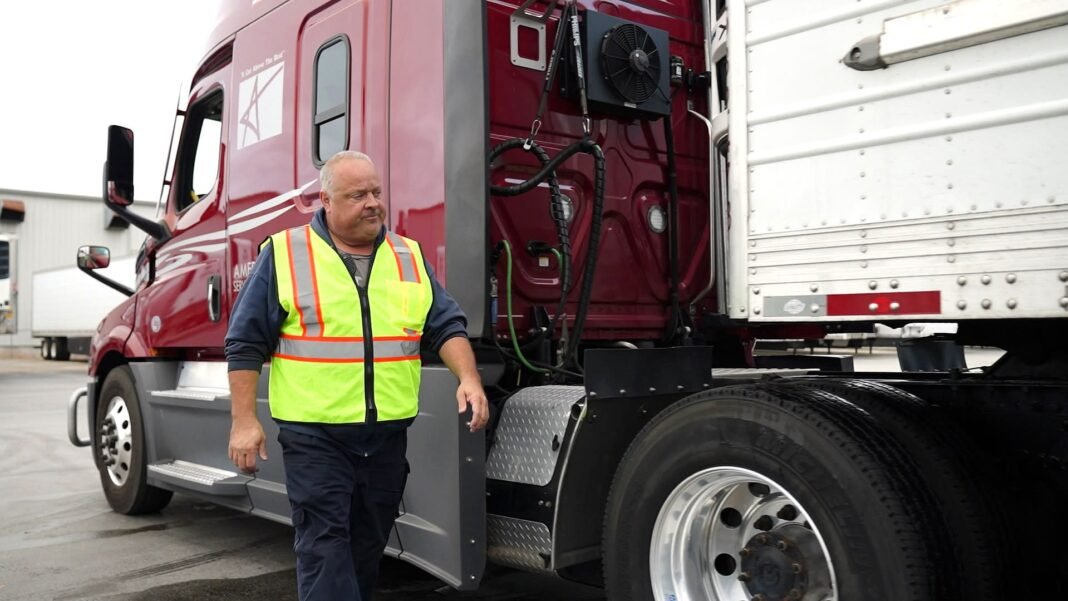

America’s Service Line adopted Link’s SmartValve and ROI Cabmate systems to address whole-body vibration, repetitive strain, and driver turnover. The trucking fleet is already seeing measurable results.
Driver health conversations in trucking often focus on diet, exercise and chronic disease. But America’s Service Line is adding to the discussion with its moves to address the physical toll of vibration and repetitive drop-and-hook work.
The Wisconsin-based private fleet has adopted two suspension technologies from Link Manufacturing: SmartValve and the ROI Cabmate suspension.
“There are lot of times we do things because it’s the right thing to do,” says Ellen Ingram, vice president of human resources and safety for the company, which is the private fleet for American Foods Group but also has for-hire operating authority.
Together, the two systems target different but related sources of strain: the physical effort of coupling and the cumulative fatigue of whole-body vibration.
That focus on driver well-being has helped earn the fleet recognition by CarriersEdge for two consecutive years as a Best Fleet to Drive For.
ASL’s operations include both local and long-haul, with a lot of drop-and-hook operations for local drivers.
Credit:
Link Manufacturing Ltd.
Reducing Drop-and-Hook Strain for Truck Drivers
Link’s SmartValve (acquired from Hadley in 2021) is an electronic suspension height control that lets the tractor do the heavy lifting during coupling. It replaces the regular suspension valve, explains Larry Wendricks, general manager of fleet maintenance for America’s Service Line.
FLEET SNAPSHOT
Who: America’s Service Line
Where: Green Bay, Wisconsin
Fleet: 165 drivers, 600 trailers
Operations: Private fleet forAmerican Foods Group, with both local and long-haul operations and for-hire authority.
Fun Fact: ASL will celebrate its 30th anniversary in August 2026
Challenge: Truck driver health and retention
With the push of a dash-mounted button, the driver can raise or lower the tractor’s air suspension. When backing under a trailer, the system can lift the tractor to take pressure off the landing gear.
“It makes it a lot easier to crank that landing gear, especially with us up here in Wisconsin, where it gets very cold out and the grease gets a little stiffer,” Wendricks says.
When pulling out, the driver can use SmartValve to lower the suspension to relieve pressure between the tractor and trailer.
“When you’re pulling out from underneath the trailer, you hit the button, and it lowers the suspension so you can pull out nice and easy,” Wendricks says.
In effect, the tractor’s air suspension acts like a built-in jack, reducing strain on drivers and helping prevent landing gear damage.
“That SmartValve technology is especially important for our city drivers who are dropping and hooking from our distribution center to our terminal,” Ingram says.
ASL has found that the Link SmartValve has reduced the number of driver injuries when coupling.
Credit:
Link Manufacturing Ltd.
When you think about the number of times these drivers have to deal with landing gear every day, she says, it’s evident how the technology can help the company retain these drivers as well as reduce injuries.
While SmartValve addresses the physical strain of coupling, ASL’s second investment targets something less visible but just as significant: whole-body vibration.
A driver uses a button on the dash to raise or lower the tractor suspension with Link SmartValve.
Credit:
Link Manufacturing Ltd.
Why Whole-Body Vibration Matters for Truck Driver Health
Whole-body vibration is the constant shaking and jolting that travels through the seat and cab while a truck is in motion. Drivers may not think much about it day to day, but research shows that even short periods behind the wheel can lead to discomfort and fatigue, according to Link. Air-suspension seats help, but they still don’t totally protect the driver from vibration.
Over months and years, repeated exposure to this kind of vibration has been linked to chronic neck and lower back pain and other musculoskeletal problems common among professional drivers.
For fleets like America’s Service Line, that means vibration isn’t just a comfort issue. It’s a long-term health and safety concern. Fatigue can affect alertness and reaction time, while cumulative strain can contribute to injuries, medical claims, and drivers leaving the profession earlier than planned.
Ingram admitted that in the past, she viewed body vibration as something that was baked into the job of a truck driver.
“But to magnify that over 10, 20, 30 years of service as an over-the-road driver, what a difference that will make in fatigue to their body and to their well-being,” she says.
Link’s ROI Cabmate is an electronically controlled cab suspension system designed to smooth out the ride and reduce vibration before it reaches the driver.
Credit:
Link Manufacturing Ltd.
ASL turned to Link’s ROI Cabmate, an electronically controlled cab suspension system designed to smooth out the ride and reduce vibration before it reaches the driver.
Sensors continuously monitor how the cab is moving. That data feeds into an onboard control unit, which adjusts the shock absorbers and air springs in real time — firming or softening them as conditions change — to stabilize the cab and limit jolts that contribute to driver fatigue.
Ingram says one longtime over-the-road driver for ASL is a huge advocate for ROI Cabmate.
“You can appreciate our over-the-road drivers stay out at least 10 days, if not in some cases, four to six weeks,” she says. “He’s at the back end of his career, and boy, he sings its praises.”
From Pilot Program to Fleetwide Rollout
As with any new technology, ASL wanted proof of both the SmartValve and ROI Cabmate before committing fleetwide.
ASL’s director of maintenance, David Giese, came back from a trucking conference where he had learned about the SmartValve and the ROI Cabmate system. So he and Wendricks worked with Link to pilot the technology on a couple of trucks.
Wendricks says he and Giese “fell in love with [the ROI Cabmate] just by driving around in our own parking lot. We didn’t even have to go that far to really understand and see how this system works.”
The technicians who installed the system loved it, too.
But “the drivers giving us the feedback is what really sold us on it,” Wendricks says.
With that kind of result, they started rolling both technologies out to the entire fleet.
In fact, Ingram says, it has worked so well that some of the company’s owner-operators are adding it to their own trucks.
The SmartValve systems are installed at the factory or at the dealer.
Credit:
Link Manufacturing Ltd.
Today, the Link SmartValves are installed either at the factory or the dealer.
“I think one thing that was really helpful for us is working with the OEMs,” Ingram says. “One of our manufacturers does that assembly for us. For another, we are working with a dealer prior to that equipment coming to America’s Service Line.”
ASL is installing the ROI Cabmate as it receives new trucks in the yard. The systems are easy to install, Wendricks says, taking about an hour.
“It’s a matter of just replacing the original cab shocks and putting on [Link’s] cab shocks,” he says. “There’s an electronic control unit that’s installed. And then we just have to run a wire up into the cab for power.”
Linking Driver Health to Retention and Maintenance Costs
Trucking companies sometimes struggle to quantify the return on investment when investing in technologies to help retain drivers.
But ASL puts hard numbers to injuries, driver turnover, and maintenance.
Ingram says the SmartValve technology has led to measurable savings in reduced injuries.
“When you have a city and a local driving workforce, there are incidents that happen over time,” she says, and there are costs for those injuries or medical events.
“And so you take those hard, fast dollars and you start to ask, ‘What’s the impact to that individual? Were there any particular loss of wages as a result of that injury?’ And you quantify that.”
In addition to the driver health benefits of the Link SmartValve system, ASL says it has dramatically reduced landing gear damage.
Credit:
Link Manufacturing Ltd.
And, as she points out, there are costs associated with driver turnover. In three years, ASL has significantly improved its driver retention, by 15%, giving it a turnover percentage around 20%.
“You put dollars and cents to turnover, you put dollars and cents to injury or potential of injury, you can easily can come to justification on both SmartValve technology and ROI Cabmate,” Ingram says.
Wendricks adds that there are maintenance cost savings for the SmartValve in reduced landing gear repairs.
“When drivers back underneath the trailer, it’s taking that pressure off the landing gear,” he says, resulting in fewer incidences of damage.
“Other than a driver dropping a trailer, we don’t have landing gear issues,” he says. “We don’t see bent landing gear anymore.”
For long-haul drivers, the cumulative effects of vibration can add up to health problems.
Credit:
Link Manufacturing Ltd.
Supporting Long-Term Truck Driver Careers
America’s Service Line recently acquired Midwest Express of Grand Island, Nebraska. Part of that merger process, Ingram says, involved revisiting the company’s mission statement as it applies to the larger combined company.
“We’ve really determined that our mission is to deliver excellence to our family of employees, our customers, our stakeholders,” Ingram says. “Our vision is to be the carrier of choice for American Foods Group and other business partners. And in order to do that, we have to be an employer of choice by attracting and retaining talent.”
Addressing driver health not only helps with driver retention, she says, but it’s also important to the company that its longstanding drivers can enjoy a healthy retirement.
In her dual role in HR and safety, she says, she sees it as a healthcare benefit, “before a healthcare benefit really needs to be utilized.”
Editor’s Note:Both the SmartValve and the ROI Cabmate were named HDT Top 20 Products when they were introduced.
What Whole-Body Vibration Does to Drivers
Whole-body vibration is the shaking and jolting that gets transmitted through the seat, floor, pedals, and steering wheel while a driver is behind the wheel. It’s something most drivers feel every day, but that doesn’t mean it’s harmless.
Short-term effects
- Within about 30 minutes of driving, ,can cause discomfort and soreness.
- Over longer periods, it contributes to fatigue, which can make drivers less alert, slow reaction times, and reduce coordination — all of which can affect safety on the road.
Long-term health concerns
- Repeated exposure over months and years is strongly linked to chronic neck and lower back pain and other musculoskeletal disorders, especially for drivers who spend a lot of time on rough roads.
- Studies show professional drivers often exceed recommended daily exposure limits, and these continual vibrations can contribute to spine strain, disc degeneration, and persistent pain that can last into retirement.
Why It Matters
Whole-body vibration doesn’t just make a driver uncomfortable for a day — over time, it can affect long-term health, increase the risk of fatigue-related safety issues, and contribute to conditions that lead to missed work and medical claims.
(AI-generated content)

