
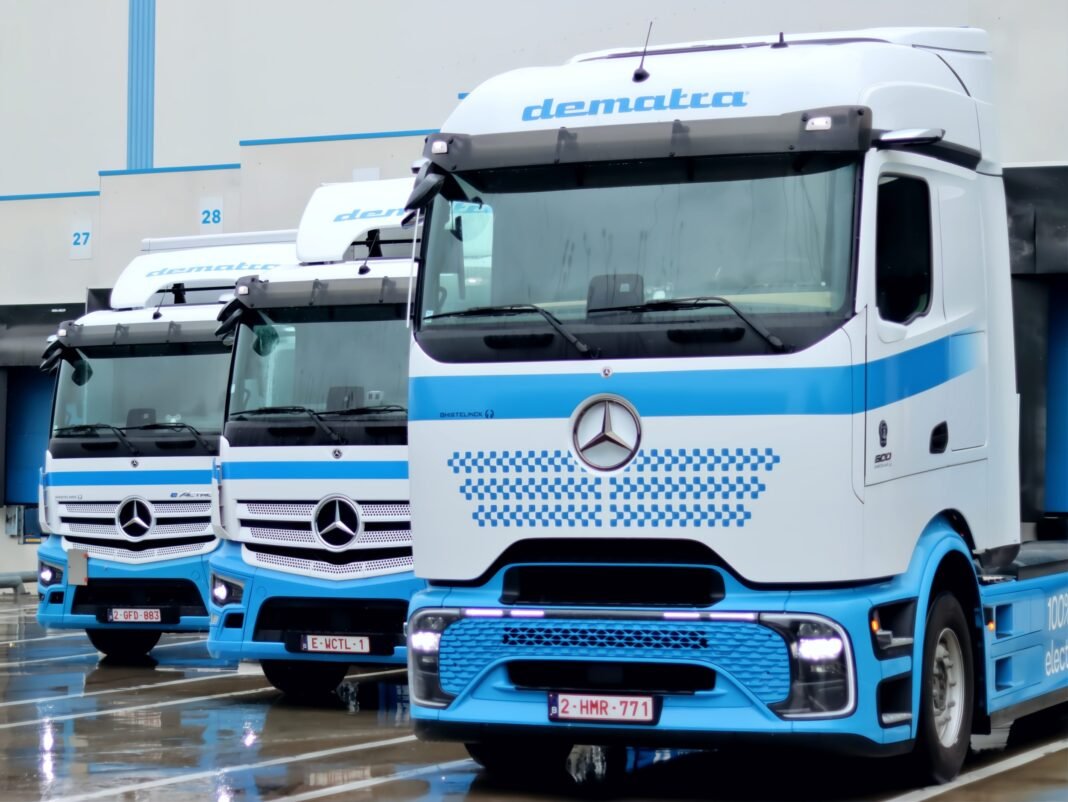

Since the beginning of the year, 246 electric trucks have been registered in Belgium. Without taking the month of December into account, this is already an increase of 86% compared to the whole of 2024. That is the good news. However, there is also less good news…
Firstly, the market share of electric trucks remains very low: 3.54%. That is a far cry from the 16.7% in the Netherlands. Secondly, this result is largely due to the financial support that Flanders has provided to buyers of electric trucks through the Ecology Premium+. Although this has not yet been officially announced by the Flemish government, this premium will no longer be granted when purchasing a new truck without emissions. This can be deduced from the restrictive list of eligible technologies that will enter into force on January 1, 2026. This list can be consulted on the website of the Vlaio agency.
Another incentive that is being weakened: electric trucks will no longer be exempt from kilometer tax from January 1, 2026. This measure was taken by Lydia Peeters, then Minister of Mobility in the previous Flemish government, but the current government coalition in Flanders has not changed the timetable. This provided for maintaining zero for the ‘external costs’ component, but for recharging an ‘infrastructure’ component, which, although reduced by 80%, will gradually increase every year. As a reminder, Europe allows Member States to zero their mileage charges until 2031.
In addition, the price of new electric trucks will be charged a new environmental contribution, which could be neutralized by a drop in list prices as electric truck production increases and competition intensifies.
Wrong signal
“That is the wrong signal, exactly at the moment when the transition in heavy road transport was visibly starting to get underway,” responds Stef Holemans (Sales Director Scania BeLux). “Thanks to the combination of investment support via the Ecology Premium+ and favorable conditions of use (such as the exemption from the kilometer charge), a quasi break-even TCO compared to diesel was achieved for some applications for the first time. Moreover, the prices of BEV trucks themselves also went in the right direction, which further strengthened the confidence of transporters. By now phasing out both investment and usage incentives, this early progress is in danger of being slowed down again. Anyone who takes the electrification of (heavy) road transport seriously must take care for continuity, predictability and trust. Policies that remove support just at the tipping point threaten to slow down the transition instead of accelerating it.”
And in Wallonia?
Nothing changes in Wallonia. No premium and no reduction in the kilometer charge. The problem is related in the first case to budgetary constraints and in the second to the concept of ‘levy’ itself. This charge is a user right, the rate of which cannot be adjusted to CO₂ emissions. Wallonia will sooner or later have to conform to the European rules that oblige the Member States to apply this tariff adjustment. According to our information, Wallonia is currently working on a two-invoice system: the user of the Walloon network would receive an invoice from Sofico for the ‘infrastructure’ part (so not adjustable) and another invoice from the region for the ‘CO2’ part, which would be adjustable.

