
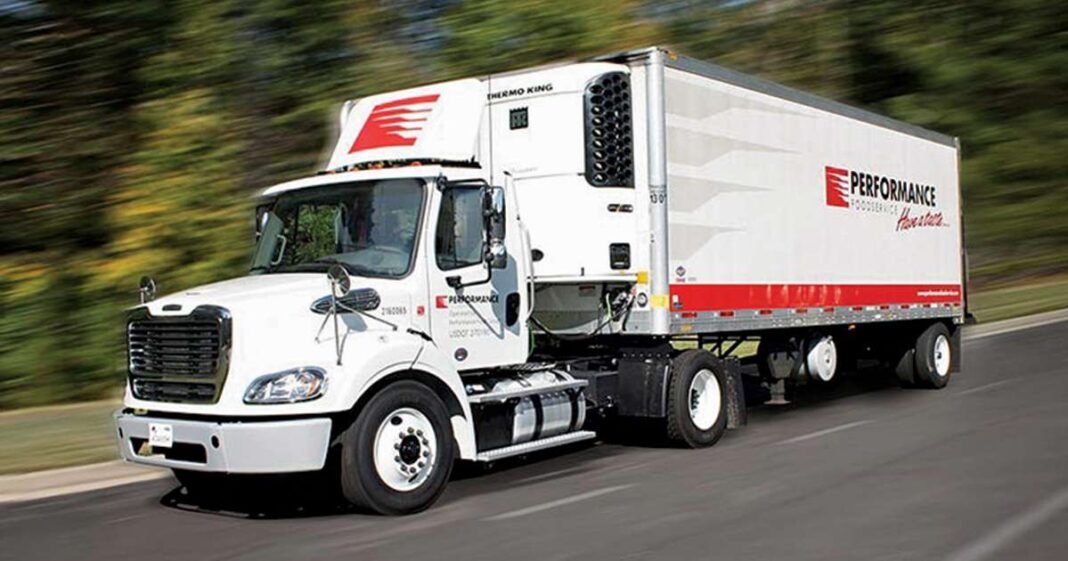

Performance Foodservice is one of five food service carrier brands under the Performance Food Group umbrella. (Performance Foodservice)
February 9, 2026 12:55 PM, EST
Key Takeaways:
- Performance Food Group operates five of the top 21 food-service carrier brands:
- PFG and US Foods called off a planned merger that would have made the combined entity the top food-service carrier company.
- Scott McPherson succeeded George Holm as PFG’s chief executive Jan. 1.
Performance Food Group is on the hunt for further acquisitions after a quarter that saw profit and its war chest for deals swell even as a proposed merger with US Foods collapsed.
PFG distributes food and related products to restaurants, supermarkets, schools, hospitals, convenience stores and retailers.
Richmond, Va.-based PFG ranks No. 4 on the Transport Topics Top 100 list of the largest private carriers in North America and No. 3 in the food service sector. The company operates five of the top 21 food service carrier brands: Performance Foodservice, Core-Mark, Vistar, Cheney Brothers and Merchants Foodservice.
The company and US Foods called off a planned merger that would have reshaped the food service carrier arena. US Foods ranks No. 5 on the private TT100 and No. 2 among food service carriers. Had the deal gone ahead, the combined entity would have leapfrogged Sysco Corp. at the top of the food service carrier table.
PFG was built on deals including the acquisition of Riviera Beach, Fla.-based Cheney Brothers in August 2024 for $2.1 billion and Core-Mark in May 2021 for $2.5 billion.
George Holm, former CEO and current executive chair of the PFG board of directors, was the driving force behind the acquisitions. Holm became CEO of PFG in 2008. He previously founded food, snack and beverage distributor Vistar in 2002.
Scott McPherson took the reins at PFG on Jan. 1. McPherson previously held the titles of president and chief operating officer. He also was CEO of Core-Mark before PFG bought the company.
McPherson paid tribute to his predecessor during PFG’s Feb. 4 fiscal second-quarter 2026 earnings call, while promising to maintain his legacy.
“PFG is defined by more than just financial results. It is a place where people want to work, where customers and suppliers want to do business, and a preferred partner for strategic M&A,” said McPherson. “There’s a reason that PFG is often the first and sometimes only call from prospective acquisition opportunities.
“I’m also thrilled that George will continue to play an important role for PFG. As executive chair of our board, he will be heavily involved in the pursuit of strategic M&A opportunities, maintain his connection to key customers and be active in PFG’s overarching strategy.”
PFG’s three-year plan — unveiled in May — focuses on achieving $73 billion to $75 billion in annual net sales by fiscal 2028, emphasizing an acceleration of growth through acquisitions, increased market share and improving operating leverage.
“So, as I’ve worked with George over the last four years, I would say that we very much align in how we look at the business,” McPherson told analysts. “I think fundamentally, we’re both believers in driving growth, you know, both organically and through M&A. I think we both pay particular attention to margin and how mix can help and drive margin.”
Chief Financial Officer Patrick Hatcher added: “The M&A pipeline remains robust, and we continue to evaluate strategic M&A. PFG has a history of successful acquisitions to drive growth and shareholder value, and we expect that to continue. At the same time, we will apply our typical high standards and robust due diligence to evaluate high-quality acquisition opportunities.”
The trucking M&A market is expected to ramp up in 2026, according to analysts at PwC, with temperature-controlled transportation especially attractive to buyers.
Meanwhile, the company’s free cash flow — funds available after operating expenses and capital expenditure — totaled $263.7 million in the six months that ended Dec. 27, compared with $175.1 million in the year-ago period.
Transport Topics reporters Eugene Mulero and Keiron Greenhalgh examine the critical trends that will define freight transportation in the year ahead. Tune in above or by going to RoadSigns.ttnews.com.
The war chest grew after a quarter that saw net income rise 45.5% in the three months to Dec. 27 — which PFG designates its second fiscal quarter — to $61.7 million from $42.4 million.
PFG’s revenue increased 5.2% year over year in the most recent quarter to $16.4 billion from $15.6 billion. Revenue rose due to an increase in deliveries and inflation boosting the price of the goods delivered, the company said.
“During the quarter, we gained share across independent, regional and national business, largely consistent with our gains in prior quarters. Share gains were broad-based across a range of concepts, with particular strength in chicken, burger, barbecue and seafood restaurants,” said McPherson.
PFG’s latest full-year fiscal 2026 guidance currently targets sales of $67.25 billion to $68.25 billion, compared with previous expectations of a $67.5 billion to $68.5 billion range.

