
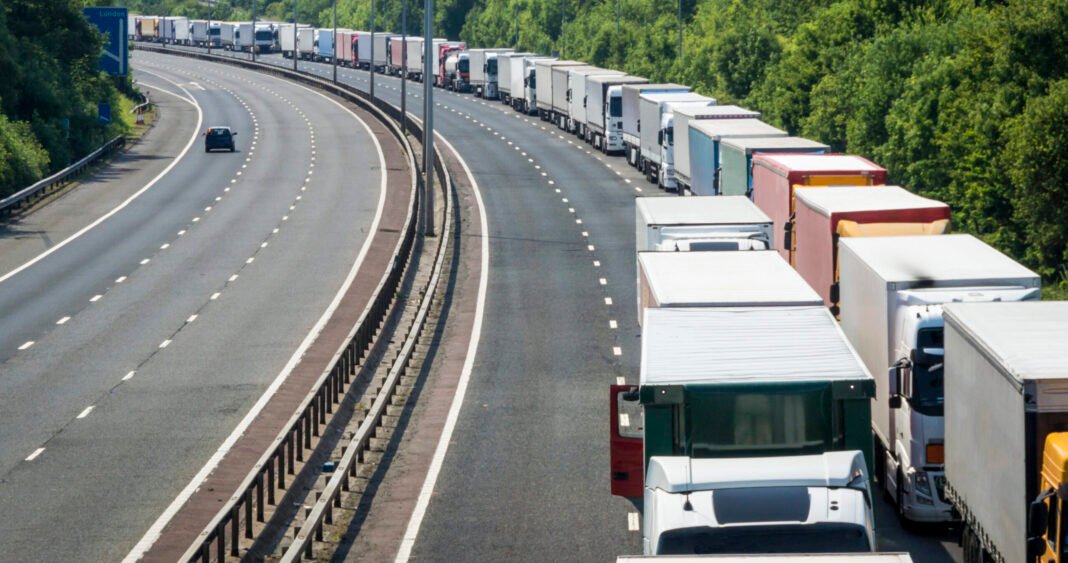

Operation Brock is a traffic management system used on the M20 motorway in Kent to manage congestion caused by freight traffic heading to the Port of Dover and Eurotunnel terminals. Introduced as a replacement for the earlier Operation Stack, it is designed to keep traffic moving during periods of disruption at the UK–France border, particularly along the busy English Channel crossing.
At its core, Operation Brock allows sections of the M20 to be reconfigured so that heavy goods vehicles (HGVs) can be queued in a controlled manner while maintaining a contraflow system for other traffic. This means that while one side of the motorway is used to hold stationary or slow-moving lorries, the opposite carriageway continues to operate in both directions for general traffic. The system is modular, allowing authorities to activate different phases depending on the severity of disruption.
The need for Operation Brock arises from the strategic importance of the English Channel, which handle a significant proportion of the UK’s trade with mainland Europe. The Port of Dover and Eurotunnel are critical gateways for goods, with thousands of lorries passing through daily. When disruption occurs—whether due to bad weather, industrial action, customs delays, or increased demand during peak travel seasons—traffic can quickly build up, risking gridlock across Kent’s road network.
Before Operation Brock, Operation Stack was used to manage such congestion by closing sections of the M20 entirely and using them as lorry parks. However, this caused widespread disruption to local communities and non-freight traffic, often bringing large parts of Kent to a standstill. Operation Brock was introduced to provide a more flexible and less disruptive alternative, allowing the motorway to remain partially open while still accommodating queuing freight.
Despite these improvements, Operation Brock is widely regarded as a temporary solution rather than a long-term fix. The system is typically deployed during predictable peak periods such as Bank Holidays, summer getaways, and times of heightened border checks. While it helps prevent complete gridlock, it also highlights the underlying capacity challenges at the UK’s busiest freight crossings.
The logistics sector has been particularly vocal about the limitations of Operation Brock. Logistics UK’s Head of Trade Policy, James Mills, has criticised the scheme, stating: “It is deeply frustrating to the dedicated logistics staff that keep the UK trading that the best solution to predictable seasonal peaks at the English Channel crossing remains to turn the M20 into a lorry park and force drivers to wait on the hard shoulder, sometimes for days at a time.
“Over half of all goods traded between Great Britain and mainland Europe travel across the Short Straits crossings between England and France, and up to 16,000 freight vehicles travel through the Port of Dover and Eurotunnel every day. This shows how critical the crossings are to the UK economy. HGV drivers heading to the ports, along with passengers and Kent residents, deserve a permanent solution to the unavoidable congestion that occurs at the border to keep trade moving while minimising delays and congestion. Operation Brock is an inefficient and expensive workaround for an issue that our sector has been raising with government for years, with over £3 million of public money spent last year alone deploying the scheme.
“Delays at the border don’t just impact drivers, but they can add cost and uncertainty into supply chains, ultimately pushing up prices for businesses and consumers.
“As the delays that occur every Bank Holiday show, a permanent solution at the border is long overdue, one that is befitting of the strategic importance of the Short Straits crossings to the UK’s economy, and where HGV drivers can wait with access to proper toilet facilities, hot food and somewhere to rest – something every other worker in the country takes for granted.”
This criticism underscores a broader issue: while Operation Brock helps manage congestion, it does not address the root causes. Increased customs checks following Brexit, combined with limited infrastructure capacity at ports, have made delays more frequent and more severe. The system effectively shifts the problem from the ports to the motorway, rather than eliminating it.
Another key concern is the impact on drivers. HGV drivers caught in Operation Brock queues can face long waiting times with limited access to basic amenities. This raises welfare concerns and highlights the need for better facilities and planning. For local residents and businesses in Kent, the scheme can still lead to disruption, particularly when traffic spills over onto local roads.
From an economic perspective, delays at the border can have far-reaching consequences. Supply chains rely on predictability and efficiency, and any disruption can lead to increased costs, missed deadlines, and reduced competitiveness. As Mills points out, these costs are often passed on to businesses and consumers, contributing to higher prices and reduced availability of goods.
In conclusion, Operation Brock is a necessary but imperfect solution to a complex problem. It plays a vital role in preventing total gridlock on one of the UK’s most important freight routes, particularly during periods of disruption. However, it is ultimately a reactive measure that highlights the need for more permanent infrastructure and policy solutions. As trade volumes remain high and border processes continue to evolve, finding a sustainable way to manage congestion will be essential for the UK’s economy.

