
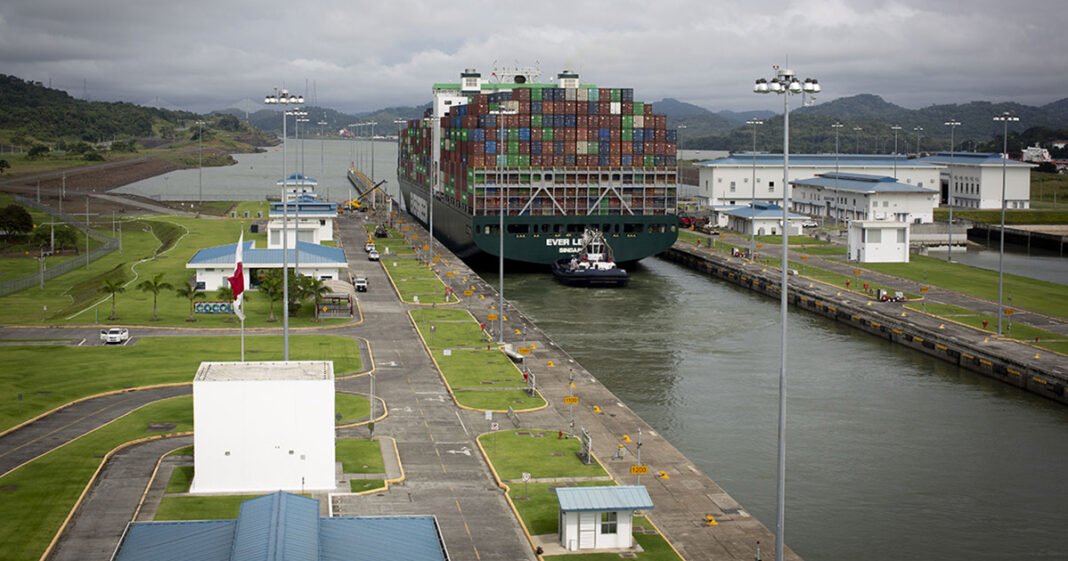

A cargo vessel travels through the Panama Canal. (Nicolo Filippo Rosso/Bloomberg)
March 6, 2026 10:31 AM, EST
The Panama Canal is reporting an unexpected jump in revenue, confounding its own forecasts that Donald Trump’s trade wars would cause traffic to drop.
Buoyant U.S. demand for goods from Asia is helping, as well as strong sales of liquefied petroleum gas, or LPG, to Japan and South Korea, according to the waterway’s Chief Financial Officer Victor Vial.
“We’ve seen a resilience in demand and quite surprisingly, because we did not expect that,” Vial said in an interview on March 4. “We are at a pace where, if everything stays in line, we could beat last year’s revenue performance.”
Canal revenue increased 8%-10% in the first five months of the canal’s fiscal year 2026, which started in October, compared to the same period a year earlier. Both ship transits and cargo tonnage increased, Vial said. The canal saw a record $5.7 billion in fiscal year 2025.
Shipments of cars from Asia to Latin America and the U.S. are also helping, he added.
In its 2026 budget published last August, the canal authority had forecast a drop in revenue of 8.8% this fiscal year, to $5.2 billion. The authority had expected a significant drop in container shipping this year after companies brought forward shipments of goods ahead of Donald Trump’s tariff announcements, artificially inflating last year’s figures.
The war in Ukraine has led to a decline in shipments of liquefied natural gas through the waterway, Vial said, as LNG tankers previously bound for Asia now head across the Atlantic to Europe. The canal authority is monitoring the situation in Iran for its impact on trade routes, and the conflict may lead to a short-term increase in transits, he added.
LPG Pipeline
In April, the canal authority plans to open bidding for a pipeline to transport LPG along the waterway, between port terminals on both coasts, which are separate from the CK Hutchison ports. This is part of $8.5 billion in investments the canal plans over the next 6 years, Vial said.
The projects will likely be awarded at the end of 2026 or early 2027. The canal authority is studying the revenue structure for the concessions and leaning toward a fixed fee and a fee based on cargo volumes, he said.
“We would be looking to ensure that we have enough skin in the game so that we can realize an important part of the value that we generate in terms of earnings,” he said.
The pipeline would increase the canal’s capacity by as much as 12% as LPG tankers dock at the port terminals, allowing other shipping segments to transit the canal’s locks. Ports and the gas pipeline are expected to be completed in 2031, he said.
The canal expects to begin the engineering this year of a $1.6 billion reservoir along Rio Indio that will supply enough water for the canal, and drinking water for Panama’s residents for the next 50 years, he said. The canal authority is finalizing consultations with 400 families who will need to be relocated due to its construction. A freshwater surcharge on shippers implemented in 2020 will cover the cost of the new reservoir and be discontinued once it opens, he said.
The canal authority will likely tap financial markets in the next two to three years to help finance some of the investments, and also use internal cash and loans, Vial said. The canal authority also plans to buy new tugboats and perform maintenance on its expanded set of locks, which opened in 2016, and Gatun dam on the canal’s main lake.
Patrick Brennan of Cox Fleet talks about the common missteps that fleets make in planning for future maintenance and operational needs. Tune in above or by going to RoadSigns.ttnews.com.
The canal drew intense scrutiny from Washington last year after Trump threatened to take back the waterway alleging Chinese influence. Panama President Jose Raul Mulino repeatedly defended the canal as a fully sovereign operation.
Though China has no role in operating the canal, Hong Kong-based conglomerate CK Hutchison Holdings Ltd. operated ports on the Atlantic and Pacific sides. Panama’s supreme court ruled against the concession granted to CK Hutchison and Panama’s government signed contracts in February with AP Moller-Maersk, and MSC Mediterranean Shipping Co. to operate them in the interim.
Maersk and MSC rank Nos. 7 and 9, respectively, on the Transport Topics Top 50 list of the largest global freight companies.

