
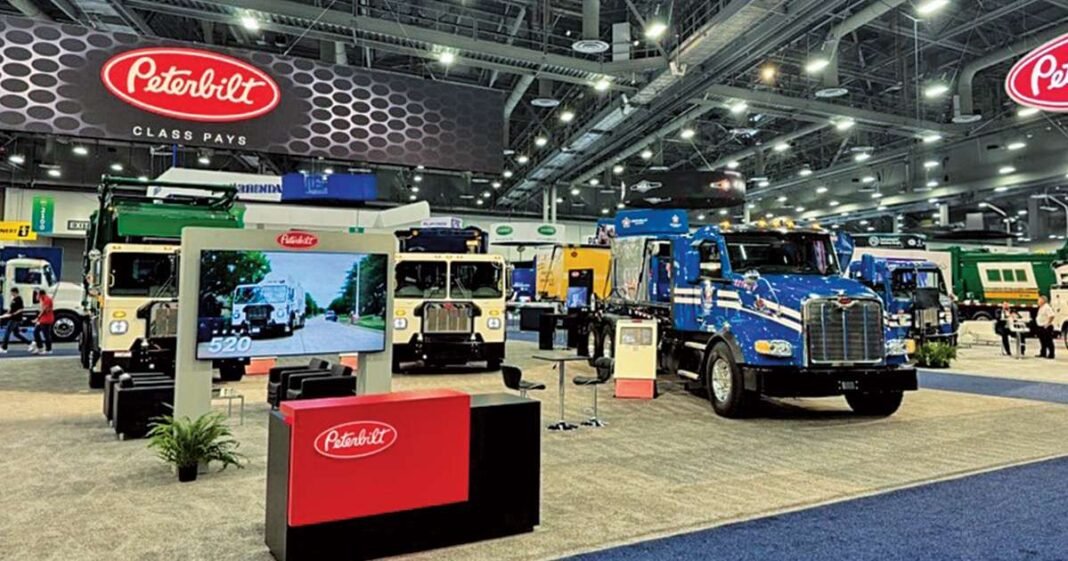

Peterbilt trucks on display. The brand contributed 15.2% to Paccar’s Class 8 market share in 2025. (Peterbilt Motors Co.)
February 13, 2026 4:43 PM, EST
Key Takeaways:
- Paccar aims to lift its North American heavy-duty truck market share to 35% after securing 30.3% in 2025.
- Executives said new Section 232 tariffs and added plant flexibility are boosting Kenworth and Peterbilt’s competitive position in the market..
- Paccar plans continued manufacturing shifts and deployment of flexible production technologies as it adapts operations after layoffs and facility realignments.
Paccar is aiming for a 35% share of the North American heavy-duty truck market, a senior executive told analysts Feb. 10.
The medium-term aim of the parent company of Kenworth and Peterbilt is set to be aided by tariffs and production plant flexibility, Senior Vice President Laura Bloch said at the truck maker’s analyst day in Denton, Texas.
Paccar brands won a combined 30.3% share of the Class 8 truck retail market in 2025, according to Omdia Automotive data. Peterbilt contributed 15.2% of that and Kenworth 15.1%. The two brands secured an overall share of 30.9% in 2024.
Bellevue, Wash.-based Paccar is not the only truck maker publicly stating a desire for an increase in its market share.
Volvo Group is aiming for a 25% North American heavy-duty truck market share by 2030, executives said during the company’s 2024 Capital Markets Day, with three key tractors overhauled and a new Mack Trucks longhaul flagship launched.
In 2025, Volvo Group brands Volvo Trucks North America and Mack secured 9.1% and 8.7% of the Class 8 retail market, respectively, for a combined share of 17.8%.
Daimler Truck North America is currently the largest OEM by volume for Class 8 retail sales, winning a 40.8% slice of the pie in 2025, according to Omdia data. DTNA is the parent company of Freightliner and Western Star.
RELATED: Paccar set to unveil engine platforms
Bloch noted that Paccar’s market share has grown gradually, and this would continue to be the case. She reminded analysts that the company had a 24% market share in 2005.
What will help grow Kenworth’s and Peterbilt’s sales and market share further, said the 22-year Paccar employee now in charge of Kenworth, purchasing, Dynacraft and supplier quality, are Section 232 heavy-duty truck and parts import tariffs introduced in 2025 plus flexibility at Paccar manufacturing facilities.
“Post the Section 232 finding, we are positioned to significantly benefit from the tariff offset program. In all, we expect more than 50% relief on our tariff exposure. While our competitors importing into the U.S. are now subject to new tariffs, Section 232 enhances our position in the market and the value of our manufacturing footprint,” said Bloch.
The company has shifted production of Class 8 low-cab refuse trucks to the Denton plant in Texas from Mexico. Paccar also moved production of medium-duty trucks from Sainte-Thérèse in Quebec to the Chillicothe, Ohio, and Denton plants.
Kenworth’s 2025 Class 8 market share was 15.1% as it nearly evenly split Paccar’s 30.3% share with Peterbilt. (Kenworth Truck Co.)
Paccar instituted a third round of layoffs at Sainte-Thérèse plant in 12 months in late October. The company let go 300 workers in the latest job cuts. According to union sources, 550 unionized staff remain at the plant.
As recently as September, Peterbilt was touting expanded manufacturing capacity at the factory, with the first 567 vocational Class 8 truck rolling off the production line Sept. 24.
Transport Topics reporters Eugene Mulero and Keiron Greenhalgh examine the critical trends that will define freight transportation in the year ahead. Tune in above or by going to RoadSigns.ttnews.com.
Institutional flexibility at other sites helped Paccar pivot when circumstances changed, Bloch said.
“So, over the last several years … we’ve really been on this journey to add [automated guided vehicles] and other flexible manufacturing capabilities into our plants. That has given us the ability to build more models and more configurations more efficiently and effectively on the line,” she said.
“We continue to build that out. It was a real help for us this last year as we decided that it was in our best interest to move … medium duty into U.S. plants. How it continues? It’s really an ongoing evolution,” she added. “We find new technologies come out, they become more scalable, they become more affordable, they become more usable and flexible for our operations. And we’ll continue to deploy those — as they make sense — into our operations.”

