
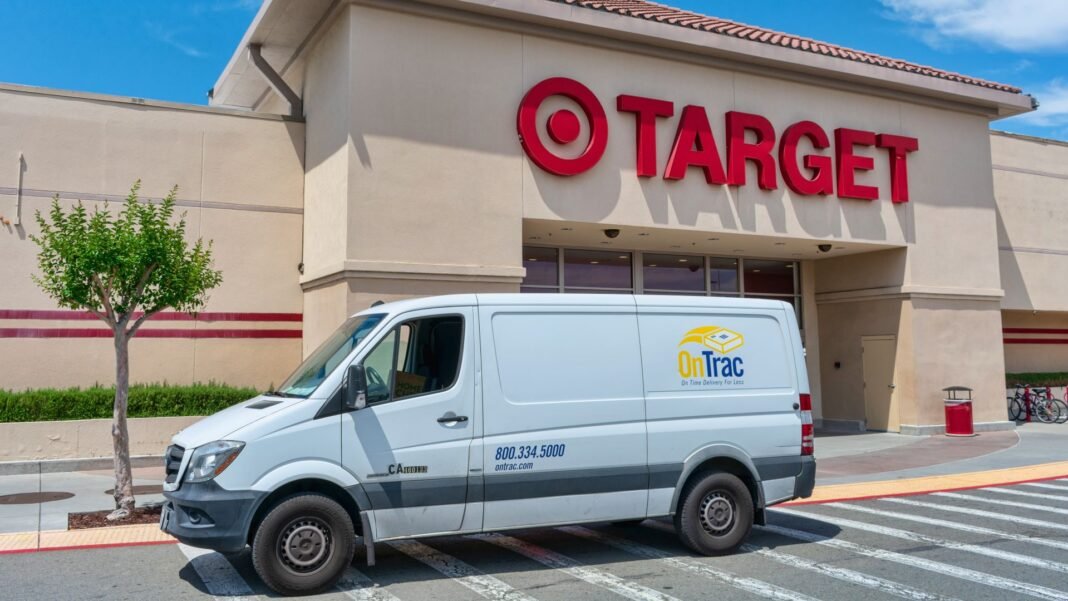

Super regional parcel carrier OnTrac on Tuesday unveiled three new coast-to-coast service levels it says will prevent e-commerce merchants from losing sales as shoppers make trade offs between speed and cost.
The announcement coincided with OnTrac’s release of a report that shows predictive delivery dates, seven-day delivery and weekend fulfillment are tied to higher order conversion and repeat purchase rates, but those capabilities remain underutilized by many online retailers.
Reaction was mixed. Some experts applauded OnTrac’s strategy of covering more of the domestic U.S. market to better compete with FedEx and UPS. Others said OnTrac, which serves 35 states and the District of Columbia, should stick to its sweet spot providing last-mile delivery from retail fulfillment centers located relatively near a customer’s residence.
Quasi-national coverage will be a very small part of their business “as they try to follow UPS and FedEx and not realizing that Amazon actually has the right operating model for the fast-growing B2C parcel market,” said Satish Jindel, the president of parcel spend management firm ShipMatrix, in an interview.
OnTrac may be able to cater to the few shippers that only have one or two fulfillment centers, “but they should focus on having the best on-time for next-day delivery of parcels that are within 100 to 200 miles of the consumer from the distribution center,” he added.
Air Express option
OnTrac said it will launch a hybrid air-and-ground Express delivery product in early 2026 with ClearJet that bridges the gap between costly express air and longer-distance ground shipping by skipping domestic ground shipping zones that add to package shipping costs. The service aims to provide consistent two-day and three-day coast-to-coast transit times. OnTrac is currently conducting pilot tests with several customers and has opened enrollment for the service.
ClearJet is a parcel delivery company that combines regional ground transport with use of narrowbody passenger aircraft. The flights are bracketed by regional carriers that handle the first-and-last mile portions of the move. Clearjet manages the on-airport sortation and then moves the parcels to the respective airlines. Upon the flight’s arrival, Clearjet either tenders the parcels to regional partners for final delivery or uses its own delivery vehicles.
Clearjet’s model is essentially a zone-skipping service, whereby package volumes are delivered to a carrier’s hub near the package’s final destination. Doing so allows the shipper to decrease costs by skipping most of the eight carrier zones that divide the U.S. transportation market. Zone skipping is generally most cost-effective when it involves large package volumes.
“Many retailers need a delivery option that’s faster than ground but doesn’t carry the cost or constraints of legacy air services,” said Vijay Ramachandran, OnTrac vice president of marketing, product strategy & marketplaces, in a news release. “OnTrac Express fills that gap with seven-day operations and highly competitive rates. It expands what’s possible for shippers who want to promise consistent speeds for all customers without overextending their fulfillment networks.”
According to OnTrac’s new “State of Speed” study, more than 50% of retailers have not fully regionalized their fulfillment networks, relying instead on one or two fulfillment centers without geographic distribution. OnTrac Express is designed to fill the gap for merchants with limited fulfillment centers.
The independent parcel carrier said OnTrac Express will be able to reach more than three-quarters of U.S. shoppers and 48 of the top 50 metro areas. It will include under one-pound rates, fewer surcharges and more competitive pricing compared to traditional air express service.
“Most companies need a FedEx or UPS because they are national. They can get from A to B with no middle person. For regionals to compete they need to have a much wider coverage area. If you can go coast-to-coast that’s huge,” Micheal McDonagh, an independent parcel consultant, told FreightWaves.
“The other thing you need is having express services, if a customer needs it there in a day or two, because most regional carriers are ground, with delivery in one to five days,” he said, noting there’s no industry that doesn’t use express to some degree.
Using too many regional carriers to provide national reach adds complexity for a retailer in terms of software integration, label printing, and management.
“So I think OnTrac is on the right track. If you’re going to compete with FedEx and UPS you have to come close to their service. You don’t have to match them, but it can’t just be ground service that you have,” said McDonagh.
Deferred Ground
The Chantilly, Virginia-based parcel carrier said it will also roll out a new deferred delivery product early next year designed for brands and logistics providers shipping non-urgent parcels at scale. Pilot testing of OnTrac Ground Essentials will begin later this year. It will offer transit times one-to-two days longer than the company’s legacy Ground service at rates up to 30% lower than economy services by national providers on comparable shipments.
The new offering follows mid-year price hikes and extra surcharges by FedEx and UPS, part of a larger strategy by the integrated express carriers to boost profits in the lower end of the market as customers trade down to non-premium service to save money. The traditional carriers, which offer deferred products for longer-distance moves, are exacerbating a downward spiral because as they raise prices more bargain-hungry shippers are switching to alternative carriers, according to the TD Cowen-AFS Freight Index.
Having services that align with the varying consumer mindsets towards delivery is important for merchants, according to OnTrac.
“Retailers have told us they need an economy service that doesn’t force a trade-off between cost and coverage,” Ramachandran said. “OnTrac Ground Essentials delivers that combination — lower costs than national economy services, fewer surcharges, and the advantage of coast-to-coast delivery through OnTrac’s 7-day/week operations. It gives merchants a distinct economy tier that finally matches scale with savings.”
The new service also fits with learnings from OnTrac’s “State of Speed” study, which found that shoppers making discretionary purchases, often in categories like low-cost apparel and housewares, were four to five times less likely to prioritize fast shipping than buyers of time-sensitive goods such as auto parts or household supplies.
Jindel questioned the need for a national, deferred delivery service. “Let the long distance parcels be handled by FedEx and UPS. It’s a smaller percentage of the B2C market and it’s shrinking. Most of the packages are moving in shorter zones,” he said. “The middle mile is going to end up costing more. They are creating additional operational complexity. And you are going to have to have a large volume to justify the pick up. The large shippers have discounted rates and quarterly rebates from the traditional carriers that they won’t want to give up.”
Predictive delivery
OnTrac’s third new product is called 7-Day Play, an enhancement of its current seven-day per week service that employs artificial intelligence to predict delivery times.
OnTrac is teaming with Fenix Commerce, a platform provider of delivery management tools for retailers, on the service. Fenix has integrated its predictive technology in OnTrac’s system, enabling the parcel carrier to provide precise delivery dates on product and checkout pages based on the service level selected.
Most e-commerce sites only promise static guesstimates, measured in business days, for when a package will arrive.
OnTrac said most fulfillment companies and ground carriers treat seven-day service as an opportunity to deliver on Saturday or Sunday, and pause sort and middle-mile operations, when the real value for multizone shipments is in using the weekend for pickups and linehaul.
The company will soon announce partnerships with third-party logistics providers to carry out weekend order processing combined with its seven-day service. OnTrac’s service includes large and small-quantity pickups, coast-to-coast transit, and reliable delivery, with orders moving Friday through Sunday arriving one to two days earlier than traditional ground service. Weekend operations come standard, without extra fees on pickup or delivery.
Retailers benefit from higher order conversion rates and customer loyalty without expanding their network footprint, logistics personnel or operating budgets, according to OnTrac.
McDonagh said retailers need to have a huge amount of volume to justify having several fulfillment centers around the United States. And even if they only ship up to Zone 4, they want to use the same carrier as much as possible for regional moves in different parts of the country, he said in explaining how OnTrac is differentiating itself from other carriers.
“Predictive dates get more powerful when shipping never pauses, and a network that runs seven days-a-week gets more value when that speed is shown to shoppers in the moments that count. That’s the multiplier retailers have been missing,” said Ramachandran.
Click here for more FreightWaves/American Shipper stories by Eric Kulisch.
Write to Eric Kulisch at ekulisch@freightwaves.com.
RELATED READING:
FedEx and UPS cease parcel discounts, ‘weaponize’ fuel surcharges: report

