
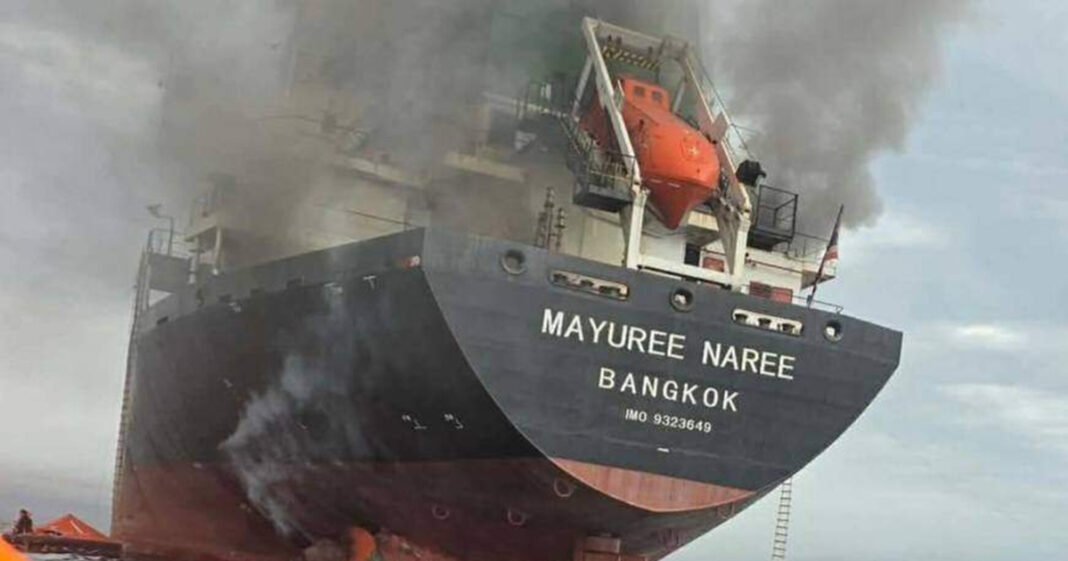

This image released by the Royal Thai Navy shows the Thai cargo ship Mayuree Naree that was struck and set ablaze in the Strait of Hormuz on March 11. (Royal Thai Navy via AP)
March 13, 2026 9:54 AM, EDT
Brent crude traded near $100 a barrel following one of the most volatile weeks ever for the oil market, with investors bracing for more upheaval as Iran pledged to keep the vital Strait of Hormuz effectively shut.
The global oil benchmark pared gains on March 13 after jumping 9.2% in the previous session, with price fluctuations this week covering the widest range on record. President Donald Trump cast a fresh warning to Iran, while the country’s new supreme leader said Hormuz should remain closed.
In a further effort to try to tame surging prices, the U.S. issued its second temporary waiver for the purchase of Russian oil. The latest measure, which is for oil that was loaded onto vessels before March 12, is broader than a directive earlier this month that only cleared India to boost its buying.
The near-halt to shipping through the narrow Strait of Hormuz between Iran and the Arabian Peninsula has choked off shipments of crude, natural gas and products such as diesel to global customers, driving up energy prices. Several ships have been attacked this week, adding to the odds that owners won’t pass Hormuz anytime soon. That has raised fears of an inflation crisis and is starting to hit some economies.
The International Energy Agency warned on March 12 that the supply disruption is the largest in the history of the global oil market, a day after its members agreed to a historic release of emergency reserves to try to cool prices. Jet fuel is trading north of $200 a barrel in Europe, underscoring the impact on refined products.
.@POTUS is taking decisive steps to promote stability in global energy markets and working to keep prices low as we address the threat and instability posed by the terrorist Iranian regime.
To increase the global reach of existing supply, @USTreasury is providing a temporary…
— Treasury Secretary Scott Bessent (@SecScottBessent) March 12, 2026
“This is the most important oil supply disruption event since the 1970s,” said Philip Jones-Lux, senior market analyst at Sparta Commodities, referring to previous Middle East supply shocks. The IEA release helps to keep prices from going to “stratospheric levels,” but probably only for a short period, he added.
European countries including France and Italy have opened talks with Tehran seeking to negotiate a deal to guarantee safe passage for their ships through Hormuz, the Financial Times reported, citing officials briefed on the discussions.
Iran has started laying mines in the Strait of Hormuz, the New York Times reported, citing U.S. officials, which will make shipping even more perilous for those considering passing through the waterway. Defense Secretary Pete Hegseth said March 13 that there’s “no clear evidence” Iran is laying mines.
Since the war began on Feb. 28, vessel traffic through the channel has slowed to a trickle.
The U.S. Navy could start escorting tankers through the strait by the end of March, Energy Secretary Chris Wright said on CNBC. Earlier this week, he wrote in a now-deleted social media post that the Navy had successfully escorted a tanker through the channel, a claim later walked back by the White House.
“You cannot clear mines during active combat in a risk-free way and the Navy will not want to enter the strait,” said Aaron Stein, president of the Foreign Policy Research Institute. “The risk is intolerable to international shipping and the options the U.S. can provide won’t mitigate it.”
Patrick Brennan of Cox Fleet talks about the common missteps that fleets make in planning for future maintenance and operational needs. Tune in above or by going to RoadSigns.ttnews.com.
Brent has swung in a range of around $38 this week, the most ever. Wild swings have been exacerbated by financial flows from options markets to exchange-traded funds. Brent’s nearest timespread jumped by more than a dollar on March 12 — the latest eye-watering swing for a gauge that normally only moves a few cents at a time.
Those extreme fluctuations are likely to continue with no signs of the war ending soon. In a social media post on March 12, Trump said preventing Iran from having nuclear weapons and being a threat to the Middle East is “of far greater interest and importance to me” than the cost of oil.
“Volatility likely stays elevated until there’s clarity on flows through Hormuz,” said Haris Khurshid, chief investment officer at Karobaar Capital LP in Chicago. A price range of “$85-$105 makes sense while the conflict is still unresolved and ongoing,” he added.

