
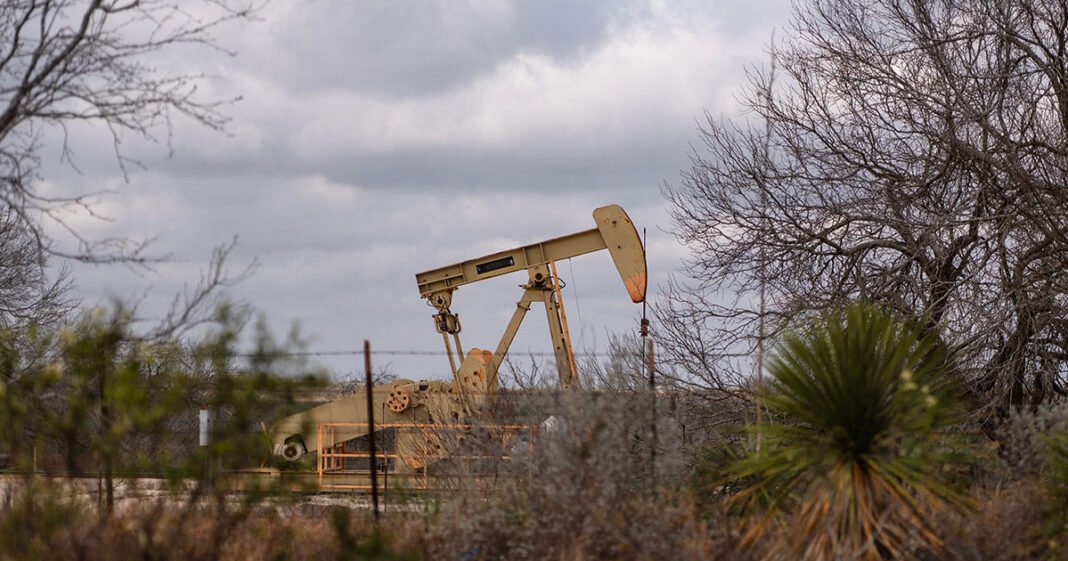

A pumpjack near Three Rivers, Texas, on March 1. (Eddie Seal/Bloomberg)
March 31, 2026 4:30 PM, EDT
Oil declined after Iran and the U.S. signaled openness toward a resolution in the conflict that’s upended global energy shipments, sanding away a long-standing risk premium in prices.
West Texas Intermediate futures fell 1.5% to settle near $101 a barrel, after earlier climbing as much as 3.9%. Iranian state media reported on March 31 that President Masoud Pezeshkian said the country is ready to end the war while reiterating Tehran’s demands. Those have previously entailed ending the conflict across all fronts and recognition of its sovereignty over the vital Strait of Hormuz.
Still, traders were wary that an imminent resolution wouldn’t undo existing disruptions to the global energy complex. The war, now in its fifth week, has caused extensive infrastructure damage and effectively closed the strait, choking off supplies of crude, natural gas and products such as diesel to global markets, which has led to skyrocketing energy prices and concerns about inflation.
RELATED: Trump Urges Allies to Take Hormuz as Oil Swings on Exit Hopes
Global benchmark Brent posted its strongest monthly gain ever amid ongoing attacks in the Persian Gulf. U.S. gasoline, meanwhile, topped $4 a gallon for the first time since August 2022, posing a major political risk for President Donald Trump’s White House in a midterm election year.
“At this point, even if the conflict resolves tomorrow, it will take weeks to months to restore flows,” said Shaia Hosseinzadeh, chief investment officer at OnyxPoint Global Management. “Price signals are not adequately reflecting the physical reality.”
The report from Iran added to signals from the U.S. that a resolution may be within reach soon. Trump told the New York Post on March 31 that the U.S. is “not going to be there too much longer,” calling the campaign against Iran “an obliteration.”
“I think we are closer to an off-ramp exit scenario than a lot of people actually assume,” Christoph Eibl, CEO and co-founder of commodities trader Tiberius Group, told Bloomberg.
Prices initially soared March 31 as Iran struck a Kuwaiti oil tanker in a drone attack during a fresh wave of attacks around the Persian Gulf, but the gains later cooled. The Al-Salmi, a fully-laden very large crude carrier, was hit in the anchorage area of Dubai’s port, with the hull sustaining damage. Tehran has regularly targeted ships across the Gulf since the war began, previously attacking two vessels near Iraq.
Trump has regularly swung between saying an end to the war is near and warning that he’s prepared to ramp up military operations. On March 30, he said that the U.S. will blow up power plants, oil facilities and “possibly” desalination infrastructure if Iran doesn’t reopen Hormuz.
The U.S. leader told allies struggling to obtain jet fuel that normally flows through the strait to just “take it,” arguing in a social media post that the U.S. had already weakened Iran enough.
Hostilities continued March 31 with Israel Defense Forces completing another wave of strikes on Iranian regime targets in Tehran, while Saudi Arabia intercepted and destroyed drones. Iran’s semi-official Mehr news agency reported a U.S.-Israeli strike on Bahman Port in the east of Qeshm Island.
“With just under 15 million barrels a day of Gulf supply offline, rising refinery shutdowns and growing infrastructure risks, we expect Brent to average roughly $125 a barrel in April with credible spikes towards $150,” Societe Generale SA said in a report. “Prices could go considerably higher if Bab El-Mandeb at the southern end of the Red Sea is effectively shut.”

