
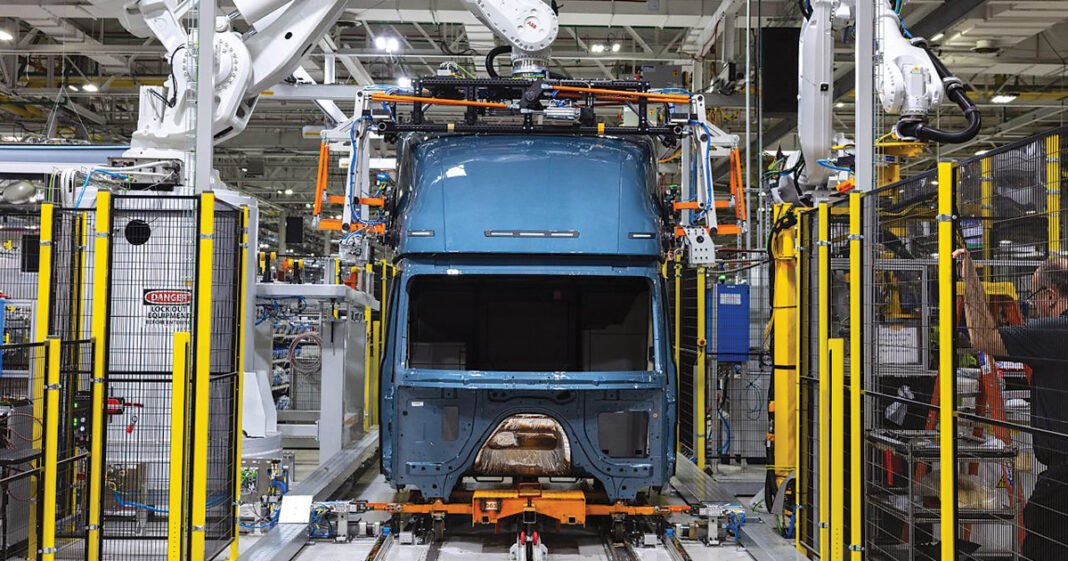

Volvo Trucks North America and Mack Trucks in 2025 increased their prices as a result of Section 232 tariffs. (Volvo Group North America via Facebook)
February 26, 2026 1:50 PM, EST
Key Takeaways:
- Section 232 tariffs on medium- and heavy‑duty trucks and parts remain the primary driver of pricing.
- Truck makers and suppliers are monitoring new tariff actions while evaluating supply chain effects.
- Analysts maintain positive production forecasts for 2026 despite increased policy uncertainty.
The threat of rising truck prices earned a reprieve after the Supreme Court struck down key tariffs under the Trump administration, but the end of those levies — and the possibility of new ones — is leading to new uncertainty for manufacturers and buyers alike.
But the latest twist in the ongoing trade policy upheaval seen since Trump’s second stint as U.S. president began in January 2025 again unsettled market observers, truck makers and freight market participants.
Greater economic uncertainty — largely as a result of the Trump administration’s mercurial attitude toward trade relations — already torpedoed expectations of a freight market rebound and consequent increase in demand for Class 8 trucks once in 2025.
The Supreme Court nixed Trump’s widest-reaching “reciprocal” tariffs on Feb. 20.
A 6-3 majority found that the Constitution “very clearly” provides Congress with the power to impose taxes, including tariffs. “The framers did not vest any part of the taxing power in the executive branch,” Chief Justice John Roberts wrote.
Trump introduced the tariffs under the 1977 International Emergency Economic Powers Act.
Almost immediately after the high court ruling became public, Trump imposed another round of tariffs, this time using the Trade Act of 1974 as the basis. Trump first promised 10% global tariffs and then upped levies on imports to 15%.
President Trump announces he will increase the global tariffs he imposed yesterday from 10% to 15%.https://t.co/fG5iQFqMU7
— CNN (@CNN) February 21, 2026
And FedEx and other companies almost as quickly sought a refund. FedEx ranks No. 2 on the Transport Topics Top 100 list of the largest for-hire carriers in North America and No. 3 on the TT Top 50 list of the largest global freight carriers.
Section 232 Tariffs Remain
But Section 232 tariffs on medium- and heavy-duty trucks and parts preclude any price hikes as a result of the justices’ ruling, noted Dan Moyer, FTR Transportation Intelligence’s senior analyst of commercial vehicles.
The Section 232 tariffs on medium- and heavy-duty truck parts apply to key parts, including engines, transmissions, tires and chassis.
According to a White House fact sheet released in October: “Products subject to tariffs under this proclamation will not be subject to additional or existing sectoral tariffs on steel, aluminum, copper, automobiles and automobile parts, and lumber; they also will not be subject to reciprocal tariffs or the tariffs imposed on Canada, Mexico, Brazil or India.”
“Few if any parts were covered by the IEEPA tariffs. Most of what our industry was directly subject to were Section 232 tariffs, and they are still in place,” ACT Research Vice President Steve Tam told TT.
“Indirectly, we will have to wait for the dust to settle, but even with a unilateral 15% tariff on all imports, the effect tariff rate should come down a little. Of course, that is before any retaliation from trading partners,” added Tam.
OEMs Parsing Developments
However, truck and engine makers are still on tenterhooks.
“We are closely monitoring the latest U.S. tariff developments and assessing any potential implications for our supply chain and operations. Certain trade measures, including Section 232 actions on steel and aluminum, remain in effect,” a spokesperson for Daimler Truck North America said in an email.
“Our priority is to maintain reliable production, support our workforce and keep our customers’ vehicles on the road. We will continue working constructively with our suppliers, dealer partners and relevant authorities to provide stability and continuity for the people and industries who rely on us every day,” the spokesperson added.
Patrick Brennan of Cox Fleet talks about the common missteps that fleets make in planning for future maintenance and operational needs. Tune in above or by going to RoadSigns.ttnews.com.
DTNA, the parent company of truck brands Freightliner and Western Star, won the largest share of 2025’s Class 8 retail sales with a 40.8% slice of the pie, according to Omdia Automotive data.
“We’re continuing to monitor the evolving tariff situation closely while working to evaluate the Supreme Court’s lengthy decision. For now, it’s worth emphasizing that the court’s decision does not affect the Section 232 tariffs on steel, aluminum and trucks, or the existing Section 301 tariffs — all of which remain in full force,” a Volvo Group spokesman said in an email.
Volvo Group divisions Volvo Trucks North America and Mack Trucks in 2025 increased their prices as a result of Section 232 tariffs imposed on steel and aluminum imports in February 2025. The tariffs rose to 50% in June.
Supply chains are complex, especially for multinational corporations such as Daimler Truck, Volvo Group or engine manufacturer Cummins.
“As a U.S.-based power solutions company serving customers worldwide, access to global markets and specialized parts is essential. While we primarily make engines for North America in the U.S., our complex supplier network cannot be easily replicated, and tariffs have added cost and complexity,” a spokeswoman told TT in an email.
“Following the Supreme Court’s ruling on the IEEPA tariffs, we are actively assessing any potential implications for our business, our suppliers and our customers including identifying options for recovery of tariffs,” she said.
However, the representative added: “We remain committed to working with the administration and staying closely aligned with our customers and suppliers, sharing updates as they become available.”
Latest Prognostications
Before the latest uncertainty, confidence was growing about the prospects for the freight market and demand for trucks and engines.
Cummins executives painted a rosier picture during the company’s fourth-quarter 2025 earnings call.
As did Paccar’s top executives, particularly as the company targets a 35% North American heavy-duty market share.
Paccar divisions Peterbilt Motors Co. and Kenworth Truck Co. declined to comment on the impact of the Supreme Court decision when approached by TT. International Motors also declined to comment.
FTR increased its North American Class 8 factory shipment forecast to 265,000 vehicles for 2026 on stronger orders, improving freight fundamentals, updated original equipment manufacturers build plans and slightly higher Environmental Protection Agency 2027 nitrogen oxide pre-buy expectations.

