
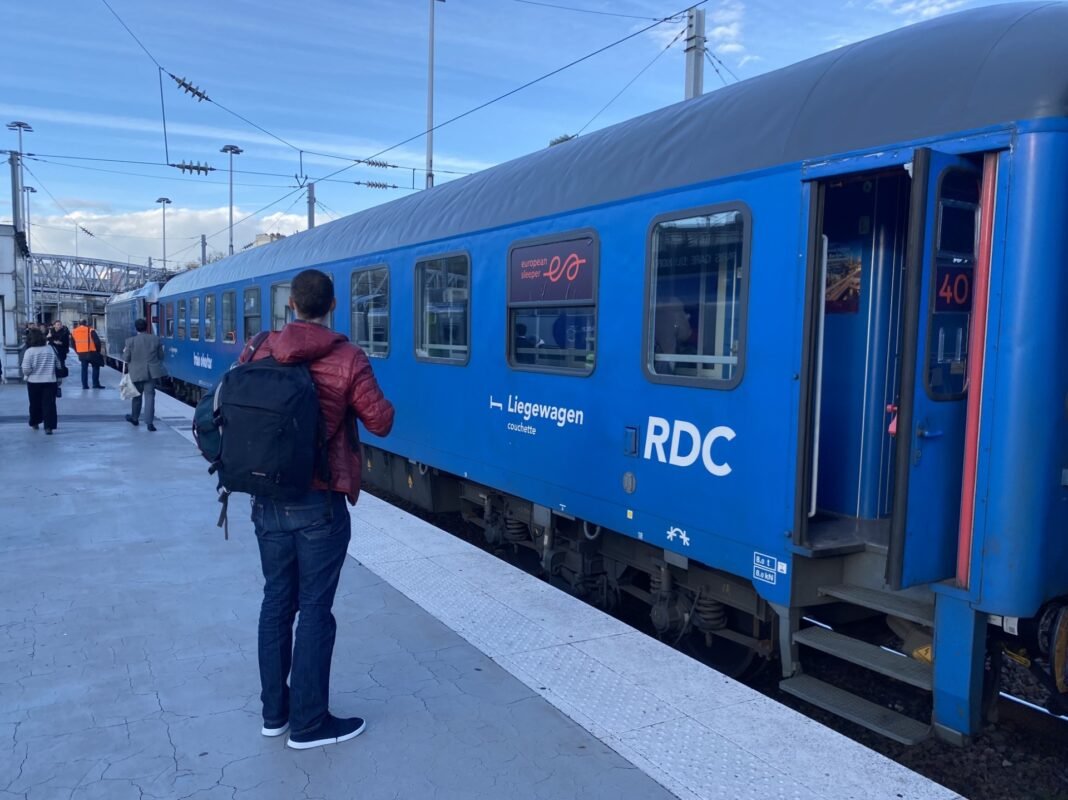

The EU night train company European Sleeper keeps believing that some Europeans not only prefer low-carbon rail travel to budget flights, and are even ready to spend an entire night on a wagon rolling across the continent.
Some three years after opening its first night train line between Brussels, Amsterdam, Berlin, and Prague, this European start-up opened a new Paris-Berlin route on Thursday afternoon.
Travellers going all the way to the German capital will arrive at 9.02am on Friday – meaning they will spend about 15 hours onboard.
That’s some six hours slower than day trains offered by national rail companies, and 8.5 times the 1h45 minutes needed by a way-more-polluting direct flight (not counting time messing around in the airport).
According to the company, however, the trip’s length hasn’t discouraged over 25,000 passenger to make a booking even before the inaugural trip left the platform on Thursday afternoon at the bust Gare du Nord in the French capital.
Mixed motivations
One young traveller who planned to leave the train mid-way in Brussels said he didn’t know that the train was going all the way to Germany when he booked his ticket on a popular online platform.
Others, of course, did. Two Berliners told Euractiv they had decided to try their first night train experience on the way home after a visit to Paris.
Another young lady said she had booked a night on the rails for the experience. A veteran of sleeper trains in France, she said she was an enthusiast user of this slow and eco-friendly travel mode.
A small group of activists had gathered next to the platform displaying a banner declaring ‘Oui au train de nuit’ (Yes to Night Trains), and they distributed flyers urging the locomotive powers-that-be to reconnect Paris not just with Berlin, but also with Vienna.
Business reality
Despite the evident enthusiasm, however, there is a problem. When it comes to business, European Sleeper is still running at a loss. Its co-founder Chris Engelsman appeared optimistic anyway.
He told Euractiv that the firm’s Brussels-Prague route was close to turning a profit, and that they expect the Paris-Berlin train sales to go up faster.
“In the railway industry it takes a bit of time,” he said. “We need a bigger network to have the overhead costs spread over more routes.”
Bureaucratic nightmare
Engelsman called the country-by-country red tape to let the trains running across borders “a nightmare”.
“There are so many different rules and regulations in every country – that’s very complex,” he said.
“We should actually be able to apply at one infrastructure manager for an international path. And they should come back to us with an offer.”
Not that the company is looking subsidies, Engelsman emphasised – though it could benefit from guarantees giving it access to hard-to-obtain loans.
The EU – which has made noises about supporting night trains, and a switch from plane to train more generally as a way to further climate action – could also help by obliging dominant ticketing platform to sell tickets from all operators, he said.
Currently, Belgium’s national railway company sells European Sleeper’s tickets – but this is not the case in France or Germany, he said.
A controversial proposal to force all rail companies to sell tickets for any trip across Europe is already in Brussels’ plans – and is being fiercely opposed by the railways’ lobby organisation.
The European Commission plans to publish on 13 May proposals for a regulation on ‘Single Digital Booking and Ticketing’ and a reform of rail passengers’ rights and obligations.
(rh)

