
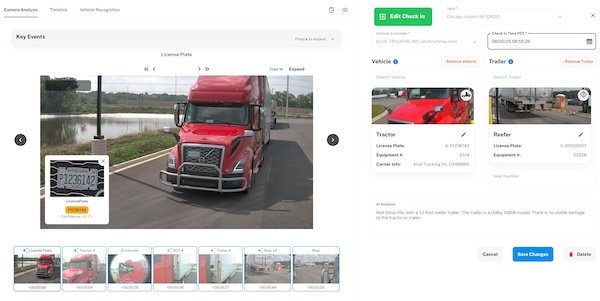

Earlier today, Austin, Texas-based Outpost, a national network of truck terminals, announced it has rolled out a new gate automation platform, geared towards various supply chain stakeholders, including shippers, enterprise fleets, and terminal operators, which it said addresses what it called significant avoidable costs.
Those costs, which are tied to terminals’ gate operations and related to labor, security/theft, and bottlenecks, are estimated to be at around $6.7 billion annually, based on the company’s analysis of facility labor cost benchmarks and national terminal counts derived from government and proprietary data.
By leveraging computer vision and AI, Outpost said that the platform is able to reduce gate operating costs by 70%, as well as improve yard security, eliminate entry and exit delays, and automatically capture 99.9% of gate events with accurate, auditable data.
Outpost Chief Technology Officer Greg Akselrod told LM that Outpost built this platform out of necessity.
“As an operator of more than 25 truck terminals and drop yards, we’ve seen first-hand how manual, outdated gate processes reduce throughput, create security risks, and drive up costs,” he said. “Traditional gate technology couldn’t adapt to the unique needs of each facility, so we created our own. Our platform combines computer vision and AI voice to automate gate operations, and we offer a turnkey installation process to get customers up and running in as little as a week. It’s been about 18 months in the making. We tested and refined it across more than one million real-world gate events at our own terminals before bringing it to market.”
When asked about the key benefits of the platform for its customers, Akselrod said that, for shippers, terminal gates are a critical point in the supply chain but are also one of the most common bottlenecks. To that end, he noted that the platform replaces manual, repetitive processes with automation that’s faster, more accurate, and available on a 24/7 basis. Which provides various benefits and efficiency improvements, including:
- Higher throughput: Most trucks clear the gate in 0-15 seconds compared to 3-6 minutes with manually staffed gates;
- Better visibility: Every gate event is documented with images, video, and verified driver and equipment data;
- Improved security: The system catches tailgating, mismatched tractors and trailers, missing security seals, and fraudulent IDs. These are issues that human guards often miss; and
- Lower costs: Customers typically see a 70% reduction in gate operations costs, freeing budget for higher-value work elsewhere
On a practical level, Akselrod presented a basic example of how the automated gate platform works.
“A truck approaches the gate, and our AI immediately starts scanning hundreds of video frames from multiple camera angles in real time,” he said. “It reads license plates, trailer IDs, and DOT numbers; checks for security seals, hazmat placards, and visible damage; and validates CDL authenticity. If everything matches the pre-approved load data, the gate opens automatically, often without the truck ever having to stop. If something’s amiss, the driver can interact with our AI voice agent in their native language to resolve it on the spot or be routed to live remote support. All of this is logged for security, compliance, and operational reporting.”
From a competitive perspective for Outpost, Akselrod cited various advantages the new platform brings, including being proven at scale, through the refining of the platform based on more than one million gate events at its own terminals before rolling out to customers.
Other advantages he cited include: Breadth and accuracy of AI, with the system recognizing more vehicle, equipment, and driver details than any other solution in the market, under all weather and lighting conditions; being vertically integrated in providing software, hardware, installation, and optional remote operations, and providing customers with a turnkey, end-to-end solution; fast deployment, with most sites are up and running in under a week without heavy civil work, trenching, or server rooms; and being adaptable to any facility, with the platform working at truck terminals, distribution centers, intermodal yards, and even off-grid locations.
Earlier this summer, Outpost expanded its service footprint across what it called “critical freight corridors,” with the acquisition of four new properties in Dallas, Southern California’s Inland Empire, Las Vegas, and Savannah, with the latter two marking its initial Nevada- and Georgia-based locations.

