
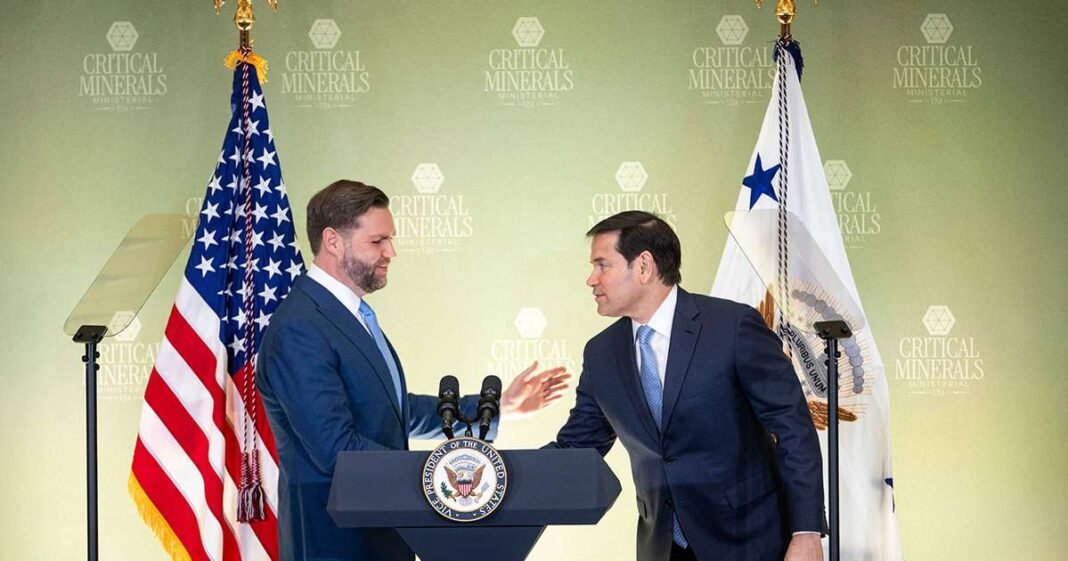

Secretary of State Marco Rubio (right) welcomes Vice President JD Vance to the stage during the Critical Minerals Ministerial meeting in Washington on Feb. 4. (Kevin Wolf/Associated Press)
February 4, 2026 2:45 PM, EST
The Trump administration hosted 55 countries at a critical-minerals summit Feb. 4, pitching price floors and a flood of U.S. private equity in a bid to reduce dependence on China and ensure U.S. manufacturers have stable access to key resources.
The European Union, Japan and Mexico each agreed with the U.S. to set up new policies including price floors to help solve critical-mineral supply chain vulnerabilities, according to statements from the U.S. Trade Representative’s office.
Each also pledged to work toward a binding multilateral agreement on trade in critical minerals.
“Today, the international market for critical minerals is failing,” Vice President JD Vance said Feb. 4 in remarks to open the summit. “Consistent investment is nearly impossible, and it will stay that way so long as prices are erratic and unpredictable.”
Vance called on the audience of foreign officials to help create stable investment conditions. He pitched a “preferential trade center for critical minerals protected from external disruptions,” and made it clear the U.S. is seeking coordinated agreement on price floors.
Price floors have long been discussed among critical minerals industry players as a way to shield non-Chinese companies from the Asian nation flooding markets and depressing Western firms’ profits.
For months, the U.S. and its trading partners have worked toward some sort of cooperation to wean their global supply chains off China. The public statements by key U.S. partners, as well as the open discussion of price floors, suggest they’re getting closer to a solution.
The U.S. and EU have committed to concluding a memorandum of understanding within the next 30 days aimed at boosting supply chain security for critical minerals.
The U.S.-Mexico arrangement will also include identifying specific critical minerals of interest and exploring price floors for metals imports, according to the USTR. Their agreement comes ahead of a joint review this year of the U.S.-Mexico-Canada free-trade agreement, which could see significant revisions under Trump’s second term.
Workers use machinery to dig at a rare earth mine in China. (Chinatopix via Associated Press, File)
In his remarks, Vance cast the market for critical minerals as broken, with mining and processing projects abandoned due to volatile prices, and highlighted the administration’s $100 billion lending authority for critical minerals.
His comments built on President Donald Trump’s Feb. 2 announcement of plans for a nearly $12 billion critical minerals stockpile, in his latest effort to aid U.S. manufacturers. What the administration has called Project Vault is meant to “ensure that American businesses and workers are never harmed by any shortages,” Trump said at the White House.
The stockpile is set to be financed through $1.67 billion in private capital and a record $10 billion loan from the Export-Import Bank, whose CEO cast the new setup as a “uniquely American” mechanism that relies on a government-led push for private funding.
“We’re crowding in, most importantly, U.S. private equity participation,” Ex-Im CEO John Jovanovic said in a Feb. 4 Bloomberg Television interview. The Bank has “an assurance of repayment, we have a fantastic basket of credit risk to look to, and we have physical inventory upon which we’ll earn interest,” he added.
While ending U.S. reliance on China has long been a goal for Washington, it became more urgent last year after Beijing announced export restrictions on so-called rare earths. Trump and Xi Jinping agreed to a trade truce in October that delayed the implementation of the Chinese measures by a year.
Trump spoke with Xi by phone Feb. 4, with the U.S. president saying in in a social media post the two leaders had a “long and thorough call” that included trade. Trump said he looks forward to his April visit to China.
U.S. officials on Feb. 4 avoided singling out China by name during the summit, with Secretary of State Marco Rubio noting that critical minerals supply “is heavily concentrated in the hands of one country.”
“That lends itself to — at the worst-case scenario — being used as a tool of leverage and geopolitics, but it also lends itself to any sort of disruptions, like a pandemic,” Rubio said at a news conference.
China is home to more than 90% of global rare earths and permanent magnets refining capacity, compared with just 4% for second-place Malaysia, according to the Paris-based International Energy Agency. The rapid expansion of AI is fueling demand for critical minerals used in data centers and high-performance chips.
“Everything is geographically concentrated in China, which really isn’t a value judgment — it’s an objective fact,” said Undersecretary of State for Economic Affairs Jacob Helberg, speaking with reporters Feb. 3. “And so, ultimately, countries want to diversify and de-risk the supply chain, which inherently means de-risking single points of failure.”
The summit and initiative build on years of efforts by prior administrations, including the U.S. Energy Resource Governance Initiative in Trump’s first term and the Biden administration’s Minerals Security Partnership.
Rubio is hosting the talks Feb. 4 and the summit is attended mainly by foreign ministers and other diplomats, but Treasury Secretary Scott Bessent and Trade Representative Jamieson Greer have also been involved in the discussions.

