
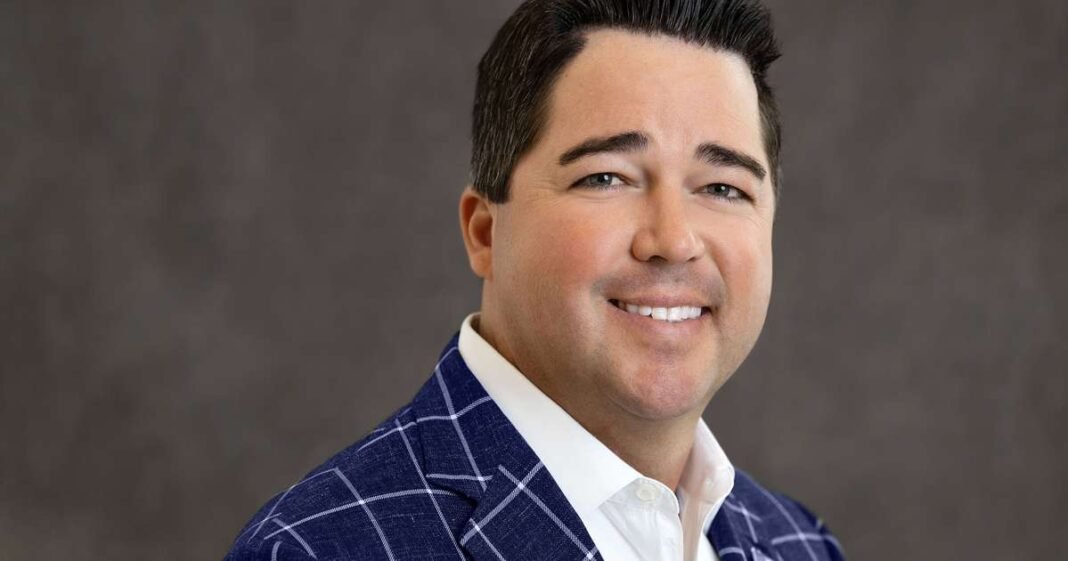

“No pun intended, the second mile will be better than the first,” Montgomery said. (Rollins Montgomery)
February 13, 2026 5:47 PM, EST
Key Takeaways:
- Rollins Montgomery will launch Second Mile Transport with 145 power units and more than 190 trailers ordered.
- Montgomery said private equity-driven decisions and cost reductions contributed to the collapse of Montgomery Transportation.
- A logistics arm for Second Mile is expected by August as Montgomery anticipates stronger flatbed demand.
Just over five months after Montgomery Transportation closed its doors due to the ongoing freight recession, company founder Rollins Montgomery is set to return to the flatbed freight segment with a new venture.
The longtime CEO of Montgomery Transportation, who sold a majority stake in the carrier and then ceded operational control to One Equity Partners, plans to launch Second Mile Transport by the end of March, he told Transport Topics in an exclusive interview.
Birmingham, Ala.-headquartered Second Mile will begin with 145 power units, the native of the city said. The company has ordered 195 aluminum 53-foot trailers and already has 70 drivers signed up.
“No pun intended, the second mile will be better than the first,” Montgomery said.
A logistics arm will be launched by August at the latest, he added. By that point, the freight market will be very different from October, when Montgomery Transportation folded, said Rollins Montgomery.
“As we all know, the market is extremely challenging right now, not just due to inflation. And you may have a tire that’s $125 more versus where it was two years ago. I remember when I was buying trailers at $33,000, and now they’re close to $50,000,” he told TT on Feb. 9. “Margins are tight. Insurance, of course, is up … and of course, nuclear verdicts are what they are. It’s just a very, very difficult industry.”
“I think there’ll be at least perhaps 5% to 10% or more capacity taken out of the marketplace,” he said. “I feel very, very confident that customers are going to have a very, very large need for flatbed capacity. And so I think our timing to get back in it as it relates to Second Mile, just from a commercial standpoint, will also, of course, be very attractive as well.”
Lessons Learned
Montgomery Transportation closed its doors Oct. 9. The group’s brands comprised over-the-road flatbed specialist Montgomery Transport, MT Dedicated, heavy-haul specialist RM Logistics and third-party logistics group Montgomery Logistics, plus a unit working with owner-operators known as MT Select.
At the time of the company’s closure, Federal Motor Carrier Safety Administration records showed Montgomery Transport operated 449 tractors with 458 drivers, RM Logistics had 17 tractors and 17 drivers, and MT Select had 171 tractors and 171 drivers.
One Equity Partners bought Montgomery Transportation in February 2022. The private equity firm decided to exit trucking in June and was in talks with P&S Transportation, a unit of PS Logistics, but a deal collapsed, a source close to the situation told TT in October. One Equity Partners was selling because of weak freight rates, an aging fleet and high maintenance costs, the source said.
(Montgomery Transport)
At the time, Rollins Montgomery publicly refuted allegations he was to blame for the failed P&S deal. “That simply is not true. I would never take steps that would intentionally harm the company I built and have fought for over so many years,” he wrote in October.
The executive launched RM Logistics in July 2011, then launched Montgomery Transport. He had 25 trucks at the time, adding another 50 shortly after. Various segments within Montgomery Transportation ran 800 power units at the time its founder stepped aside from day-to-day control.
In February, Montgomery expanded upon his October statement.
“What happened to Montgomery Transport is not uncommon. Across the country, private equity involvement in trucking has, in many cases, produced harmful results,” he said. “Operational support is often reduced under the guise of short-term cost cutting, while leadership roles are filled by individuals lacking transportation expertise. Growth targets are set without regard for operational realities, and investment in equipment, company culture and workforce stability steadily declines. At the same time, restructuring strategies erode long-standing customer relationships and undermine employee trust, leaving companies vulnerable to failure.”
Ambitions Thwarted
Montgomery said he brought OEP on board because he believed it would support a significant acquisition strategy.
“Everybody has their regrets in life, and perhaps you could consider that one of mine. But nonetheless, you know, I had a very strong feeling at the point in time that I had a lot of support. They would help me grow the business,” he told TT.
“They would provide me the autonomy to go by, call out the A-plus players out in the marketplace. We could do so by broadening our scale, depreciating our footprint and building something extremely special, creating more jobs, providing more value-add to our customer base,” he added.
Private equity firm OEP focuses on the industrial, health care and technology sectors in North America and Europe.
Transport Topics reporters Eugene Mulero and Keiron Greenhalgh examine the critical trends that will define freight transportation in the year ahead. Tune in above or by going to RoadSigns.ttnews.com.
“I saw an opportunity in the marketplace for further consolidation. My viewpoint was to do it a little bit differently because I didn’t want to just buy somebody to buy somebody. I always had the mindset that I wanted to buy the people that were not for sale because I wanted to be able to scale a company that had a lot of the same core values, the cultural element, versus just cutting cost,” Montgomery said.
“So I worked extremely hard for at least a year, almost completed three very large acquisitions, but it just came down to price. And unfortunately, I could not get my equity partners at that point in time to move the needle much,” he said.
After stepping aside, Montgomery decided to build a second business providing accounting, marketing, HR, IT and legal resources.
While Montgomery built Montgomery Enterprises, OEP was facing problems that eventually saw more than 600 employees lose their jobs.
Montgomery expressed strong opinions about what his one-time partners got wrong, including expense reduction, culture, safety focus, capital expenditure on rolling stock and attitude toward maintenance.
OEP declined to comment on Montgomery’s analysis.

