

The Mobility Package is celebrating its fifth anniversary. In complete silence, because no one really seems to feel like partying. Still reviled in Eastern Europe, it is also under fire in Belgium. So, that famous Mobility Package? A measure for nothing?
It took the European Union 14 years to develop measures to level the playing field between transporters from ‘old Europe’ and newcomers from Central Europe. Many had always said that one should first harmonize (competitive conditions) before liberalizing (the market), but no one listened. The result was a wave of trucks with Eastern European license plates, massive relocations (which have now been partly reversed) and a loss of influence of Belgian transport companies.
Fierce lobby battle
After years of negotiations (and attempts at sabotage), the European Union finally agreed in August 2020 on a package of measures covering several essential aspects of road transport: posting of drivers outside their country of origin, rules on driving and rest times and tachographs, access to the profession and to the market.
One measure from that package remains to be implemented: the application of driving and rest times to light commercial vehicles carrying out international freight transport. This will happen on July 1, 2026. Of the other measures, only one was withdrawn under pressure from several Central European countries: the mandatory return of the vehicle to the country of registration every eight weeks. Theoretically this could be combined with transport orders, but in practice it was either not applied or led to many empty kilometers. The other 14 lawsuits against the package were all dismissed.
Too few checks
The balance after five years differs depending on the organization you contact. The unions continue to say that the measures are in the right direction (read: protection of workers and eradication of ‘letterbox companies’) and argue that the lack of controls undermines their effectiveness.
This position is more or less shared by some Belgian transporters, but Febetra is of the opinion that the Mobility Package has served no purpose. Philippe Degraef sticks to the numbers: “The Eurostat data show that the easterly wind has not subsided. The hopes of one side and the fears of the other for a thorough revolution of the European transport landscape have not materialized so far. For example, the share of foreign trucks on the Belgian motorway network has remained virtually unchanged. The top five largest cabotage operators are identical to those before the Mobility Package, and in cross-trade transport Polish, Lithuanian, Romanian, Bulgarian and Slovenian transporters dominate.” His conclusion is in line with that of the unions on one point: the lack of controls encourages fraud.
“Illegal cabotage – carried out by non-posted drivers who therefore receive wages in the country of registration – remains a problem,” acknowledges Ludovic Moussebois (CSC-Transcom).
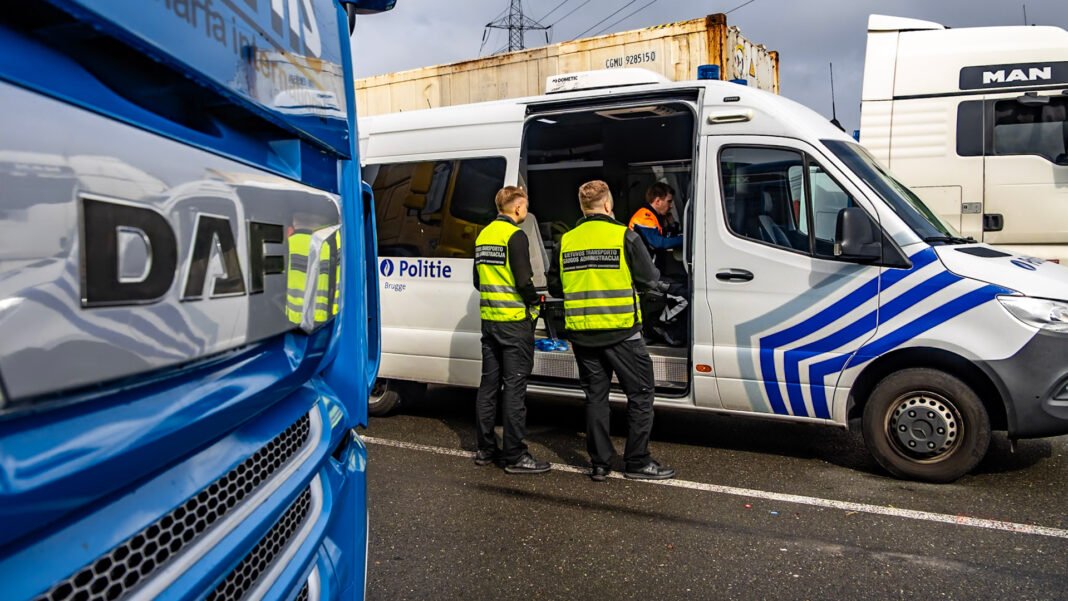
As for the living conditions of drivers, recent checks in Zeebrugge show that the ban on spending the long weekly rest in the cab is also being massively ignored: more than 50% violations in one day, and still poor hygienic conditions.
However, there are also Eastern European companies that do adhere to the rules. In Rekkem, the Polish transporter Batim has set up a building with parking and rooms for its drivers. The company even founded a Belgian transport company with six vehicles registered here. “Unfortunately, that is an exception,” says L. Moussebois. “For every Batim, how many Hegelmanns employ African or Filipino drivers through their Lithuanian branches?”
However, something has changed on the ground, says Frédéric Martin, inspector at the Federal Road Police: “Especially since the introduction of the new smart digital tachograph. We observe fewer rest period violations than 15 years ago. Transporters are better organized to be in order.” He does admit that the driver’s mandatory return ‘home’ is difficult to monitor: “The excuse we hear most often is that the driver does not want to go home. What can you do about that?” Since a complete check takes half an hour, this is indeed the Achilles heel of the system.

