
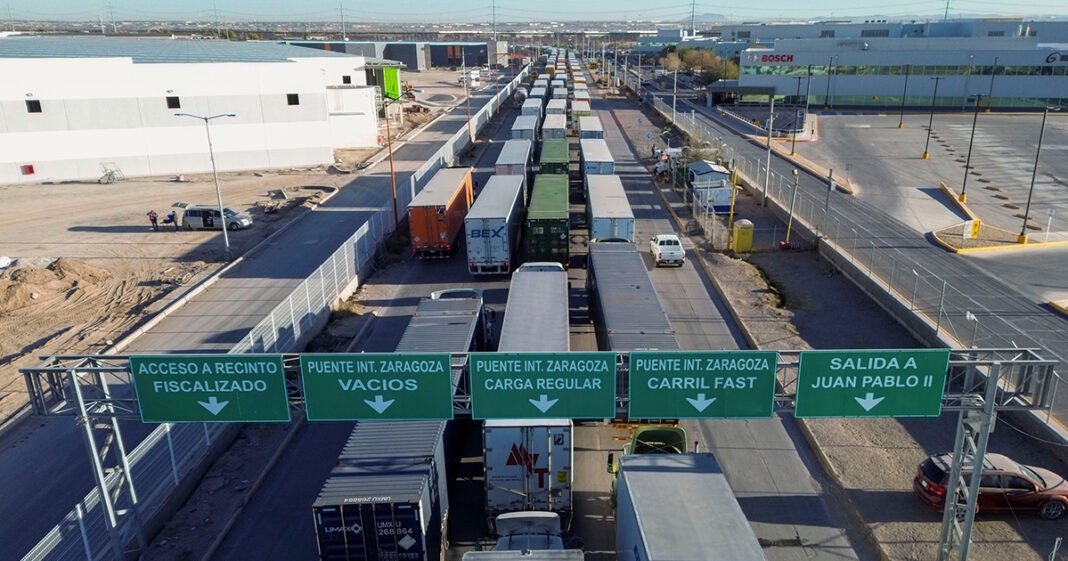

Tractor-trailers wait in line at the Ysleta-Zaragoza International Bridge port of entry on the U.S.-Mexico border in Juarez, Mexico. (David Peinado/Bloomberg)
March 9, 2026 1:01 PM, EDT
Key Takeaways:
- Mexican government consultations found broad business support for preserving the USMCA while seeking improvements as the pact’s formal review begins March 16.
- Sector groups said the deal boosts investment and integration but raised concerns about unilateral U.S. tariffs and costly compliance while differing on whether rules of origin should tighten or loosen.
- Mexican officials expect upcoming negotiations with the U.S. and Canada to center on rules of origin and supply chains as industries push competing priorities for the review.
The U.S.-Mexico-Canada free trade deal shouldn’t undergo a major renegotiation but instead be improved and strengthened, according to consultations with key economic sectors overseen by the Mexican government.
The consultations concluded that the three-nation accord known as the USMCA has successfully promoted economic integration across North America while enhancing the region’s global competitiveness.
“The treaty is perceived as an asset that should be preserved, even though its operation could be improved,” according to a report from Mexico’s economy ministry that cited a majority of business interests surveyed.
The high-stakes review of the trade pact could boost or undermine trillions of dollars’ worth of cross-border North American commerce that has grown dramatically over the past three decades.
“The challenge is to implement it better, modernize it, and make it more inclusive,” Deputy Minister for Industry and Commerce Vidal Llerenas said during an event to present the results of the consultation process.
President Claudia Sheinbaum is betting on a successful review to bolster a sluggish Mexican economy battered by U.S. trade uncertainty as well as business concerns over sweeping reforms she has championed, including a judicial overhaul that critics argue has undermined the independence of the country’s courts.
President Donald Trump, Mexican President Claudia Sheinbaum and Canadian Prime Minister Mark Carney holds their countries’ name during the draw for the 2026 soccer World Cup at the Kennedy Center in Washington on Dec. 5, 2025. (Chris Carlson/AP)
The USMCA, which supplanted the earlier NAFTA trade pact, was inked during President Donald Trump’s first term. Its long-anticipated review is set to start on March 16, but Trump has offered mixed support, at times suggesting he’d prefer new bilateral deals instead.
The economy ministry conducted consultations with 30 sector roundtables, spanning metals, agriculture, construction, carmaking and tourism. It sent more than 500 surveys to companies, chambers and industry groups.
Despite Trump’s frequent criticisms of the deal, Sheinbaum’s trade lieutenants touted its benefits during the March 9 event.
Llerenas, also a former ruling party lawmaker, insisted that Mexico’s simultaneous push to diversify its export markets beyond North America doesn’t signal a weaker commitment to the deal’s future.
“Diversification doesn’t compete with the USMCA, it’s a complement,” he said. “Mexico can consolidate North America as its productive base and at the same time broaden its horizons.”
Perceptions and Proposals
The consultation process showed that Mexican business backs USMCA’s track record of ensuring legal certainty for projects as well as promoting integration and attracting foreign investment. Priorities flagged by the consultations include defending existing rules of origin policies that provide for tariff-free market access as well as maintaining established dispute settlement mechanisms.
Concerns among the sectors consulted include the persistence of unilateral tariffs that stoke uncertainty, specially those that cite Section 232 of US law, which Mexican business see contradicting the USMCA’s “objectives and spirit.” The high costs of complying with some technical and administrative rules are also a cause for concern.
“Mexico must maintain a firm stance in defense of regional free trade, current rules of origin, and Chapter 10 on dispute settlement,” the report noted.
Still, Mexican business interests aren’t entirely on the same page. Some sectors like electronics, the auto industry and metals hold divergent views on whether established rules of origin and regional content should be tightened or made more flexible.
Speaking alongside Llerenas, Deputy Minister for Foreign Trade Luis Rosendo Gutiérrez indicated that the main issues to hash out with U.S. and Canadian negotiators will likely focus on rules of origin and supply chains.
In the case of Mexico’s regionally integrated auto sector, current rules are seen as adequate, according to the report. But businesses focused on electronics and aerospace tended to call for more flexibility due to technological dependence and regional supply concerns.
The consultations also showed that the aerospace sector complained that U.S. domestic content policies cause delays in import and export authorizations.
Meanwhile, representatives surveyed from the steel, aluminum, plastics and petrochemicals sectors, among others, favored stricter rules due to what they described as threats including unfair competition, triangulation and subsidies, plus concerns over traceability.
Patrick Brennan of Cox Fleet talks about the common missteps that fleets make in planning for future maintenance and operational needs. Tune in above or by going to RoadSigns.ttnews.com.
Mexico has already been cracking down on steel imports from some Asian economies. Earlier this month, Mexican officials suspended import permits for 350 steel companies after alleging irregular activity. Another 400 companies are under review in order to determine if administrative proceedings are necessary, according to the economy ministry.
Mexico also imposed tariffs of up to 50% on more than 1,400 categories of goods imported from Asian nations that don’t have a trade deal with Mexico, including China. The new import levies affect products ranging from clothing to auto parts.
In the consultations report, Mexican industry called for the elimination of U.S. tariffs. But while it sought to highlight business community “perceptions, concerns and proposals” it did not set an official Mexican position ahead of the review.

