
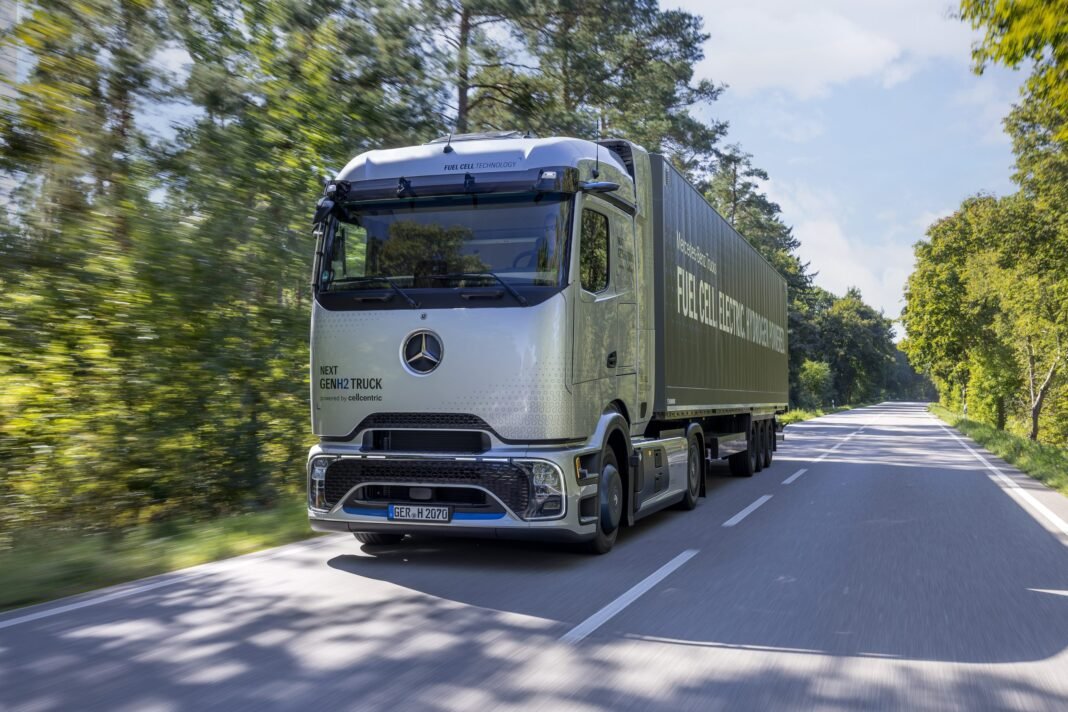

100 units of the Mercedes-Benz Actros NextGenH2 will be produced, which will go into customer service from the end of 2026. This truck features a number of improvements over the previous generation.
Daimler Truck continues the development of hydrogen technology. After a first series of vehicles, the German manufacturer presents an evolution of its Actros GenH2, in which certain components have been adopted, such as the two cellcentric BZA150 fuel cells of 150 kW each. The novelty is in the tanks: two tanks can now store 85 kg of liquid hydrogen at a temperature of -253 degrees Celsius. These tanks are still located behind the cabin in what the manufacturer calls the Tech Tower, which has become more compact thanks to a better arrangement of all components. As a result, the wheelbase of the tractor has been shortened by 150 mm compared to the previous model, to 4,000 mm.
The NextGenH2 also has the integrated electric axle and ProCabin cab of the eActros 600. The energy supplied by the two fuel cells is stored in a high-voltage LFP (lithium-iron-phosphate) battery developed by Daimler Truck. This has an installed power of 101 kWh and works in combination with the drive shaft and the 4-speed transmission (two forward and two reverse), so that as much energy as possible is recovered when descending or braking. This gives hope of a range of more than the 1047 km that was recorded during a record attempt with the GenH2 at the end of 2023.
The NextGenH2 is also equipped with the latest advanced safety systems, such as Active Brake Assist 6, Front Guard Assist and Active Sideguard Assist 2. New hydrogen safety systems have also been introduced. The Tech Tower includes a new hydrogen evaporation management system, which allows the vehicle to be parked in closed spaces, and there is also a new cooling system that ensures stable operating conditions even at very high ambient temperatures or on difficult terrain. In the event of a hydrogen leak, which Daimler Truck considers highly unlikely, a new sensor system allows immediate response, allowing the driver to sleep in the cab.
Daimler Truck is now considering series production of fuel cell trucks before the early 2030s.

