
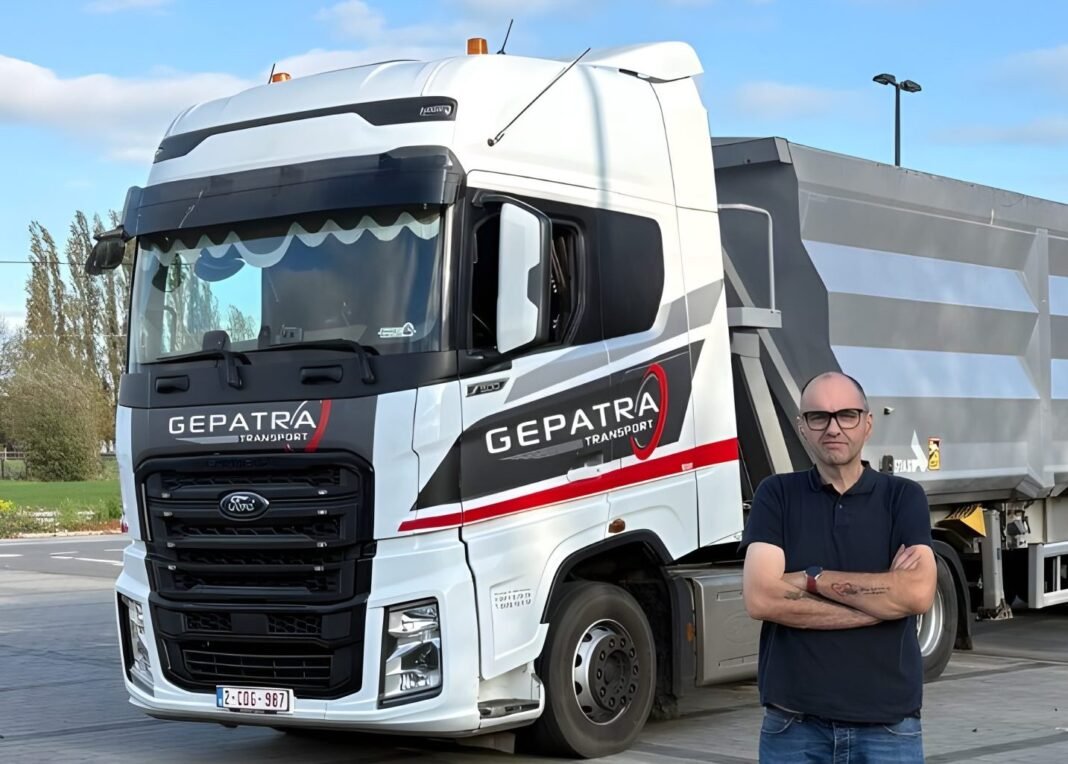

Marino Deleersnijder (51) from Wielsbeke is a man of many paths – literally and figuratively. During the week he is a professional driver, but at the weekend he trades the steering wheel for the cash register system in the local supermarket. For him, this is the perfect balance between the solitary existence of a truck driver and social contact with customers.
“It actually made sense that I would follow in my father’s footsteps,” Marino begins. “He was a master guest in a textile factory. Yet I soon felt that a life between machines and production lines was not for me.”
First batch
At a young age he started helping out at a nearby truck wash on Wednesdays and Saturdays. “On Sundays I washed trucks for a transport company a little further away. When the training to become a truck driver was introduced in secondary education – more than 30 years ago – this felt like a gift from God. I immediately registered and was part of the first group of professional drivers in secondary education at the VTI in Kortrijk.” Marino has been a driver for 32 years now and has not regretted his choice for a moment. “The sector has changed significantly. Sometimes I look back with nostalgia to the early years, when everything was a bit more relaxed. But I still do my job with great pleasure and passion.”
In the beginning, Marino rode nationally and internationally for various companies. “On average, I had to sleep in two nights a week. The neighboring countries surrounding us were regular destinations, but the conditions along the highways have deteriorated over the years: overcrowded car parks, rising prices for meals, dirty sanitary facilities… You have to start looking for a suitable resting place almost from mid-afternoon. Every international driver will recognize this. However, there are few alternatives, unless you opt for closed and paying car parks, but the ARAB reimbursement often does not cover those costs.”
That is why Marino decided to say goodbye to international work and switch to a night driver, which involved emptying textile containers at night, a physically demanding job that he did for thirteen years. “Six years ago I switched to my current employer, who runs a rental and brand garage. At first I worked in the garage as a jack-of-all-trades. A varied job, but I missed real driving, especially when garage work started to take over.”
From Ford to… Ford
His employer, together with a business partner, has a small transport company Gepatra, with three trucks. “When a place became available there, I immediately made the switch. I am still grateful to both my employers for that. I now drive a reinforced volume tipper for a large scrap metal and recycling company with which it is a pleasure to work. Depending on the distance, I make two to three trips a day with metal scrap to other scrap dealers or blast furnaces in Belgium. Fortunately, I can avoid cities such as Antwerp and Brussels, because the traffic jams around those cities have not gotten any better.”
Marino usually leaves home around 4 am and returns home by 4 pm at the latest, already pre-loaded for the next day. “My Ford F-Max is now five years old and was one of the first on Belgian roads. Funnily enough, the first truck I ever drove was a Ford Transcontinental. A car that was very much appreciated by many drivers at the time.”
Although some drivers may look down on this car somewhat disdainfully, Marino thinks this is completely unjustified: “There were indeed some teething problems in the beginning, which is the case with all brands, but they have now been resolved. I am secretly looking forward to the F Max Gen 2.0. The car sometimes has a hard time when loading iron, but the consumption is decent, especially considering the maximum load. The biggest problem are the tires, due to perforation of iron residues. We are without a doubt among the best customers of the tire centers.”
Sometimes Marino also drives a refrigerated truck when it is quiet at the scrap dealer. “I briefly considered doing something else, but I am attached to the work, my client, the customers, the routine. That brings peace and reduces stress, which is good for mental and physical health.”
Last year Marino made an important decision. “Due to the sedentary job, unhealthy lifestyle and irregular hours, my weight had increased to such an extent that the risk of heart failure or other conditions became too great. The physical discomfort increased as I got older. A phenomenon that many professional drivers have to contend with. Medical intervention was the only way out. In retrospect, that was a wise decision. I feel fitter, have more energy, have lost 67 kg in the meantime and can handle my work better.”
And a flexi-job on the side!
Kathy, Marino’s partner, works at the supermarket and is at work every weekend. “As a result, we sometimes didn’t see much of each other. When she asked if I didn’t feel like doing a flexi-job in the supermarket, I didn’t hesitate for long. I have to admit: I have the time of my life there every weekend. You see many customers every week and you build a bond. Some almost just drop by for a chat. I think I have found an ideal combination with this. As long as my health allows it, I would like to continue working until I retire or even longer. I have a job that I enjoy, a second activity that gives me energy, and a life partner who supports me. What more could anyone want?”

