
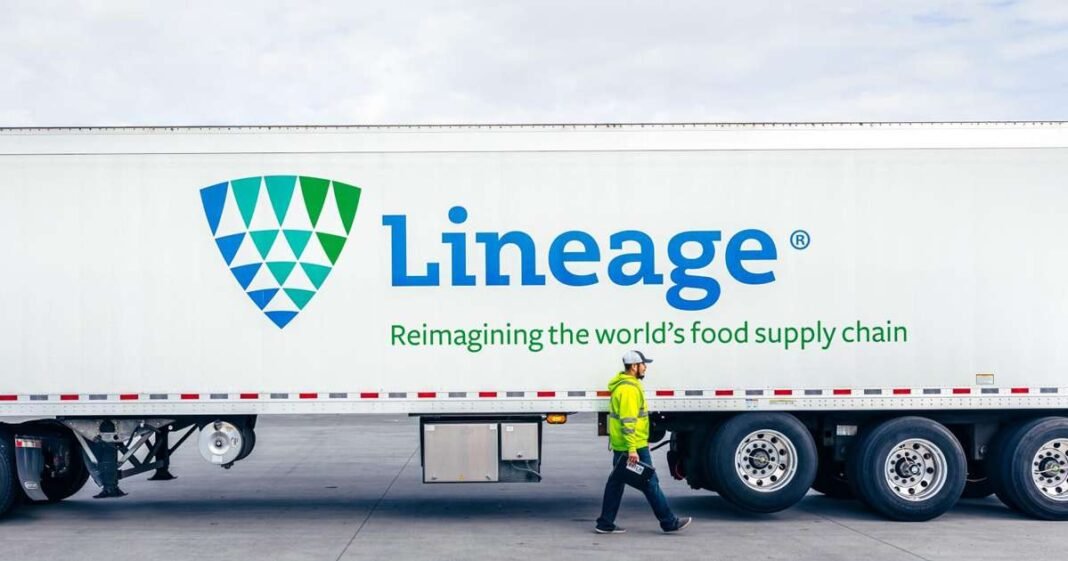

Lehmkuhl told analysts the company’s Q4 performance was in line with or slightly ahead of its expectations on all key metrics. (Lineage)
February 25, 2026 3:05 PM, EST
Key Takeaways:
- Lineage expects steady 2026 after challenging 2025 as Q4 revenue was little changed and the CEO cited early signs of stabilization.
- The company saw 4.4% warehousing revenue growth but slight occupancy declines while expenses fell amid tariff disruptions and a major expansion program.
- Lineage plans further 2026 expansion with 24 facilities under construction as it expects sector supply to contract when older sites are shuttered.
Lineage expects a steady 2026 after a challenging 2025, key executives at the temperature-controlled warehouse real estate investment trust said Feb. 25, even as its fourth-quarter 2025 revenue was little changed.
“We continue to see early signs of stabilization in many areas of our business, and in fact, many geographies are stable or growing, including Europe, Asia Pac, Canada and most U.S. regional markets,” CEO Greg Lehmkuhl told analysts during the company’s Q4 earnings call.
“While we’re not out of the woods yet, we believe we will continue to build on these trends throughout 2026 and drive further productivity to address this temporary new normal,” the company’s top executive said, following a year in which international trade flows were upended by U.S. tariff policies.
Novi, Mich.-based Lineage controls 482 warehouses globally.
Lineage ranks No. 12 on the Transport Topics Top 100 list of the largest logistics companies in North America and No. 1 in refrigerated storage.
“Overall, we’re assuming a similar operating environment as 2025 and not building into our guidance any upside from potential catalysts such as tariff resolution, interest rate reductions, a stronger consumer or the benefits to the consumer from pending tax relief. In the meantime, we’re not standing by and waiting for a stimulus,” Lehmkuhl said.
“In 2026, we expect 1%-2% net pricing increases in our warehousing segment,” he said. “We also expect our business to track to normal seasonality in 2026, albeit entering the year at a slightly lower occupancy level than we entered 2025.”
Lineage posted a profit of $6 million (3 cents per diluted share) in Q4 after reporting a $71 million (33 cents/share) loss in the year-ago period as expenses fell more than revenue.
Revenue decreased 0.2% to $1.336 billion in the most recent quarter from $1.339 billion in the year-ago period. The company’s expenses fell 6.7% to $1.269 billion from $1.360 billion.
The company’s warehousing division revenue rose 4.4% to $1.023 billion in Q4 from $980 million in the year-ago period.
The division’s economic occupancy percentage averaged 83.5% in the most recent quarter, compared with 83.9% a year earlier. Its physical occupancy percentage averaged 77.8% in Q4, down from 78.1% in the same period 12 months earlier.
Economic occupancy is a metric that compares actual rent collected to potential maximum rent, while physical occupancy measures square footage or pallet positions.
Lehmkuhl told analysts the company’s Q4 performance was in line with or slightly ahead of its expectations on all key metrics.
Lineage carried out a substantial North American expansion program in 2025.
The company expanded its Louisville-Winstead cold storage facility in Louisville, Ky., to 82,000 square feet and about 10,300 pallet positions. Lineage also expanded its operations in Arizona, Illinois, Kansas, Pennsylvania, Quebec and Washington state in 2025.
Further expansion is expected in 2026. “We have 24 facilities that are under construction or in the process of ramping and stabilizing,” the company’s top executive told analysts, representing more than $1 billion of previously invested capital.
At the same time, Lineage idled 10 sites in 2025, Lehmkuhl said. “The benefits are obvious. We can, you know, move labor, move the customers to adjacent sites and lower overall cost and increase our occupancy in the receiving sites,” he said.
Across the temperature-controlled storage sector, supply will contract in 2026, according to Lehmkuhl. “Over the last couple of years, especially coming out of COVID or during COVID, when every single pallet position, basically in the U.S. and around the world, was full because our customers were overstocking, if you will, it didn’t make sense to retire old assets,” he said.
“The average age of cold storage facilities here in the U.S. is 42 years, and given that there is oversupply, that we think we’ll start to see, you know, some of these buildings being shuttered and repurposed to residential or various other applications,” he added.

