
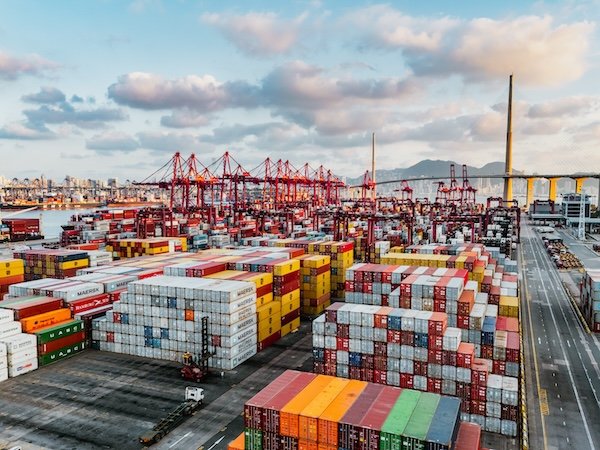

Another record for United States-bound containerized freight imports was set in July, based on data recently issued by S&P Global Market Intelligence.
The firm reported that July imports, at 3.01 million TEU (Twenty-Foot Equivalent Units), headed up 3.7% annually, topping the 2.90 million TEU in July 20214, and cracking the 3 million TEU mark for the first time. Through the first seven months of 2025, total imports came in at 18.35 million TEU, for a 4.5% annual gain. This gain came on the heels of a June decline, coupled importers looking to optimize sourcing following the White House’s reciprocal tariffs related to the International Emergency Economic Powers Act (IEEPA) on most U.S. trading partners, which went into effect on August 7.
“The advent of the IEEPA tariffs resulted in a burst of shipments in July, linked to the relaxation of higher tariff rates during May,” the firm said.
S&P Global Market Intelligence reported the following for July imports:
- capital goods fell 5.3% annually, down from a 10.8% annual June decline;
- materials were up 6.6%, ahead of June’s 3.0% increase, expanding for the 23rd consecutive month, spurred on by a 26.8% increase in shipments of chemicals, a sector that the firm said has dealt with tariff-related issues for years, and electrical equipment showing the fastest rate of decline (S&P said that a drop in inventory build by manufacturers will also have contributed to slower imports of components);
- IT was off 5.0%, after a 0.4% June gain, with computers down 12.4%;
- healthcare rose 2.1%;
- consumer electronics and leisure goods increased 39.2% from June to July (with consumer electronics down 9.9% annually), whereas it was up 16.6% for the month over the past decade (with the firm stating that tariffs are expected to be a drag on total imports over the balance of 2025);
- consumer discretionary imports, excluding autos, were up 1.5%, after an 8.2% decline in June, with the group paced in July by a 9.5% gain in imports of home furnishings, while home appliances were up 7.4% annually, after a 21.2% decline in June; and
- leisure goods, including toys and exercise equipment, was down 5.4% annually
Chris Rogers, Head of Supply Chain Research for S&P Global Market Intelligence, explained in an interview that July’s gains do not come as a major surprise.
“If you think about the stuff that arrived in July, the decisions that were being made to ship that [cargo] were being made just as President Trump and the Chinese government came to this kind of agreement to not keep escalating tariffs,” he said. “What you saw in May and June was a sense of ‘tariffs have gone to the moon and are now going to Mars, but suddenly we are not going to Mars, we are only going to the moon.’ And what we saw with the July data is the hangover of that process combined. For some of the core consumer hard lines, particularly around furnishings, there was a sense of needing to get it done. And for some of the more seasonal stuff, the brakes were still on for textiles and toys and so on, they were still down a little bit—but for everything else there is a feeling of ‘tariffs are here to stay so let’s carry on.’”
Citing the aforementioned 39.2% sequential increase in shipments of consumer electronics and leisure goods, Rogers said that speaks to the degree of turmoil that tariffs have caused, noting that what was meant to be smooth, seasonal planning subsequently saw major spikes in July, which was reflected in the import data.
Looking ahead, S&P Global Market Intelligence said it expects U.S.-bound containerized freight imports to be down 7.1% annually in the third quarter, with fourth quarter imports expected to be down 3.5% annually.
To that end, Rogers said that, in theory, on a seasonal basis, if August and September come in down, they would still be pretty close to July,” he said. “With the way our forecasts are set, July is likely to be the peak for the year, but August and September would be at a similar level. We would definitely expect to see a dip later in the year.”

