
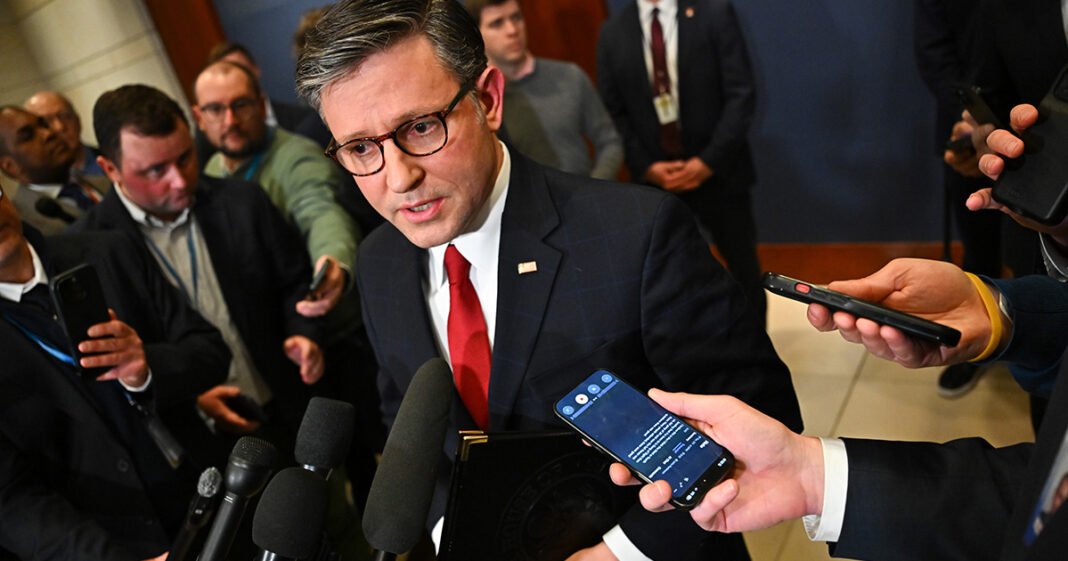

Speaker Mike Johnson said he expects the Strait of Hormuz to reopen within weeks and that gas prices will “come back down.” (Graeme Sloan/Bloomberg)
March 12, 2026 7:00 AM, EDT
Key Takeaways:
- Johnson says gas prices should decline once the conflict in Iran stabilizes.
- Lawmakers in both parties are pressing the administration for clarity on Iran strategy and fuel price relief.
- Senate leaders remain split over Homeland Security funding during a shutdown affecting TSA and other agencies.
House Speaker Mike Johnson sought to calm concerns about rising fuel costs, saying the recent jump in prices will recede as the conflict with Iran stabilizes.
Gas prices have jumped in the aftermath of the U.S. conflict with Iran, squeezing households and drawing political scrutiny in a high‑stakes election year. The rapid rise has intensified calls in Congress for clarity on the Trump administration’s strategy and relief for consumers.
RELATED: U.S. to get new oil refinery
Speaking to reporters during the Republicans’ policy retreat in Florida on March 10, Johnson (R-La.) said “gas prices will readjust” once the intense fighting in Iran subsides. The speaker attributed the higher prices to the closure of the Strait of Hormuz, saying he expects it to reopen within weeks and that gas prices will “come back down.”
Johnson and his fellow House members resume their legislative agenda in Washington the week of March 16. The Senate, led by Majority Leader John Thune (R-S.D.), has remained in session.
Thune continues to express frustration with Democrats for the failing bipartisan talks to fund the Department of Homeland Security. During the department’s shutdown, Thune said lines at airports have grown longer because the Transportation Security Administration is not funded. DHS also funds the Federal Emergency Management Agency and the Coast Guard, among other agencies.
“The American people want us to do our jobs,” the Senate leader said March 11. “Republicans are at the table. … Democrats have walked away.”
Several Republican lawmakers and most congressional Democrats, however, are pushing back on rising gas prices linked to the Iran conflict.
The U.S. will release 172 million barrels of oil from the Strategic Petroleum Reserve to help lower energy costs during the Iran war, Energy Secretary Chris Wright said Wednesday evening. https://t.co/ATXWJCSpfB pic.twitter.com/douOqnWlXb
— CNBC (@CNBC) March 11, 2026
During the post-State of the Union news cycle, Senate Minority Leader Chuck Schumer (D‑N.Y.) has stepped up pressure on the administration to address rising fuel costs. In a March 10 letter to the president, he asked for specific steps to lower gas prices and pressed the White House for details about the U.S. objective in Iran.
“The American people … deserve clear answers about the war,” Schumer wrote, urging public hearings with senior officials. Democratic Sens. Jack Reed and Jeanne Shaheen, the top Democrats on the Armed Services and Foreign Relations committees, joined him on the letter.
Donald Trump’s war has sent gas prices skyrocketing through the roof.
“If they rise, they rise,” is all he has to say. Tough luck, America.
What contempt. What cluelessness. pic.twitter.com/2QIr0ydTPi
— Chuck Schumer (@SenSchumer) March 9, 2026
Trump recently indicated the war would soon reach its end, as the White House has de-emphasized concerns associated with rising gas prices. According to AAA, the prices at the pump, which were $2.89 a gallon last month, have reached $3.57 as of March 11.
Defense Secretary Pete Hegseth recently said U.S. strikes in Iran remain “our most intense” to date, noting improved intelligence and sustained pressure on Iranian targets. He added that Iran has launched fewer missiles in the past day, describing it as the lowest level of fire yet.

