
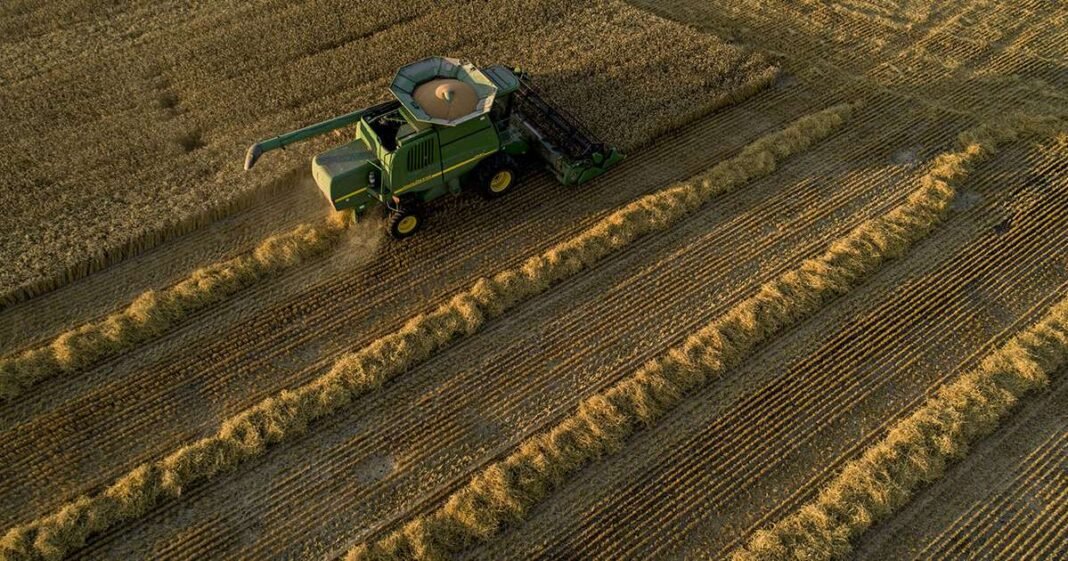

A Deere & Co. combine harvester is used to harvest soft red winter wheat in Kirkland, Ill. (Daniel Acker/Bloomberg)
February 24, 2026 5:30 PM, EST
Israel plans to make further trade concessions to the U.S. on food and agricultural goods, as part of efforts to persuade its closest ally to ease tariffs on exports from the Jewish state.
Prime Minister Benjamin Netanyahu’s government intends to scrap a tax-free quota and raise levies to 50% on wheat-feed imported from countries other than the U.S. starting in April, Israel’s deputy trade commissioner, Yifat Alon Perel, told Bloomberg.
Officials hope that boosting the competitiveness of U.S. wheat against Israel’s traditional suppliers — the largest of them being Russia — will help clinch a deal to ease tariffs on goods shipped to the U.S. These have remained in place even after Netanyahu, who enjoys a close relationship with Trump, said all duties on U.S. products would be removed.
Plans to give the U.S. an edge on wheat imports were undisturbed by the Supreme Court’s decision Feb. 20 to strike down President Donald Trump’s global tariffs, which he swiftly replaced.
The latest round of talks between the two countries took place in Washington in early February and continued “in a very positive trajectory,” said Perel, who heads Israel’s negotiating team.
Israel imports almost all of the wheat it consumes, primarily from the Black Sea basin. Russia accounted for 60% of all wheat imports last year, according to a report by the U.S. Department of Agriculture.
Separately, Israel is planning to spend up to 600 million shekels ($193 million) over the next decade subsidizing freight costs on human-grade, or milling, wheat imported from the U.S., an Israeli official familiar with the government’s thinking said, asking not to be identified discussing ongoing negotiations. Wheat for human consumption is duty free for all exporters.
The U.S. Trade Representative’s office did not respond to requests to comment. Subsidies on U.S. freight costs were first reported by Israeli newspaper Globes.
Incentives on U.S. wheat purchases expand on a free-trade agreement between Israel and the U.S., revised in December to include food and agricultural goods previously left out to protect farmers. A limited group of some 30 items like apples, almonds or cherries will gradually become tax-free over the course of a decade to allow Israeli growers time to prepare.
Israel had a trade surplus, excluding services, of $7.4 billion with the U.S. as of 2024, according to the USTR. Last year, Israel’s goods surplus narrowed to $6.7 billion, according to data released earlier this month in Washington.
Farmers Concerned
The plans have raised concerns in Israel that the end of tariffs on U.S. agricultural goods will negatively impact the local sector. Members of a parliamentary committee are holding up the approval of the revised free-trade agreement with the U.S. and are making it contingent on the government committing to compensate farmers.
“It’s a death sentence for some industries,” Israeli Agriculture and Food Security Minister Avi Dichter said.
Israel’s wheat imports are expected to increase in this marketing year to 2.15 million metric tons, primarily due to demand from farmers who lack grazing land for livestock, according to the USDA report.
Farmers say that imposing high levies on animal-grade wheat from non-U.S. suppliers — even if U.S. imports are excluded under the revised free trade agreement — will further increase already-high food prices in Israel.
“The price of chicken will surge by 50%-70%,” the Business Sector Presidium’s chairman, Dubi Amitai, said at a monetary committee hearing.

