
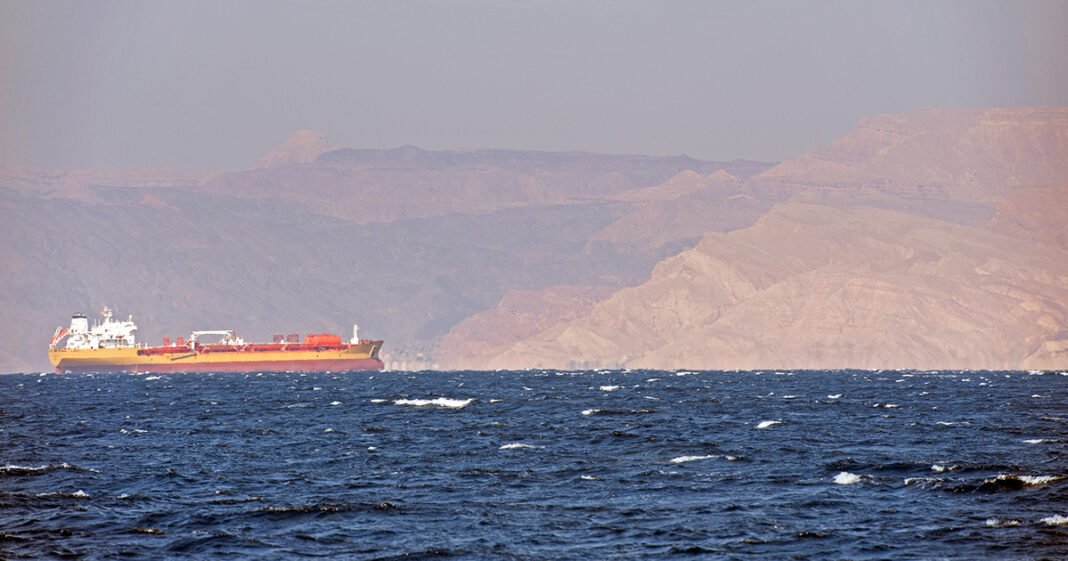

A freighter makes headway toward the Red Sea port of Aqaba, Jordan, in 2023. (pilesasmiles/Getty Images)
March 6, 2026 11:22 AM, EST
The widening conflict in the Middle East is stoking fears over a global energy crunch as exporters scramble for routes out of the region while a swath of refineries reduce output.
More oil tankers are diverting away from the Persian Gulf and toward the Red Sea, where Saudi Arabia is increasing crude loadings at the port of Yanbu. The near-halt of traffic through the Strait of Hormuz is causing storage tanks across the region to top out, while drone and missile attacks have targeted refineries in Saudi Arabia, Kuwait and Bahrain, prompting several to cut capacity.
The escalating war has choked off oil and gas supplies to key customers in Asia and Europe and sent energy prices soaring. The inability to export via Hormuz forced Iraq to start shutting its biggest oil fields earlier this week. Neighboring Kuwait has now cut production, too, according to the Wall Street Journal. Qatar told the Financial Times that a complete halt in energy shipments from the region is in the cards if hostilities persist.
Five supertankers have loaded at Yanbu this month and others have recently diverted toward the area. But while Saudi Arabia can reroute much of its crude, other producers in the region face a shrinking window to resume exports via Hormuz before they run out of storage space.
Commercial vessel traffic through Hormuz, the route to global markets for a fifth of the world’s oil supplies, remains largely suspended. The frequency of attacks on ships in and around the strait remains high, making it too risky for tankers and their multimillion-dollar cargoes to attempt transit.
A prolonged shutdown of the waterway would force oil output cuts by more producers across the region, according to Giovanni Staunovo, a commodity analyst at UBS Group AG.
“If the strait stays closed, all will feel it and will have to reduce production once storage reaches tank-tops,” he said March 6. “Pipelines don’t allow to divert everything.”
Kuwait began reducing production at some oil fields after running out of places to store bottled-up crude, the Wall Street Journal said March 6. Analysts at JPMorgan Chase & Co. had said the country would be one of the Gulf nations most at risk of shut-ins, after Iraq.
Iran fired a barrage of missiles and drones targeting countries across the Persian Gulf overnight, and on March 6 threatened to ramp up attacks and use more advanced missiles. Benchmark Brent crude soared above $90 a barrel for the first time in almost two years, while U.S. oil futures topped $88.
U.S. President Donald Trump has signaled “imminent action” to reduce pressure on prices, and the Treasury Department has eased curbs on India’s ability to buy Russian oil. Yet with no sign of a let-up in hostilities, Goldman Sachs Group Inc. flagged the risk of oil topping $100 a barrel were disruption to extend.
Refinery Cuts
Bahrain’s only refinery, a 90-year-old plant that’s just been upgraded, was hit in an attack the night of March 5, though it continued running.
Patrick Brennan of Cox Fleet talks about the common missteps that fleets make in planning for future maintenance and operational needs. Tune in above or by going to RoadSigns.ttnews.com.
Elsewhere in the region, Saudi Arabia’s largest refinery is shut, Kuwait’s biggest has slashed capacity and Qatar has shuttered refining — along with its massive liquefied natural gas operations.
The effects of energy shutdowns in the Middle East are being felt globally. China’s government has told the country’s top oil refiners to suspend exports of diesel and gasoline as crude deliveries are disrupted.
In the US, gasoline pump prices have advanced to the highest level at any time under Trump — in either his first or second term — potentially posing a challenge for the president and his party at midterm elections later this year.

