
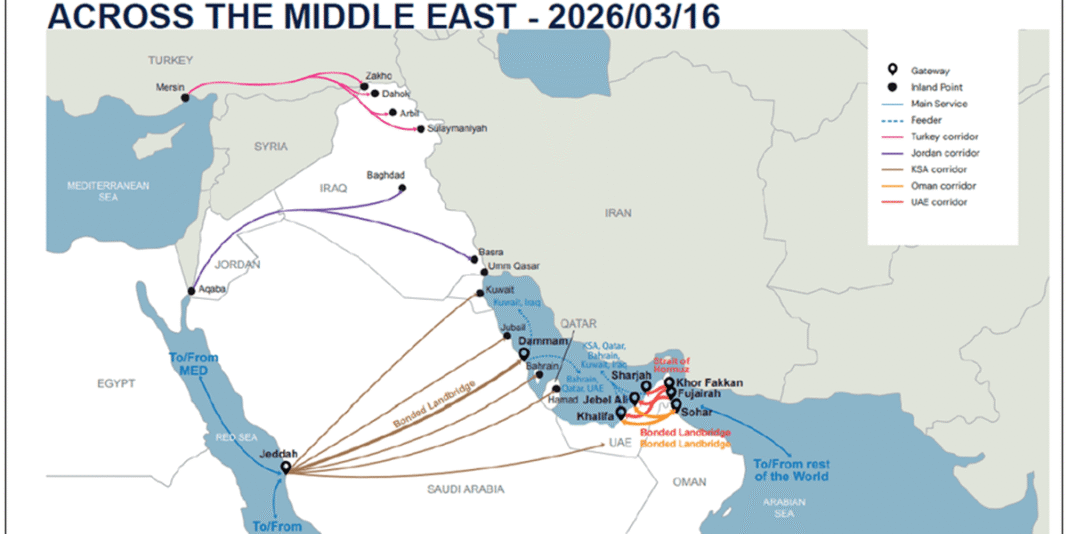

As the Strait of Hormuz remains closed to nearly all maritime traffic as a consequence of the U.S. and Israel’s war on Iran, the ocean carrier CMA CGM Group on Tuesday said it has deployed “alternative multimodal solutions” combining sea, rail, and road transport to maintain the smooth flow of logistics in the region.
Specifically, CMA CGM says its emergency solutions support supply chains in the United Arab Emirates (UAE) and the northern Gulf—including Iraq, Bahrain, Qatar, and Kuwait—without transiting the Strait of Hormuz.
It achieves that goal in three ways:
- Secure logistics corridors via the United Arab Emirates. Multiple alternative transport routes connect the UAE, Saudi Arabia, Oman, Iraq, Qatar, Bahrain, Kuwait, and Jordan via four ports which are all located south of the Strait of Hormuz. Those strategic entry points for Gulf-bound flows are the ports of Khor Fakkan, Fujairah, Sohar, and Jeddah. From those ports, CMA CGM offers logistics corridors to serve the main hubs in the UAE (Khalifa, Jebel Ali, Sharjah), as well as other countries bordering the Arabian Gulf, via a combination of regional road and maritime transport.
- Alternative road corridor via Saudi Arabia. The port of Jeddah on the Red Sea also provides an alternative to passing through the Strait of Hormuz. From Jeddah, CMA CGM has established road corridors, with or without maritime connections, for onward delivery to Saudi Arabia (Dammam), the UAE, Qatar, Bahrain, Kuwait, and Iraq. This setup also allows flows to connect to the Mediterranean and Asia without exposure to the strait.
- Complementary road solution via the Sultanate of Oman. CMA CGM also leverages Omani ports to provide a third major alternative road route. These ports enable road connections to the UAE and northern Gulf countries combining road and feeder services, offering a reliable alternative for regional and cross-border flows.

