
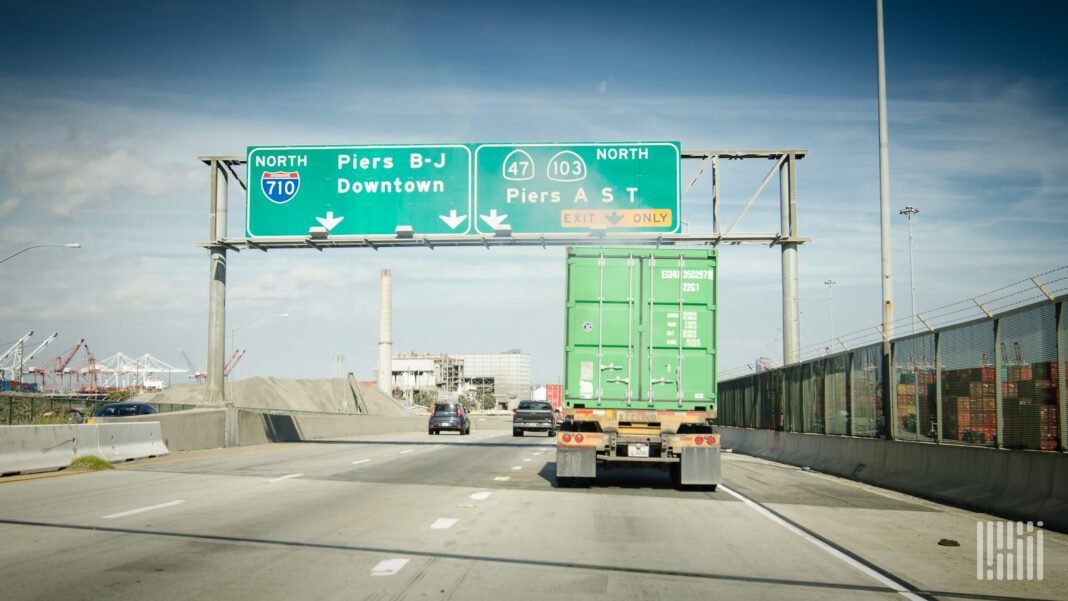

For most Americans, crossing a state line barely registers. For truck drivers, it can change everything.
A carrier hauling freight within a single state might follow one set of safety, insurance, and weight regulations. But the moment that same load crosses a border, an entirely different rulebook applies, one governed by federal agencies and layered with unique state-level requirements. That invisible line represents one of the most consequential distinctions in U.S. trucking: interstate versus intrastate operations.
Join the leaders shaping freight’s future at
F3: Future of Freight Festival, Oct 21-22.
Network with the industry’s best and discover what’s next.
The distinction may seem bureaucratic, but it drives how fleets register, insure, and manage their trucks. And as freight networks evolve throug emissions standards and digital compliance, the gap between state and federal systems is becoming more consequential than ever.
Intrastate carriers operate entirely within one state and are regulated by that state’s department of transportation. They typically need a state DOT number, must meet local insurance minimums, and follow state-specific safety and inspection standards. Their business model often revolves around regional or short-haul freight.
Interstate carriers, on the other hand, fall under Federal Motor Carrier Safety Administration (FMCSA) jurisdiction. They must obtain a USDOT number and operating authority (MC number), maintain federal insurance minimums, and comply with federal mandates such as drug and alcohol testing, hours of service (HOS) tracking, and vehicle inspection standards.
The key distinction is that “interstate commerce” includes any shipment that crosses state lines or is part of a transaction that originated or will terminate in another state. A driver may never physically cross a border yet still be subject to federal rules if the freight’s journey extends beyond their home state.
The Federal Motor Carrier Safety Administration (FMCSA) requires carriers hauling freight across state lines to meet minimum coverage limits for public liability insurance. Coverage minimums will vary depending on the type of freight you move and the vehicle weight.
- Non-hazardous transported in a vehicle weighing less than 10,001 pounds: $300,000
- Non-hazardous transported in a vehicle weighing more than 10,001 pounds: $750,000
- Hazardous material moved by private carriers and for-hire: $5 million
- Oil carried by private carrier and for-hire: $1 million
These are minimums. Many shippers and brokers will require you to have at least $1 million worth of coverage, even for non-hazardous freight.
For those fleets, keeping up with overlapping federal and state rules is a constant challenge. Fuel taxes, weight restrictions, and rest-break requirements vary widely across states. Environmental regulations create further disparity: California’s CARB standards have forced many carriers to reconsider routes or equipment strategies, while states such as Texas and Florida maintain more flexible emissions policies.
According to the American Trucking Associations (ATA), 97% of U.S. trucking companies operate 20 or fewer trucks meaning the vast majority are small carriers with limited compliance resources.
Interstate operations give you access to more freight and better-paying lanes but it also means keeping track of a dozen different deadlines and filings. Missing a deadline could sideline operations.
The good news: digitalization is helping carriers manage the mounting complexity of interstate operations.
Some systems now leverage AI and predictive analytics to identify potential compliance risks before violations occur, helping carriers avoid costly penalties or downtime. That kind of automation has become a lifeline for smaller fleets, allowing them to operate across state lines with the same efficiency as national carriers.
Technology doesn’t eliminate regulatory complexity, but it is reducing its drag on productivity and profitability.
As the U.S. supply chain becomes more interconnected, pressure is mounting to harmonize rules between states and the federal government. FMCSA initiatives to modernize CDL testing standards, unify drug and alcohol testing protocols, and digitize safety reporting reflect that shift.
Still, major gaps remain. Environmental policies such as California’s Advanced Clean Fleets rule highlight growing disparities in emissions mandates. Meanwhile, state labor laws, including those defining independent contractor status, continue to complicate compliance for carriers working in multiple jurisdictions.
The line between intrastate and interstate trucking may be invisible, but its effects are anything but. It dictates how carriers grow, how much they pay in compliance costs, and how efficiently freight moves across America.
As technology, regulation, and market forces continue to converge, the industry’s future may depend on how effectively those borders, both literal and bureaucratic, are managed. The next era of freight efficiency won’t just come from advanced equipment or automation. It will come from a more unified regulatory framework that lets carriers spend less time on paperwork and more time on the road.

