
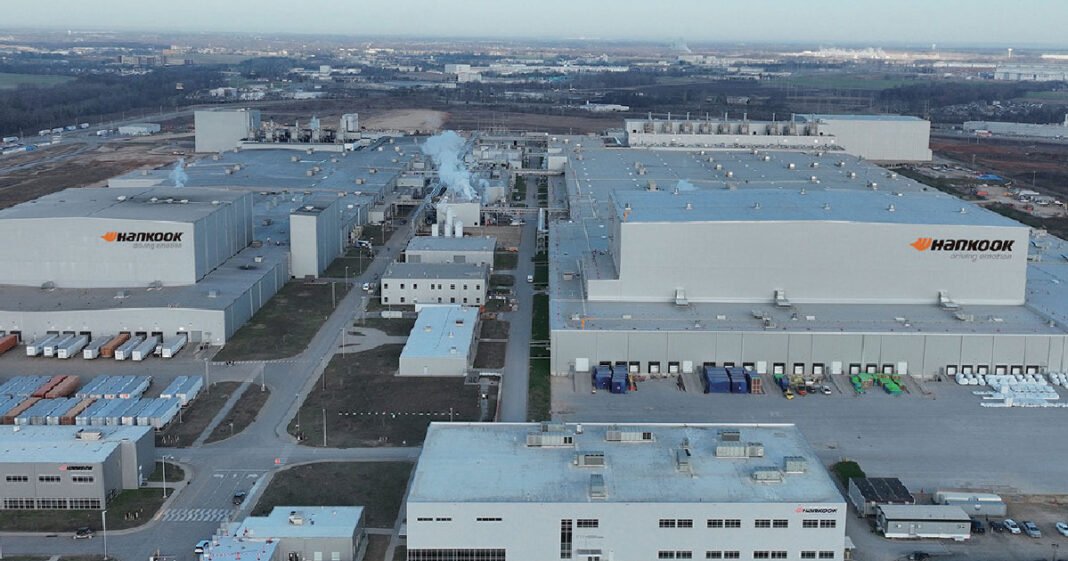

Production will focus on Hankook’s fifth-generation tires, and some fourth-generation products currently sourced from South Korea. (Hankook)
April 3, 2026 4:19 PM, EDT
Key Takeaways:
- Hankook Tire America will begin U.S. truck tire manufacturing in early July at its Clarksville, Tenn., plant, marking the company’s first domestic TBR production.
- It reverses U.S. tire plant closures and supports a $1.6 billion expansion adding 400 jobs and aiming to supply 85%-90% of U.S. demand by 2027.
- Phase 3 construction finishes in late June, production will focus on fifth-generation tires, and Hankook plans to ramp output amid flat demand and tariff uncertainty.
Truck tire manufacturing at Hankook Tire America’s Clarksville, Tenn., plant is set to start in early July, a key executive said, reversing a recent tire production trend.
Construction of Phase 3 of the South Korean company’s expansion of the Clarksville plant, which began in December 2023, is scheduled to be completed in late June, Vice President of Truck and Bus Radial Sales Mark Roe said.
When production of TBR tires at Clarksville gets underway, it will be the first time Hankook will manufacture tires on U.S. soil. Until now, U.S. customers were buying tires produced in South Korea.
“We’ve been talking about producing TBR products [in the U.S.] for many, many years. And with our growth throughout the U.S. and many of our other countries, it just makes sense to invest in the U.S.-made product,” Roe told Transport Topics.
Production will focus on Hankook’s fifth-generation tires, and some fourth-generation products currently sourced from South Korea, the executive said. The fifth-generation products include 11-inch trailer drive, regional steer and over-the-road steer tires.
About 85%-90% of Hankook’s truck tires for sale in the U.S. will be produced at the Clarksville plant by the end of 2027. The TBR expansion will bring 400 additional jobs to the plant, Hankook said when announcing the plans in August 2022.
“While many others have pulled out, we absolutely feel like we need to have the U.S.-produced product,” Roe said. “It just makes sense for us in the long term in our work, and we’ve got very, very high growth and intentional growth plans. And in order for those growth plans to materialize, we have to have a localized product.”
Since the start of 2025, three major U.S. tire plants have been shuttered:
- Yokohama — Salem, Va. — March 2026 — passenger and light truck tires
- Yokohama — Spartanburg, S.C. — February 2025 — agricultural radial tires
- Bridgestone — La Vergne, Tenn. — July 2025 — commercial tires
Hankook is also doubling annual production of passenger car and light-truck tires to 10 million units as part of an overall $1.6 billion investment in Clarksville. By the time the passenger car and light-truck and TBR expansions — known as Phase 2 and Phase 3, respectively — are complete, the Clarksville facility will employ 2,200 staff.
Hankook’s decision to expand Clarksville operations “was well before any tariffs were talked about,” said Roe, adding that the Hankook Tire & Technology division decided investing in U.S. production was the best move for future growth.
The U.S. Tire Manufacturers Association expects truck OEM demand to total 4.7 million tires in 2026, up 8.3% compared with 4.4 million tires in 2025.
USTMA expects replacement truck tire demand to rise 0.2% year over year in 2026 to 24.7 million units.
The replacement truck tire market in the first quarter of 2026 was flat at best, while 2027 is “going to be an interesting year,” Roe said.
Roe said the overall truck tire market is “very flat” at the moment, particularly with uncertainty related to the Iranian conflict persisting. The OEM tire market is down at present for both trucks and trailers, he added.
Uncertainty persists about tire and rubber imports too, particularly after President Donald Trump tweaked steel and aluminum tariffs April 2.
Tariffs on U.S. imports from South Korea currently stand at 25% after an increase from 15% in January.
Hankook said in a statement to TT: “Hankook Tire has been closely monitoring the tariffs and their potential impact on the tire industry. Our teams have regularly assessed updates and the impact on Hankook’s business since the tariffs were first enacted.”

