
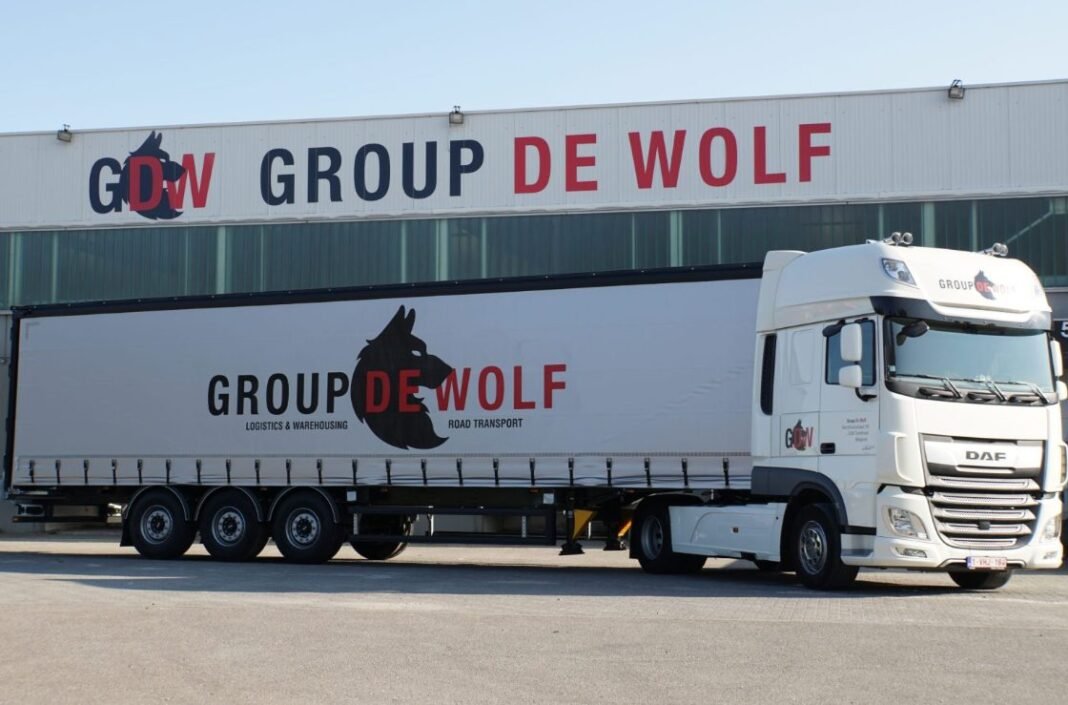

The Court of Commerce of Antwerp has declared the five companies of Group de Wolf from Turnhout bankrupt. It is the biggest bankruptcy of a transport company in Belgium for a long time, since the group employed around a hundred people.
Group De Wolf consists of a holding (Group 5216) and four operational companies: Red Line Service, Transport De Wolf & Berre, Red Line Logistic Service and Transport Bellekens, which Group de Wolf took over in 2021. Originally the activities were strongly focused on the transport of full loads, but the shareholders who had taken over the group (Didier Potters, his brother Pascal, Jef and Fons de Wolf and Luc De Koninck) re -balanced the activities by a shift to the transport of partial loads and express transport, as well as to logistics services with a total surface of a lot of warehouses. In 2023 these activities offered work to around 80 full -time equivalents. According to the figures of the three curators Geert Naulaerts, Kristof Benijts and Philip Somers, about a hundred people are in danger of losing their jobs if a transferee is not found quickly.
The situation of the five companies has probably deteriorated quite recently. Despite a difficult period in 2019/2020 (ie before the introduction of the new shareholder structure in June 2020), the financial basis remained fairly correct. The acquisition of Transport Bellekens, on the other hand, was unable to prevent the situation with this former carrier of the year (1998) to deteriorate: the company lost half a million euros in 2022 and another 135,000 euros in 2023. The balance sheets of 2024 of the five companies in the group are not yet available.
The annual accounts of 2024 of the five companies of the group are not yet available, but it should be noted that the restructuring plans were approved by the Antwerp Commercial Court in April 2025. Four months later this means that Group De Wolf is in a state of bankruptcy or that there were no realistic prospects on recovery, or because the debts were too heavy or because the order portfolio was not sufficiently filled.

