
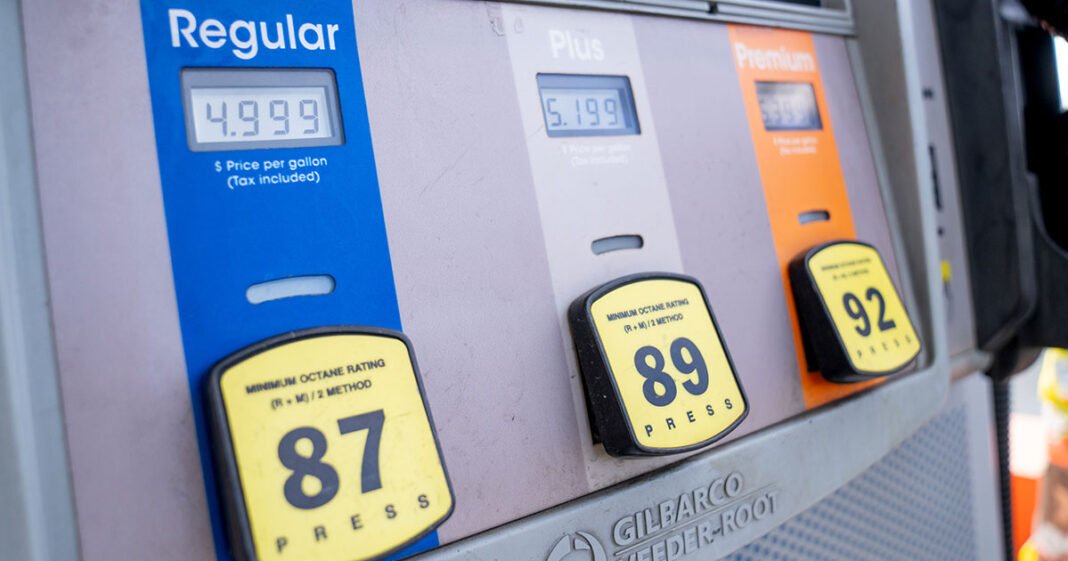

Prices for regular, plus and premium unleaded gasoline at a 76 gas station in Seattle on March 9. (M. Scott Brauer/Bloomberg)
March 10, 2026 4:00 PM, EDT
Key Takeaways:
- Trump’s strikes on Iran have triggered a surge in gasoline prices to an average of $3.54 a gallon.
- Higher fuel costs threaten consumer sentiment and economic stability, with analysts warning they could erase household gains from recent tax refunds.
- The impact depends on how long tanker traffic through the Strait of Hormuz remains disrupted, with experts saying prolonged closure could drive oil to $150 and risk recession.
President Donald Trump’s efforts to stabilize prices at the pump underscore the unique role oil and gasoline play in the economy — and American voters’ perceptions of it.
Trump’s war with Iran has fueled one of the biggest spikes in gasoline prices in recent decades, lifting pump prices to the highest levels he’s seen as president. The surge threatens to ripple through the economy, from factories and farms all the way to the ballot box.
The president seemed to try to appease markets March 9 by signaling a quick end to what he called the “excursion” in Iran, a distinct pivot from recent days in which administration officials indicated the conflict was just beginning.
RELATED: How the Iran War Is Affecting Diesel and Gasoline Prices
He said he’s determined to keep “energy and oil flowing to the world,” promising to lift oil sanctions, dispatch the U.S. Navy to escort tankers through the Strait of Hormuz and hit Iran with “harder” bombing if it disrupted crude flows.
Although Trump has spent months gushing about low gasoline prices, the war has erased the president’s success on the issue. Prices at the pump have climbed from $2.98 a gallon before the U.S. and Israel began strikes on Iran to $3.54, according to the latest figures from AAA. Global oil prices are up more than 20%.
RELATED: Trump Considers Relief Moves as Fuel Costs Climb
That risks compounding persistent voter anxieties about affordability ahead of the November midterm elections that will determine whether Republicans keep control of Congress.
Get the war in Iran over.
Chuck Grassley, Republican senator from Iowa, when asked what can be done to lower diesel prices
Any prolonged spike that pushes up shipping costs, airfares and fertilizer prices threatens not only to stoke anger among voters but also wipe out the boost Trump was counting on from larger tax refunds and business tax breaks in his signature second-term legislation.
In the short term, tax refunds supercharged by the law could help offset higher gasoline costs. However, Bloomberg Economics estimates if oil endures at $83 per barrel for much of this year, that would be enough to erase the average American household’s gains from the tax refunds. Global benchmark Brent crude was fluctuating around $89 on March 10.
‘Small Price to Pay’
Trump and top administration officials have maintained that higher prices are temporary and will ebb once the war subsides, even as they search for short-term fixes to blunt climbing costs and the president vows to waive oil-related sanctions on some countries.
“In the long run, oil supplies will be dramatically more secure,” Trump predicted March 9, as he threatened “harder” attacks on electricity production and other important targets if Iran attempts to stop the global oil supply. Indeed, Trump’s comments seemed to at least partially soothe markets, with oil futures whipsawing below $90 a barrel March 9 after surging above $119 over the weekend.
The president also has downplayed the problem, saying that overall, prices have climbed less than he expected. And he’s appealed to Americans for patience, saying in a March 8 social media post that the short-term increase is “a very small price to pay” for safety and peace.
Still, it’s a dangerous gamble. The cost of gasoline plays an outsize role in consumer sentiment and inflation expectations because it’s a common and very visible expense, with prices posted at every filling station and many motorists filling up weekly.
Some Republicans are sounding the alarm. Sen. Rand Paul of Kentucky told Fox Business on March 10 that “high oil prices will be a problem” for fellow Republicans in the midterms, and if they remain elevated due to the war, then “I think you’re going to see a disastrous election.”
Even though most households devote a relatively small share of their budgets — less than 3% — directly to gasoline and other energy, those expenditures are difficult to curtail when prices rise, Wells Fargo & Co. economists said in a note.
Patrick Brennan of Cox Fleet talks about the common missteps that fleets make in planning for future maintenance and operational needs. Tune in above or by going to RoadSigns.ttnews.com.
The price jumps resonate even more among older Americans who experienced the 1970s energy crisis, said Lance Bachmeier, a Kansas State University economics professor. The impacts could also be disproportionately felt by low- and middle-income consumers, who spend a larger share of their income on gas, he added.
“This is kind of a big shock to the system,” Bachmeier said. “Everybody sees it; everybody’s paying attention.”
White House Press Secretary Karoline Leavitt said Trump’s team is taking steps to ensure oil continues to flow through the Persian Gulf.
“Rest assured to the American people, the recent increase in oil and gas prices is temporary, and this operation will result in lower gas prices in the long term,” Leavitt told reporters March 10 at the White House, predicting they could drop “rapidly” and “potentially even lower than they were prior to the start of the operation.”
Long Memory
Experience shows Americans can have a long memory for short-term pain at the pump. Former President Joe Biden experienced that firsthand in 2022 when prices surged after Russia’s invasion of Ukraine.
Even after Biden responded by deploying the largest drawdown of the U.S. emergency crude stockpile and prices dropped, “he didn’t get very much credit for it,” said Kevin Book, managing director at Washington-based ClearView Energy Partners.
Higher energy prices hit many sectors of the economy, including manufacturing and agriculture, where it’s often a major input. Enduring crude disruptions could translate to more expensive fertilizer at the start of planting season and push up grocery prices, which spiked after the pandemic and have continued rising.
Sen. Chuck Grassley (R-Iowa) noted farmers are already being hit by higher diesel prices. Asked how to mitigate it, he said, bluntly: “Get the war in Iran over.”
Analysts say that while there might be more tolerance for surging oil and fuel costs when they’re seen outside a president’s control, Trump may get less forbearance since these increases are tied to his decision to launch strikes alongside Israel.
“The average American doesn’t go to the grocery store, look at the bill and how high it is, and say, ‘Oh, well, at least we’re bombing Tehran.’ It just doesn’t work that way,” said Jon Hoffman, a research fellow at the libertarian Cato Institute.
Carola Binder, an associate professor of economics at the University of Texas at Austin, said she expects the run-up to have a significant effect on views about the economy because consumers know the war drove the increase.
“Sometimes gas prices rise, and we don’t really know what the drivers are, but this time we know what it is,” Binder said.
Duration Matters
To be sure, much of the impact will depend on the severity and duration of the oil price spike, which is tied to the near-halt of tanker traffic through the Strait of Hormuz, a conduit for roughly a fifth of the world’s crude flows. Both the economic and political consequences are governed by when the strait opens, said Bob McNally, president of consultant Rapidan Energy Group.
In a worst-case scenario, there’s “a prolonged closure and oil prices go to $150 and cause a recession,” McNally said. “Then, even if we win, that may be hard for the president to recover from politically.”
However, a short-term disruption is unlikely to cause a big shift in political attitudes, especially among Trump voters who back his move against Iran, said James Lucier, managing director at research group Capital Alpha Partners.
“He’s got a certain amount of vulnerability here, but I don’t think that the public is going to turn on Trump in a matter of days,” Lucier said. “It’s going to take longer than two weeks to peel off Trump supporters.”

