
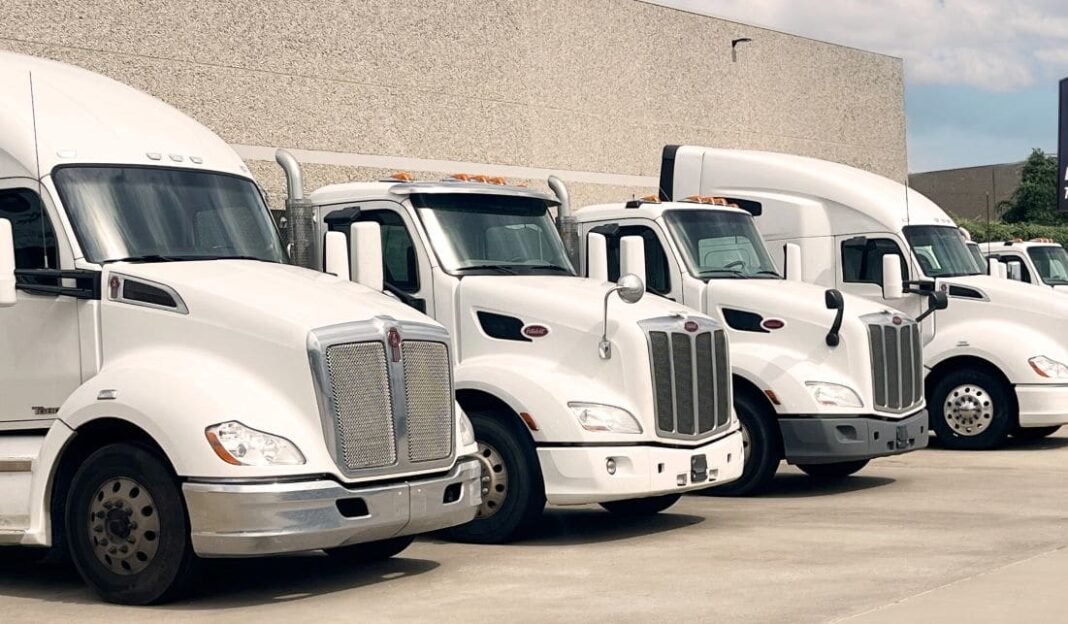

North American Class 8 truck orders surged in February, reaching their highest monthly level since late 2022. The sales spike is reinforcing signs that the heavy-duty truck market may be entering the early stages of a cyclical recovery.
That is according to preliminary net orders gathered by FTR.
According to the analytic firm, new Class 8 sales totaled 47,200 units, according to data released March 3. That figure represents a 47% increase from January and a 159% jump year over year, far exceeding the 10-year February average of 24,991 units.
The strong result marks the third consecutive month of at least 20% year-over-year growth and reflects strengthening freight conditions as fleets begin to move forward with equipment purchases.
On-Highway Demand Drives Surge
The on-highway market accounted for the bulk of February’s increase, although vocational segments also contributed meaningfully to the gains both month over month and year over year.
Over the past 12 months, Class 8 orders have totaled 258,466 units, according to FTR.
February’s performance continues a recent trend of strengthening order activity that began late in 2025 as freight volumes and equipment utilization improved.
Order Cycle Showing Improvement
For the current order season — spanning September 2025 through February 2026 — Class 8 orders are now up 4% year over year. That represents a significant turnaround from earlier in the cycle when orders were tracking double-digit declines compared with the previous year.
FTR said the narrowing deficit and stronger freight conditions suggest the market is stabilizing and may be transitioning into the early phase of a cyclical recovery.
Freight Conditions Boosting Fleet Confidence
Dan Moyer, senior analyst of commercial vehicles at FTR, said recent order activity reflects improving freight fundamentals as well as greater clarity around regulatory and pricing issues.
For the current order season — spanning September 2025 through February 2026 — Class 8 orders are now up 4% year over year.
“February’s very solid year-over-year increase in net orders extended the firmer tone that has been building since late last year,” Moyer said. “Freight volumes and utilization are trending higher, and FTR’s rate forecasts have strengthened.”
Trucking Conditions Start to Show Signs of Life
He noted that some orders still reflect deferred replacement purchases returning to the market, but the consistency and breadth of recent demand suggest that improving freight conditions are now playing a larger role.
Moyer added that greater clarity around tariff-adjusted pricing and upcoming EPA 2027 NOx regulations is also helping reduce policy uncertainty, allowing fleets to move ahead with capital spending plans.
As a result, order patterns increasingly reflect structured fleet replacement cycles and longer-term planning, rather than short-term catch-up buying.
Risks Remain
Despite the strong order performance, FTR cautioned that several risks could still affect the pace of recovery.
These include the durability of the freight rebound, persistently high financing costs, potential changes in tariffs or regulations and geopolitical uncertainty — including the new conflict in the Middle East.
Still, the continued strength in recent orders suggests that underlying demand is firming as 2026 progresses.

