
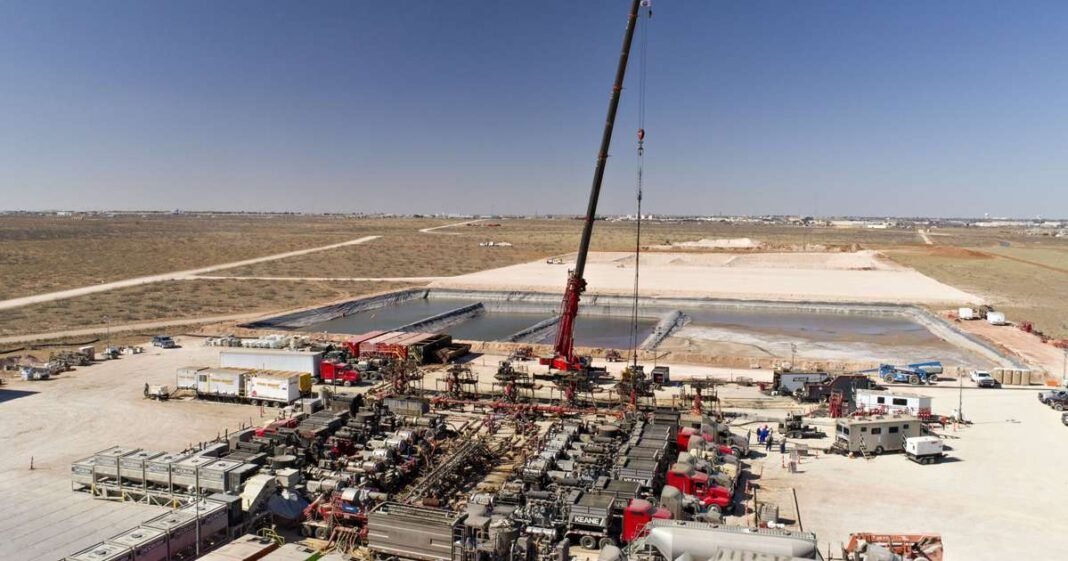

A fracking spread in Midland, Texas. If equipment becomes harder to secure domestically, projects could stall, Johnson said. (Daniel Acker/Bloomberg)
February 25, 2026 10:00 AM, EST
Key Takeaways:
- U.S. fracking companies have begun exporting large amounts of idle equipment to countries such as Argentina and Australia as domestic shale growth slows.
- Analysts say the shift could tighten U.S. equipment supply and raise costs for producers if drilling rebounds, with up to a quarter of idle capacity expected to move overseas.
- Companies see Argentina and other emerging markets as key opportunities, though experts say it remains uncertain whether international shale plays can match U.S. success.
U.S. fracking companies are increasingly sending their idle equipment overseas, finding new markets abroad as growth slows in the shale fields of Texas, New Mexico and elsewhere.
Over the past two years, hundreds of pumps the size of 18-wheelers have been sent to Argentina by providers including Halliburton Co., Calfrac Well Services Ltd. and Tenaris SA, and to Australia by Liberty Energy Inc. and Halliburton, according to estimates from analytics firm Primary Vision. The shipments also include sand towers, water tanks, industrial blenders and miles of hoses used to inject fluid and sand into rock layers more than a mile underground.
Halliburton ranks No. 8 on the Transport Topics Top 100 list of the largest private carriers in North America. Calfrac ranks No. 85.
All this equipment amounts to nearly one-fifth of the fracking power deployed in the Permian Basin as recently as last year, and more could follow. Halliburton, the world’s largest fracking service provider, has said it sees incentives to move equipment abroad as its international business expands. Patterson-UTI Energy Inc. also sees an opening in Argentina for its diesel equipment as it transitions its U.S. fleet to run on natural gas, CEO Andy Hendricks said.
“The opportunity in Argentina is one of the most promising that we see to put our idle assets to work globally,” Hendricks said on a call discussing fourth-quarter results earlier this month.
Patterson-UTI ranks No. 18 on the private TT100.
Sending underused diesel-powered fleets abroad could help oil-field service companies recover after years of squeezed profits and pressure from customers to lower costs. There is a downside, however, for the oil and gas producers that hire Halliburton and the others to frack their wells: less equipment in the U.S. is apt to drive up costs when and if companies start ramping up production again.
Private operators may feel the squeeze first. These companies tend to ramp up drilling and fracking when oil and gas prices rise. If equipment becomes harder to secure, projects could stall, said Primary Vision CEO Matt Johnson.
“It could take an independent guy and push him into a non-operational scenario, and then potentially put himself into an acquisition because he doesn’t have the availability or means to hire that pressure pumper or the equipment isn’t available, or they don’t want to get in a contract,” Johnson said.
(Bloomberg)
The heavy-duty frack pumps have been a ubiquitous symbol of the shale patch for decades — a necessary piece of equipment used to pump water, sand and chemicals underground to blast open tight, oil-bearing rock so the crude can flow.
Of about 18 million horsepower of U.S. fracking capacity, about 8 million represents idle inventory held in reserve and available for reactivation should market demand shift, Johnson said. As much as a quarter of that inventory will be exported over the next year or two, he added.
Countries including Saudi Arabia and the United Arab Emirates may deploy more sophisticated fracking machinery for the first time to boost natural gas production, with diesel-fueled equipment in high demand, according to Barclays Capital Inc. analyst Dave Anderson.
“We’ve been drilling shale for 20 years and know it inside and out, but we’ve never really seen this take off anywhere else,” Anderson said in an interview. “What’s really happening right now is international unconventional resources, which we’ve never seen before.”
RELATED: US Embraces Gas Guzzlers While World Goes Electric
To be sure, outside of Argentina, it’s uncertain shale work will be needed as much in other countries, Bobby Tudor, a Houston-based banker who helped finance the U.S. shale revolution, said in an interview Feb. 24.
“That’s not what you need in the Eastern Mediterranean, it’s not what you need in Vietnam, or Malaysia or West Africa, that’s more of an offshore business,” Tudor said. “I think the U.S. onshore shale business will continue to be the swing supplier for the foreseeable future.”
The success of the U.S. shale revolution of the early 2000s — when hydraulic fracturing and horizontal drilling unlocked hard-to-reach energy reserves — prompted some companies to prioritize domestic resources over international exploration, said Josh Dixon, a Wood Mackenzie analyst.
Now, a growing number of countries are evaluating those unconventional methods, and a wider mix of players — including independent operators and national oil companies — is defining a new era of global exploration, Dixon said.
“There isn’t anything obvious out there which is going to distract people from the second phase of unconventional exploration right now,” Dixon said. “The biggest question is going to remain on whether these plays can be proven to be successful.”

