
Most forklift fleets rely on their equipment dealers’ technicians to maintain and repair their lift trucks. Many large fleets, though, hire their own technicians to handle some of those responsibilities while leaving others to their dealers.
So suppose you have your own technicians on staff. It’s the middle of the second shift, and one of your forklifts is acting sluggish. Do you try to diagnose and fix it yourself, or should you send the operator home, tag the truck out of service, and call your equipment dealer in the morning? The answer may not always be clear. We asked forklift service experts for guidance on when in-house technicians can tackle maintenance and repairs, and when bringing in a dealer’s technicians is the right thing to do.
WHAT DO FORKLIFT TECHNICIANS DO?
Before we talk about who should handle what, it’s helpful to know more about dealers’ technicians. These essential service providers undergo extensive formal training at their workplace and sometimes at the manufacturer’s factory. (Wondering how they learned so much? See the sidebar “How technicians know what they know.”)
Trained techs handle planned maintenance, diagnostics, and, of course, repairs. These days, they use tablets, mobile phones, and laptops to access repair manuals and perform diagnostics and troubleshooting, according to Rob Jackson, service manager with Abel Womack, an authorized Raymond solutions and support center with locations in New England and New York. (For a look at how technology has affected forklift technicians’ jobs, read Jackson’s blog post, “How has field service changed? The not-so-standard day of a technician,” at www.abelwomack.com.)
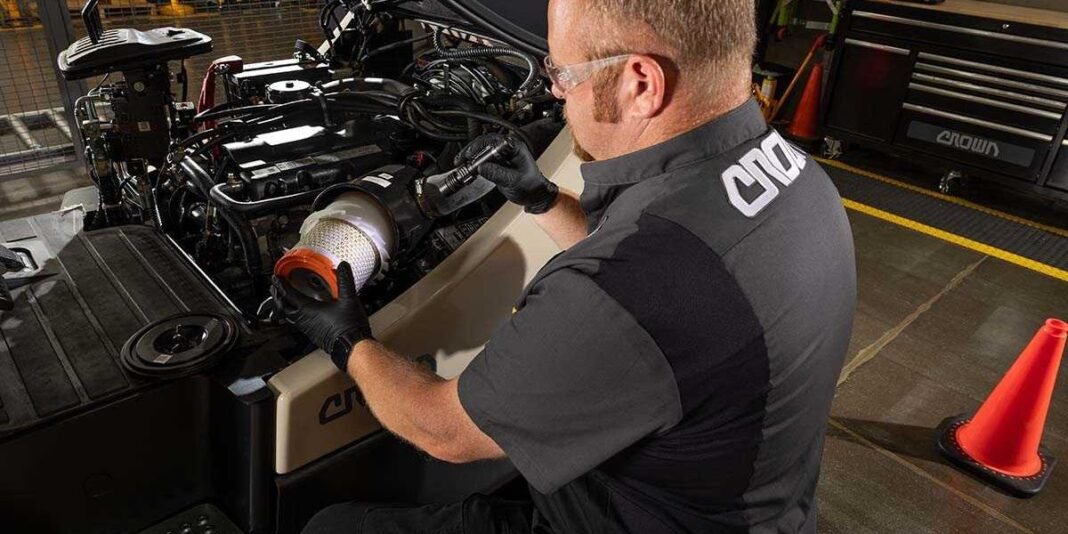
Planned maintenance is a big part of their work. The technicians who service your lift trucks test all functions, including forward and backward travel, lifting, lowering, braking, acceleration, and deceleration. They change filters and top off, clean, or change fluids; lubricate mechanical components like axles, bearings, and masts; tighten belts and chains; check the cooling system; and make sure radiators, motors, wheels, and any intake and exhaust openings are free of debris. They inspect hoses, cables, connectors, tires, batteries, lights, hour meters, wheels and casters, forks, masts, chains, and brakes for damage, leaking, or signs of wear. As with scheduled maintenance on a car, some items are checked every time and others get a look at longer intervals. Some of this work is specific to the truck class or model. On average, a planned maintenance session lasts from an hour to an hour and a half, but that can vary depending on the type of truck and the application, according to Brandon Simon, managing director, customer support department at Crown Equipment Corp. A turret truck, for instance, may take three or four hours.
WHO SHOULD DO WHAT
Fleets that hire their own technicians usually do so because they operate dozens of trucks (100-plus under one roof is not unusual in large DCs), so the volume of maintenance and repair work is substantial. For multishift, high-throughput operations, having access to a technician at all hours may be a necessity.
The experts we spoke with agreed that training is a crucial determinant of what in-house technicians can handle. Before making any decision, Simon advises fleet managers to verify that the technicians have been trained on the specific task at hand. If they are not and they make the repair incorrectly, they could create a safety risk for both technician and operator and, potentially, liability for the fleet owner.
Liability is a consideration for dealers and OEMs too, and some decline to train customers’ technicians for that reason. Most, though, offer training because they want to ensure their products are maintained and repaired correctly.
“If a customer is interested in us training their in-house technicians, we can tailor a program to their specific needs,” says Robert Clayton, training manager at Kion North America, which provides Linde forklifts. “We’re flexible, but we want to make sure whoever is trained is getting the right information, so we work hand in hand with our dealerships to make sure the information they deliver is correct for that particular customer.”
Such training falls into two categories: basic and equipment-specific. Crown Equipment, for example, provides a weeklong course that not only teaches the fundamentals of maintenance and repair but also emphasizes how to safely manage this heavy machinery and avoid potential hazards. Jackson’s company offers basic maintenance and repair classes, either at his company’s facilities or at the customer’s site. In early 2026, the Raymond Corp., which Abel Womack represents, will introduce an updated series of on-demand online learning materials for in-house technicians, including some 24 videos and additional training resources. These training materials are designed to be used as preparation for hands-on instruction.
Equipment-specific training that considers the customer’s particular applications is a must, several experts said. That’s a priority for Big Joe Forklifts, says Ron Winkler, vice president, aftermarket. “If a large customer wants to take care of their own equipment, we provide training that is specific to that customer’s particular application and each model and type of equipment they buy from us.” Service experts also recommend additional training whenever a fleet receives a new type of truck or a familiar model has been upgraded.
Safety considerations should always be front of mind. It’s important to be cognizant of how heavy lift trucks are, and what may be at stake if technicians attempt a repair they’re not qualified to make, Winkler cautions. “Any kind of repair on any class of lift truck—whether it’s on a man-up application or simply bleeding brakes, for example—has the potential to put the operator and the people around them in harm’s way. We always encourage end-users to get someone who really understands the equipment on site to repair it.”
In-house staff should step back when a repair requires heavy parts to be removed, advises Jerry Burns, manager of technical training development and delivery at forklift manufacturer Hyster. Examples include taking apart a mast and changing a drive motor or an engine. Special equipment is required to safely remove a counterweight, which weighs as much or more than the maximum load weight the model is certified to lift (5,000 to 6,000 pounds for a 5,000-pound truck, for example). In such cases, Burns says, the right call is to send the forklift to the dealer’s facility, where it can be safely disassembled and reassembled.
A manufacturer-trained technician should also handle repairs involving parts that are under warranty, Abel Womack’s Jackson says. Warranty lengths vary, but in general, he notes, components tend to have one-year warranties, while electronics are three years, and some items like pallet jack frames are five years. Wearable parts like wheels typically are under warranty for 120 days after the truck leaves the factory.
As lift trucks have become more technologically sophisticated, the number of maintenance and repair tasks an in-house tech can safely do has diminished. Most often, in-house technicians are capable of doing standard preventive maintenance tasks, like oil filter changes, hydraulic fluid changes, watering batteries, making basic brake and belt adjustments, cleaning of coolant, and replacing tires, Clayton says. But, he cautions, “if you’re getting fault codes that are outside of routine adjustments … or it’s something involving software configurations, like setting up speed parameters or software updates to the controller,” it should be handled by a dealer. Burns concurs. “If it involves the controller or some other major electronic component, or it affects programming, bring in the dealer,” he says. “Those are proprietary to the lift truck manufacturer and cannot be altered. Only a dealer’s factory-trained technician can service that.”
Joe Karasek, corporate director of parts, service, and aftermarket at Eastern Lift Truck, a Yale Lift Truck Technologies dealer with locations throughout the Mid-Atlantic states, offers an example: An electric truck won’t move because something is wrong with the signal input to the traction-motor controller. “A factory-trained technician will plug in and use proprietary software to diagnose the controller problem and knows how to replace it,” he says. An in-house technician, he adds, won’t have access to the software-configuration data files or the necessary replacement hardware. There are exceptions, though. Clayton says his company’s customers have the option of purchasing Linde’s diagnostic software so they can determine what’s wrong and decide whether to handle it themselves or turn it over to the dealer.
Winkler points to another reason to leave more complex repairs to OEM-certified technicians. In today’s forklifts, many components have to “work in concert,” so making a change to one thing improperly can have unintended consequences elsewhere on the truck. If something is incorrectly installed, wired, or programmed, he observes, it may not be able to communicate with other components it interfaces with, and the truck may shut down.
MAKE THE CALL
As we’ve seen, decisions about who should handle which maintenance and repair tasks depend on several factors. Of those, the most important are the specific training your employees have received and the imperative that safety not be compromised. If, after assessing those and other considerations, you’re still uncertain, the best decision is to not take chances. Instead, call the “forklift doctor” (a.k.a., your dealer) for expert guidance.
How technicians know what they know
We asked six lift truck service experts how they make sure their technicians have the right knowledge and experience. Here’s some of what they had to say (comments have been edited and condensed for length).
Joe Karasek, corporate director of parts, service, and aftermarket, Eastern Lift Truck, a Yale Lift Truck Technologies dealer: We have full-time trainers and field service managers. The FSMs manage our apprentice program, working with the trainers who provide classroom and hands-on training to make sure trainees demonstrate that they are qualified to graduate to the next level of certification. The FSMs also mentor and work with technicians in the field. When technicians are ready for independent work, we send them for factory training. Our technicians spend many additional hours in training every year, including special classes for specific products or components.
Robert Clayton, training manager, Kion North America, provider of Linde forklifts: We have three certification tracks. The first is baseline internal combustion (IC) and electrical maintenance and troubleshooting. The second is equipment-specific courses with classroom time, troubleshooting scenarios, and hands-on work. The third includes two advanced courses, one for electrics and warehouse units and one for IC trucks. In those courses, trainees spend 70% of their time working on the units; we give them various scenarios to verify their understanding and retention of what they’ve been taught. Additional field training typically is handled by the dealer.
Ron Winkler, vice president, aftermarket, Big Joe Forklifts: Our approach is a three-tiered bronze, silver, and gold certification. Our dealers may sell only some of our models, so we tailor that training to the specific models they are selling. All our products use lithium-ion batteries, so in addition to basics like diagnosing and repairing motors, hydraulics, and pumps, we demystify lithium and how to safely work with that power source. On the technology side, our unique Big Joe Pulse telematics system lets the dealer dial into an individual truck to see things like fault codes and the reasons for them. This helps guide the technician to a first-time resolution.
Brandon Simon, managing director, customer support department, Crown Equipment Corp.: When we hire a new technician, they go through six weeks of training, regardless of their [previous] training or background. We can’t assume that another company has trained them the right way, plus they have to be trained for our specific products. They also receive 40 additional hours of annual training. The technicians know what they need or want to learn, so they have some say in what is included in their annual training.
Rob Jackson, service manager, Abel Womack, an authorized Raymond solutions and support center: For the first 90 days, new hires ride along with an experienced technician, so they get to know our customers, the routines, how to do paperwork on the computer, and what our and our customers’ expectations are. When we know we will hire them as a permanent employee, they get a two-week introduction to basic maintenance and simple repairs. After another six months, we teach them diagnostic methods for troubleshooting and repairs and theory of operation. When they’re “fully fledged,” they can fix 90% to 95% of what they encounter.
Jerry Burns, manager of technical training development and delivery, Hyster: Our training program includes both online and instructor-led instruction. New technicians start with basic preventive maintenance. They usually partner with a senior technician, who introduces them to customer applications and different types of equipment, then supervises them as they do hands-on work. After that, they receive detailed training on seven subsystems, each with its own instruction and exam. For example, they have to understand hydraulics, how to read a schematic, and how electrical current flows in our systems. They learn about specific products and go out on service calls to get field experience, and they have to pass a field exam. Altogether training can take 12 to 18 months.

