
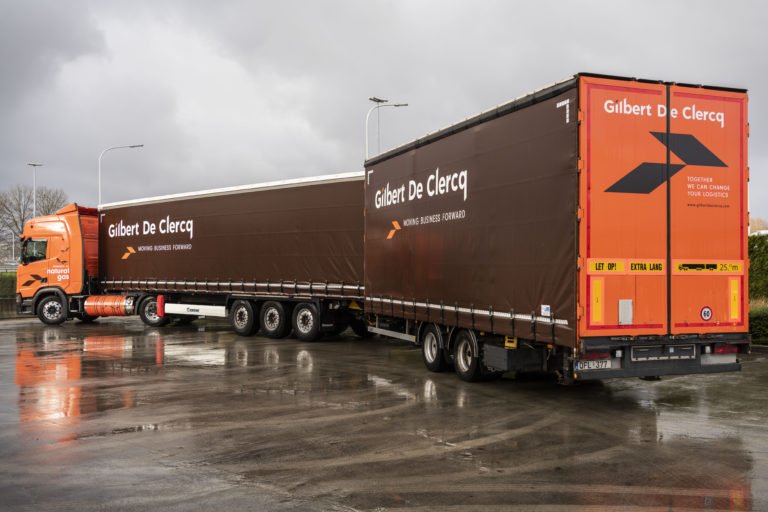

The final admission of LHVs (longer and heavier freight vehicles) or eco-combis on Flemish highways is getting closer. The Flemish Government approved a preliminary draft decree for this purpose last Friday. Transport federation TLV responds satisfactorily.
Since 2015, Flanders has been investigating the impact of LHVs on traffic. Transport companies can currently propose routes twice a year and apply for a permit to drive LHVs. Flemish Minister of Mobility Annick De Ridder wants to structurally anchor LHVs – also known as eco-combis – on Flemish roads. Compared to the Netherlands and Germany, Belgium is currently lagging behind.
At the proposal of Minister De Ridder, the Flemish Government gave its approval in principle to the preliminary draft decree on special road transport on Friday 27 February. The new framework replaces the decree of May 3, 2013 and finally creates a clear decree basis for LHV combinations. According to Transport and Logistics Flanders (TLV), definitive anchoring is necessary after two pilot projects, together with a workable and realistic regulatory framework.
Alleviate driver shortage
The preliminary draft is now submitted for advice to the Council of State, the Mobility Council (Mora) and the Flemish Supervisory Commission (VTC). The Flemish Parliament must then also give its opinion. “There is still a lot of legislative work ahead of us, but we hope that in the meantime work will also be done on the implementation decisions,” says Johan Staes, CEO of TLV. “Potential LHV routes with clear ecological and mobility benefits should no longer remain unused. With this preliminary design, Flanders is taking an important step towards smarter and greener freight transport. LHVs immediately deliver climate and efficiency gains and can relieve the pressure on the driver shortage. We now ask that we quickly work on a practical and realistic framework that allows more LHV routes to be opened on our roads.”

