
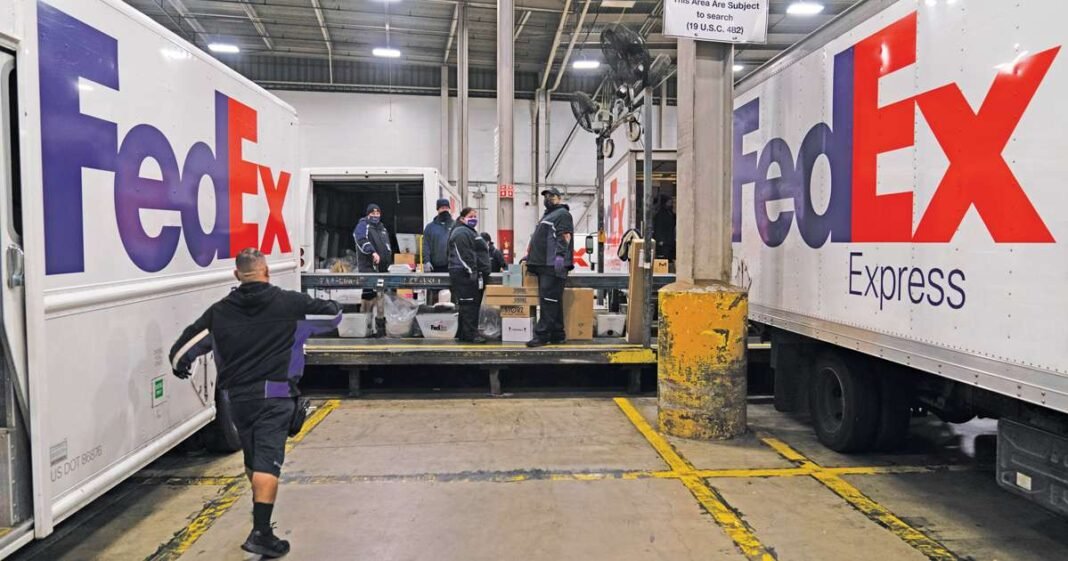

“Our vision is simple — to make supply chains smarter for everyone,” Subramaniam said during the presentation. (Jae C. Hong/Associated Press)
February 20, 2026 12:25 PM, EST
Key Takeaways:
- FedEx outlined four strategic priorities centered on growth, digital scaling, efficiency and network upgrades.
- The company expects its freight spinoff to create long‑term value and sharpen business focus.
- FedEx introduced 2029 financial targets citing measured revenue growth and improved operating income.
FedEx Corp. outlined its four strategic priorities for the year during its 2026 Investor Day.
The Memphis, Tenn.-based transportation services company cited growth in high-margin verticals, scaling digital capabilities, improving efficiency and upgrading its network as key pillars of its ongoing transformation plan.
“Our vision is simple — to make supply chains smarter for everyone,” FedEx CEO Raj Subramaniam said during the presentation. “You will hear how every part of FedEx is sharpening its focus and strengthening the value of this industrial network, through a better customer experience, a modern technology stack and a structurally lower cost to serve.”
Subramaniam views the company as entering a new era with efforts to build a more flexible, efficient and intelligent network. He believes technological advancements around digital intelligence have set the current moment apart, with their ability to act as a value multiplier.
“FedEx operates one of the world’s most valuable industrial networks, the backbone of global supply chains,” Subramaniam said. “We move high-value, time-sensitive and highly regulated goods that power essential industries like healthcare, automotive, aerospace, technology and manufacturing.”
Subramaniam continued, “These are markets that reward the capabilities of an industrial network built for time-critical high-value shipments, and they create meaningful opportunity.”
FedEx transports about $2 trillion of goods annually while delivering more than 17 million packages each business day. These efforts are supported by a global team of more than 500,000 employees. The company also has thousands of facilities, an air fleet, hundreds of thousands of vehicles and regulatory and customs expertise that support global commerce.
“Our advantage starts with something our customers cannot compromise on, and that is reliability,” Subramaniam said. “It’s also what allows us to take on the most complex time-critical shipments in the world, day after day.”
FedEx in December 2024 announced its intent to spin off its freight unit into a separate company. It recently filed a Form 10 registration statement that sets the expected spinoff for June 1. Company leadership hopes the split will create significant value for both companies.
“As a result of that spinoff, FedEx Corp. will have two primary businesses, U.S. domestic and international,” Subramaniam said. “Today, you will hear us speak to each of these businesses as they are — industry leaders within their respective markets. Both our U.S. and international markets are expanding, which provides a solid foundation for growth.”
Subramaniam noted that portfolio diversification has provided resilience across economic cycles and shifting trade flows, as the company’s revenue breakdown currently is about 70% domestic and 30% international. He views the breadth and balance of the portfolio as creating a powerful and differentiated network that supports a customer-centric approach, infrastructure and technology.
“Historically, we have delivered strong growth with our core business, growing revenue at a 6% CAGR [compound annual growth rate] since the turn of the century,” Subramaniam said. “We did this as we gained share through business cycles, navigated economic turbulence and scaled our business to establish ourselves as the leading industrial network in the world today.”
FedEx also unveiled a financial framework that sets operational targets for 2029. Revenue targets are about $98 billion, with a roughly 4% CAGR. Operating income is aimed at about $8 billion at around a 17% CAGR. Adjusted free cash flow has a goal of about $6 billion, with return on invested capital expected to be up about 200 basis points.
“Our strategic priorities through 2029 are the bridge from architecture to action,” Subramaniam said. “The four strategic priorities are how we activate that transformation, turning the elements of our transformation into an execution plan with clear accountability and measurable progress.”
Bank of America Global Research described the investor event as setting the tone for measured and profitable growth, cost improvement and significant cash yields. The investment banking company highlighted revenue, adjusted operating income, free cash flow and other operational targets. It also expects segment gains driven by the reengineered network, as well as a refocus on business-to-business, cross-border e-commerce and intercontinental express air freight.
BofA Global Research reaffirmed its buy rating on FedEx and raised its price objective to $431 from $414. The firm cited expectations for mid‑teens operating income growth through 2029 — excluding the Freight business — alongside continued progress integrating FedEx’s network, improving yields, gaining profitable market share and completing the Freight spinoff.
FedEx ranks No. 2 on the Transport Topics Top 100 list of the largest for-hire carriers in North America, No. 3 on the TT Top 50 list of the largest global freight carriers and No. 43 on the TT Top 100 list of the largest logistics companies in North America.

