
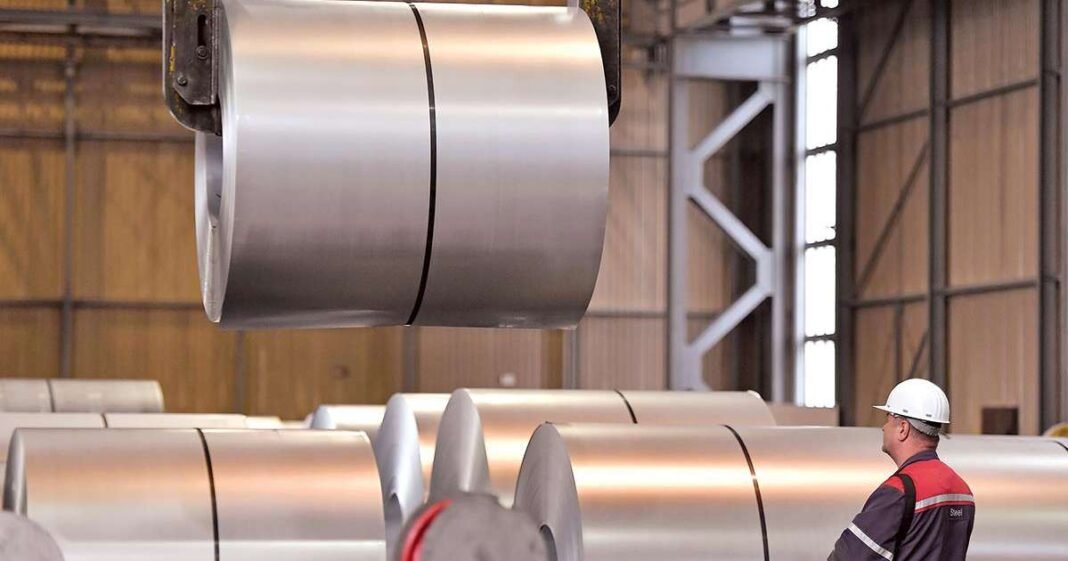

A worker moves steel coils at the Thyssenkrupp steel factory in Duisburg, Germany. (Martin Meissner/Associated Press)
January 21, 2026 10:23 AM, EST
[Stay on top of transportation news: Get TTNews in your inbox.]
A trade deal between the U.S. and European Union is on hold after the European Parliament decided to freeze a ratification vote in response to President Donald Trump’s escalating threats to seize Greenland.
The Parliament’s trade committee postponed the vote indefinitely on Jan. 21, according people familiar with the decision, casting doubt on whether the pact will ever get across the finish line.
The deal has been swept into the deepening crisis between the EU and U.S. over Greenland, which has brought the transatlantic alliance to the brink of rupture. Trump is currently vowing to slap tariffs on several European countries until he is allowed to buy the island, a Danish territory.
The tariff threat prompted EU lawmakers to reconsider an expected ratification vote on a trade deal the bloc struck with Washington last July. The agreement set a 15% tariff on most EU goods in exchange for a pledge to erase all tariffs on U.S. industrial goods and some agricultural products. The pact was partially implemented but still needs Parliament’s approval to be finalized.
At the time, the EU concessions were seen as an effort to avoid a full-blown trade war with Trump and to maintain U.S. security guarantees for the continent as Russia waged its war in Ukraine.
Arctic security can only be achieved together.
This is why the proposed additional tariffs are a mistake, especially between long-standing allies.
The EU and US have agreed to a trade deal last July.
A deal is a deal.
And when friends shake hands, it must mean something. pic.twitter.com/5wpMic148s
— Ursula von der Leyen (@vonderleyen) January 20, 2026
But Trump’s Greenland ultimatum has turbocharged long-running European criticism that the pact gave away too much, even prompting proponents to say that final approval should be withheld for now. Trump has said that a 10% tariff will go into effect on Feb. 1 for eight European countries, rising to 25% in June, unless he gets a deal for the “purchase of Greenland.”
The Jan. 21 decision was expected after senior lawmakers from Parliament’s largest political groups proposed a delay on Jan. 17, following Trump’s tariff announcement.
Manfred Weber, leader of Parliament’s largest group, the center-right European People’s Party, said on Jan. 21 that “for us as EPP, and I think for all parliamentarians, it’s clear there will be no ratification, no zero percentage tariffs access to the EU for U.S. products until we have clarified the question of reliability.”
EU leaders will then gather in Brussels on Jan. 22 to discuss their response to Trump’s aggression. Options under consideration include counter tariffs on 93 billion euros’ ($109 billion) worth of U.S. goods and the possible deployment of the so-called anti-coercion instrument, which allows the bloc to curb investments into the EU and impose more fees and tariffs.
“Europe prefers dialogue and solutions — but we are fully prepared to act, if necessary, with unity, urgency and determination,” European Commission President Ursula von der Leyen, the EU’s top executive, told EU lawmakers on Jan. 21.
Even before Trump’s Greenland saber-rattling, the EU-U.S. trade deal faced a rocky path in the Parliament. A group of EU lawmakers opposed the deal from the start, and criticism mounted after the U.S. extended a 50% metals tariff to hundreds of additional products. The U.S. then demanded changes to EU tech rules in exchange for rolling back the expanded tariffs, drawing further ire from opponents.

