
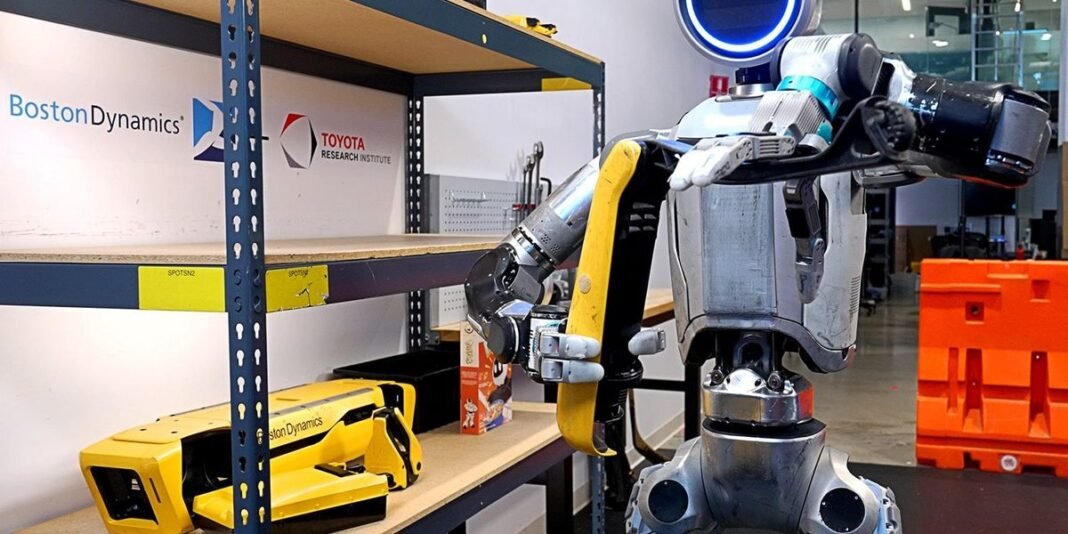

Robot vendor Boston Dynamics today said it had expanded the artificial intelligence (AI) capabilities of its Atlas humanoid robot, teaming with Toyota Research Institute (TRI) to enable the two-legged bot to learn new skills through demonstrations from humans, instead of complex software coding updates.
Specifically, the partners empowered the Atlas model with a Large Behavior Model (LBM) to give it new capabilities that previously would have been laboriously hand-programmed, but can now be added quickly and without writing new code, by copying a human instructor. The result allows an Atlas unit to perform a long, continuous sequence of complex tasks that require combining object manipulation with locomotion, the partners said.
Boston Dynamics makes commercial products such as its dog-like, four-legged walking “Spot” model and its “Stretch” model that combines a robotic arm with a mobile conveyor to autonomously unload truck trailers. But it may be best known for its Atlas design, which has been featured in a series of popular videos doing gymnastics routines and jogging through obstacle courses. The Massachusetts firm doesn’t sell that model commercially, but uses it as a test bed for robotics research.
In recent years, other vendors have added humanoid robots to that product category, including Apptronik’s Apollo unit and Agility Robotics’ Digit unit. Both those robot models are currently being used in pilot tests for business sectors including logistics and warehouse tasks.
According to Boston Dynamics, its latest release allows the Atlas product to use humanoid whole-body movements, such as walking, crouching, and lifting, to accomplish a series of packing, sorting, and organizing tasks. It achieved those movements even as researchers interjected unexpected physical challenges mid-task, such as closing the lid of a box and sliding it across the floor, requiring Atlas to self-adjust in response.
The two companies said that result reaffirms the “incredible potential” of AI technologies in developing general-purpose humanoid assistants. “One of the main value propositions of humanoids is that they can achieve a huge variety of tasks directly in existing environments, but the previous approaches to programming these tasks simply could not scale to meet this challenge,” Russ Tedrake, senior vice president of Large Behavior Models at Toyota Research Institute, said in a release. “Large Behavior Models address this opportunity in a fundamentally new way – skills are added quickly via demonstrations from humans, and as the LBMs get stronger, they require less and less demonstrations to achieve more and more robust behaviors.”

