
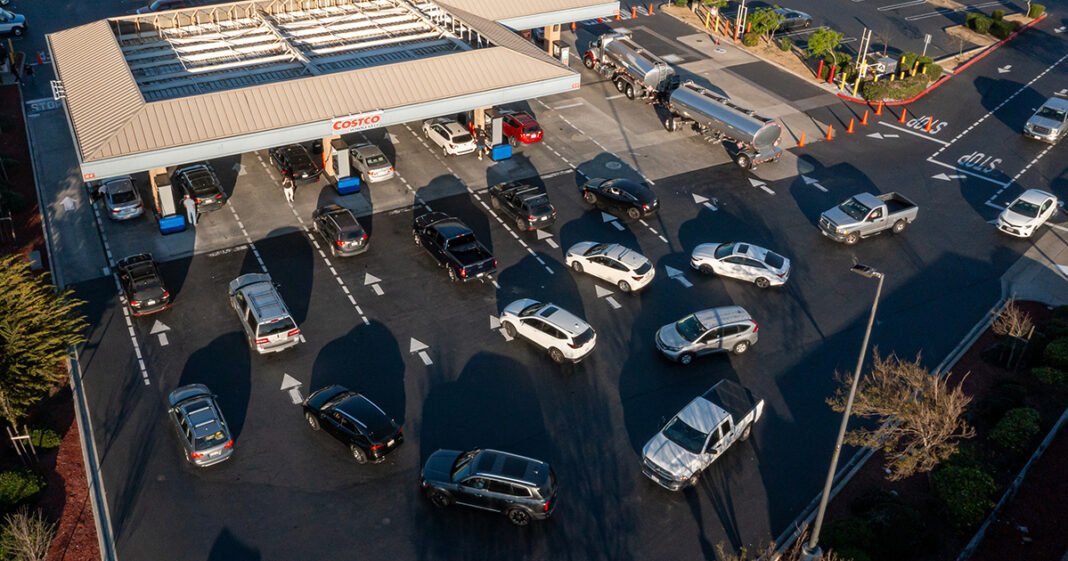

Drivers wait to refuel vehicles at a Costco gas station in Richmond, Calif. (David Paul Morris/Bloomberg News)
March 25, 2026 2:27 PM, EDT
Wall Street is cutting its forecasts for the U.S. economy this year, boosting its projections for inflation and unemployment and nudging up the odds of a recession as the impact of the Iran war starts to come into view.
Goldman Sachs Group Inc. says the risk of a downturn over the next 12 months has risen to 30% as a result of the surge in oil prices, and predicts the jobless rate will climb to 4.6% by the end of 2026 from 4.4% in February. Several firms say inflation will now be closer to 3% this year than 2%, eating into disposable incomes and keeping a lid on hiring.
That’s a shift from what was supposed to be a strong year in 2026 as the shock of President Donald Trump’s tariffs faded into the background and stimulus from tax cuts kicked in. Even if the fighting ends soon, economists say the damage already done will keep the U.S. economy on a narrow footing, with job seekers and lower-income consumers alike continuing to struggle.
“Lots of elements of the economy are going to be weaker because of this war,” said Nancy Vanden Houten, the lead U.S. economist at Oxford Economics.
“The impact is very visible very quickly,” Vanden Houten said. “You just have to drive by your local gas station.”
Tax refunds, amped up by Trump’s One Big Beautiful Bill Act, have helped blunt the blow. But forecasters are starting to expect the increase in refunds — a key element underpinning sunny forecasts for consumer spending in 2026 — will be effectively neutralized by higher energy costs.
The price of gasoline has surged more than 30% so far this month to about $4 a gallon, according to the American Automobile Association, marking the biggest increase since Hurricane Katrina knocked out Gulf Coast oil production in 2005.
Early data on tax refunds, meanwhile, are coming up short of expectations. In a March 23 report, Morgan Stanley economists estimated refunds are tracking 12% higher than last year, below the 15% to 25% increase they had anticipated. The bank downgraded its forecast for consumer spending, projecting a 1.7% increase in 2026 instead of 2%.
“The oil shock essentially washes out that bump that we were counting on,” Morgan Stanley’s Arunima Sinha said in an interview.
That leaves the U.S. on track for growth of around 2% in 2026 by most accounts, thanks in large part to ongoing investments in data centers that is seen as relatively insulated from costly imported energy thanks to America’s abundance of cheap natural gas.
But it keeps the economy dependent on continued investor optimism toward artificial intelligence, and the associated spending by top earners buoyed by growing portfolios that helped keep the expansion going in 2025 despite near-zero job growth.
Oil prices have eased somewhat amid a diplomatic push by the U.S. to end the war with Iran, though Brent crude remains around $100 a barrel. Even if the two sides can come to an agreement to end hostilities soon, forecasters caution it will take time for oil shipments through the Strait of Hormuz to ramp up. Damage to oil infrastructure in the region, combined with increased global demand as countries rebuild stockpiles after the conflict, will also sustain higher oil prices than before the war.
Stopped short: the national average is inching lower after hitting $3.994/gal yesterday evening, we’re now at $3.983/gal as price cycling markets push 1-3c/gal drops every ~day or so. With oil dropping- we could see more small decreases soon.
— Patrick De Haan (@GasBuddyGuy) March 25, 2026
American consumers can already see the impact when buying gasoline or plane tickets. But a growing fertilizer shortage created by the war is also set to push food prices up as the year goes on. Higher prices for diesel fuel — which have risen even faster than regular gas — will add to shipping costs, which could also eventually boost a whole range of prices for consumer goods that were already boosted by tariffs.
“Everyone’s very concerned about how long it’s going to take before things are settled,” said Jennifer Lee, a senior economist at BMO Capital Markets. “Even if it does get settled today, it’s going to take some production. It’s going to take a long time to have things restart.”
Many economists see less spending translating to less hiring, which means another year of meager gains for employment after 2025 registered unprecedented low job growth so far into an economic expansion.
Consumer Impact
Several Wall Street firms, including Citigroup Inc., are forecasting a rise in the unemployment rate this year. That’s one reason why many are sticking with their calls that the Federal Reserve will resume interest-rate cuts at some point in 2026, even as investors have rushed in recent days to bet on rate hikes instead.
Slower job growth also could feed back into the outlook for consumer spending, said Gisela Young, an economist at Citi.
“To the extent that job growth continues to slow further — it’s already on average sort of a zero — that could be another headwind to the consumer,” Young said, adding that Citi expects wage growth to step down again this year.
Bob Toews of TruckDown explores how fleets can streamline their response to breakdowns and safely get their trucks back on the road as quickly as possible. Tune in above or by going to RoadSigns.ttnews.com.
Early signs of the impact are more mixed than the quickly souring outlook would suggest. Economists at JPMorgan Chase & Co. and Bank of America Corp. say weekly internal data on credit-card spending show little evidence of a slowdown as of mid-March, suggesting consumers have yet to start pulling back even as they pay more at the pump.
The University of Michigan will release final results from its monthly survey of consumer sentiment March 27. Forecasters expect it to show a decline in March, according to the median estimate in a Bloomberg survey, though not to the level seen in November, which marked the lowest reading in more than three years.
“The first two weeks of the conflict, you’re not seeing anything really pronounced in terms of changes in consumer spending,” said Michael Feroli, the chief U.S. economist at JPMorgan. But “I do think this takes a little bit of pep out of the expansion.”

