
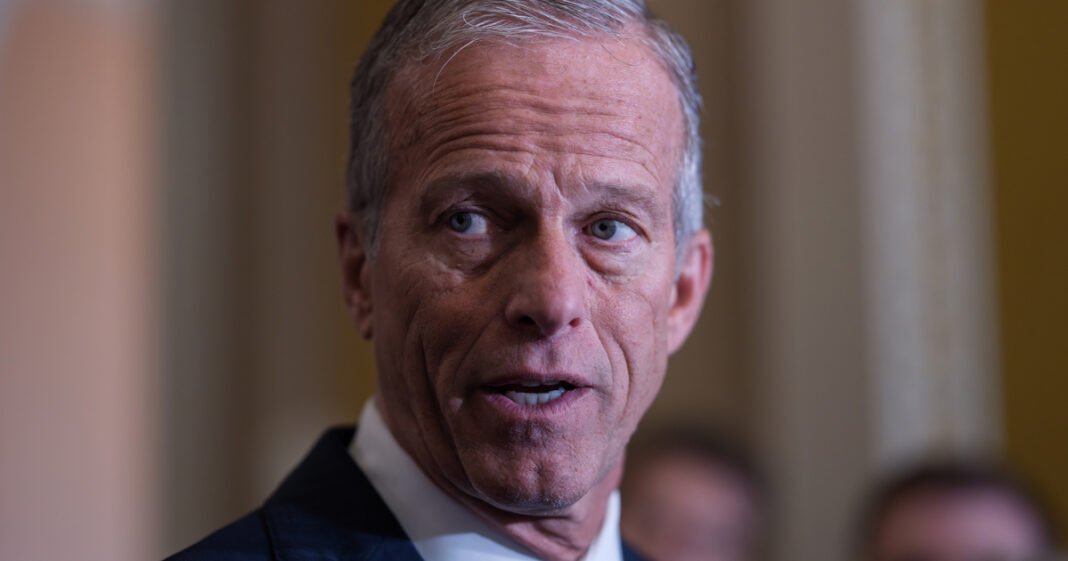

TSA agents are “quitting in droves” amid the funding fight, Thune said. (J. Scott Applewhite/Associated Press)
March 26, 2026 2:53 PM, EDT
Key Takeaways:
- A DHS funding standoff is delaying trucking legislation and a new highway bill while straining TSA staffing and consuming congressional floor time.
- Lawmakers warn the lapse has forced TSA officers to work unpaid more than a month, causing long airport lines and worsening workforce attrition.
- The impasse threatens progress on a long-term highway bill due by September as Congress awaits the administration’s budget and discusses fiscal 2027 funding.
WASHINGTON — Key transportation priorities, from trucking legislation to a new multiyear highway bill, are being pushed to the sidelines as lawmakers remain locked in a funding standoff over the Department of Homeland Security, a clash that is straining airport security staffing and consuming congressional floor time.
House Majority Leader Steve Scalise (R‑La.) had been preparing to schedule votes on trucking‑related legislation aimed at strengthening commercial driver license requirements, with expectations that the next highway authorization could also reach the House floor near the Memorial Day recess. But both efforts remain in limbo.
Funding for DHS has lapsed for more than a month, forcing many Transportation Security Administration officers to work without pay. With the funding fight claiming committee time and overtaking floor bandwidth, lawmakers who oversee transportation programs are forced to sit on the sidelines.
Rep. Steve Womack (R‑Ark.), chairman of the transportation appropriations subcommittee, emphasized at a March 25 hearing that members need to stay engaged despite the distractions. “Every district has housing and transportation assets,” he said.
Separately, House Transportation Committee Chairman Sam Graves (R‑Mo.) has signaled he aims to move the next long-term highway bill as early as April. Current authorization for federal highway programs expires in September, leaving limited time to resolve funding challenges.
The sooner the DHS funding battle is resolved, the better for those wheels to start turning.
Democratic leaders insist the situation is avoidable if Republicans agree to broader immigration policy changes as part of the funding package. Senate Minority Leader Chuck Schumer (D‑N.Y.) said TSA lines are “literally stretching out the door of airports,” adding, “Our TSA agents need to be paid.”
Travelers wait in line at a TSA checkpoint in Houston March 9. (Mark Felix/Bloomberg)
“We can pay TSA workers right here, right now,” added Sen. Jeff Merkley (D‑Ore.), accusing Republicans of “holding the rest of DHS hostage.”
Senate Majority Leader John Thune (R‑S.D.) said March 25 the standoff could have far-reaching effects on airport security staffing, noting that TSA agents are “quitting in droves” amid the funding fight.
“A lot of DHS employees have been working without pay for more than 80 days so far this fiscal year,” he said.
Scalise stressed the effect the standoff is having on travelers.
“People waiting hours and hours at my home airport in New Orleans … you’ve got people sleeping overnight the night before flights so that they can have a chance of making their flight,” he said.
At the White House, President Donald Trump has remained focused on election security as the shutdown drags on. The administration has also highlighted the Senate’s recent confirmation of former Sen. Markwayne Mullin (R‑Okla.) as the new DHS secretary.
Mullin. (Al Drago/Bloomberg)
Even as the DHS impasse dominates attention, lawmakers have begun informal fiscal 2027 funding discussions while awaiting the administration’s next budget proposal, which is expected to include a request for war‑related spending.
Meantime, the Highway Trust Fund — established under President Eisenhower and traditionally fueled by federal gas and diesel taxes — remains under severe strain as revenues continue to fall short of infrastructure needs. Major highway-related programs continue to operate under a fall 2026 deadline, tied to the 2021 Infrastructure Investment and Jobs Act.

