
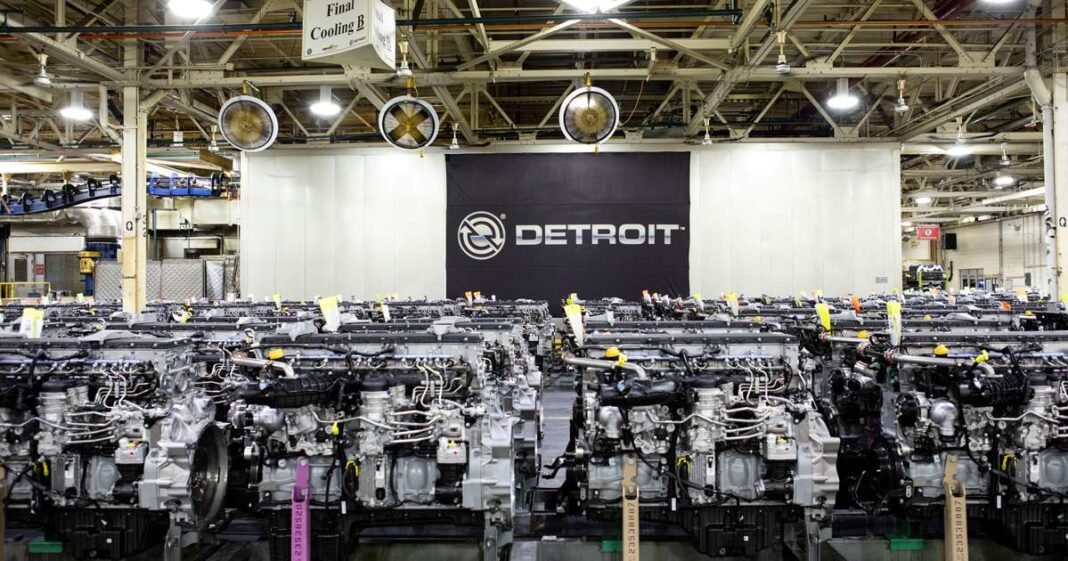

Research, development and production for all of these components are handled at Detroit’s Redford, Mich., campus. (Detroit via broadhead)
February 19, 2026 12:30 PM, EST
Key Takeaways:
- Detroit introduced its Gen 6 DD13, DD15 and DD16 engines for Freightliner and Western Star trucks to meet EPA’s 2027 emissions standards.
- The engines add a pre-SCR system, redesigned fuel system and other efficiency upgrades to reduce nitrogen oxide and improve performance, according to the company.
- Gen 6 DD13 and DD15 engines will be available in January 2027 with DD16 production starting in January 2028.
Engine and component manufacturer Detroit is launching a new generation of heavy‑duty engines for Freightliner and Western Star trucks that comply with Environmental Protection Agency emissions limits taking effect for 2027 model-year engines.
The company’s Gen 6 portfolio — introduced Feb. 19 — comprises the 13-liter DD13, 15-liter DD15 and 16-liter DD16 engines, and will be available for all heavy-duty Freightliner and Western Star trucks. Detroit is a subsidiary of Daimler Truck North America.
The engines build on previous generations of the DD engine family with technology that boosts efficiency to help offset emissions, the company said.
“It’s a big moment — it’s exciting for us,” said David Carson, senior vice president of sales and marketing at DTNA, during a Feb. 17 media briefing “We love to launch trucks, but launching an engine is even more special. It’s the heartbeat of the truck, and it’s super important for customers in terms of innovation, efficiency and reliability.”
Carson stressed that return on investment for the new engines was a focus during the development process, as fleets continue to face difficult on-highway market conditions and the arrival of the new emissions requirements. He stressed that those involved with bringing the engines to market took a holistic approach to bringing together the engines, components and solutions that will work together on the truck — including integrated business services and connected technologies.
“We have integrated all of those components into what we offer to our customers,” Carson said. “Detroit is not just components; it’s also an ecosystem in terms of what we offer as solutions to our customers.”
To meet tougher nitrogen oxide requirements in EPA’s 2027 standards, the engines use a pre-Selective Catalytic Reduction system containing the same elements of aftertreatment systems on current engines, but positioned upstream of the primary system. This arrangement, combined with a thermal control valve, helps the aftertreatment system reach operating temperature more quickly, reducing the need for the SCR system to undergo regeneration cycles when the truck is parked, Detroit said.
A mockup of a Gen 6 engine and aftertreatment system in a Freightliner Cascadia. (Detroit via broadhead)
The new design also preserves existing chassis space with no impact to back-of-cab packaging, a key consideration for vocational customers and truck equipment manufacturers, the company added.
A redesigned fuel system removes the need for amplified injection and supplies higher, stronger and more consistent fuel flow, Detroit said. The addition of an asymmetric intake port increases swirl and works with new fuel injectors to improve air-fuel mixtures to improve combustion. The use of Miller timing on the camshaft increases compression ratio and contributes to overall engine efficiency, Detroit added.
In addition, a new wastegate actuator improves braking performance and gradeability with increased power for high-altitude conditions. New engine ratings of up to 1,900 lb.-ft. of torque enable improved downspeeding capabilities.
“Freightliner and Western Star customers depend on Detroit to operate reliably, efficiently and powerfully, and we’re honored by the trust placed in both the Detroit brand and the DD13, DD15 and DD16 engines to help navigate past transitions as well as this next one,” said David Carson, senior vice president of sales and marketing at DTNA. “With our Gen 6 engines, we have a successor that builds on years of proven performance to be prepared for ’27 and beyond.”
A Gen 6 engine and aftertreatment system. (Detroit via broadhead)
The DD series of engines launched in 2007. Each successive generation — arriving in 2010 (Gen 2), 2013 (Gen 3), 2016 (Gen 4) and 2021 (Gen 5) — has met increasingly stringent federal emissions standards.
In addition to engines, Detroit also produces transmission and axles. Research, development and production for all of these components are handled at Detroit’s Redford, Mich., campus, which employs about 2,000 people.
The Gen 6 DD13 and DD15 engines will be available beginning in January 2027, with Gen 6 DD16 production to follow in January 2028.

