
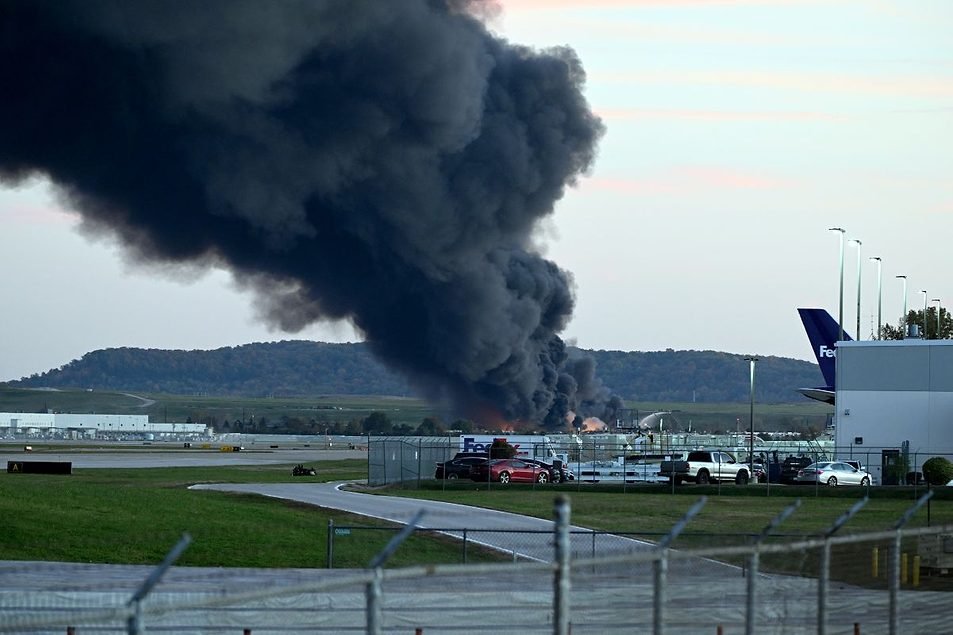

The death toll from a crash of a United Parcel Service Inc. cargo plane rose to nine as investigators began looking into what caused the fiery accident near the company’s global hub in Kentucky.
“Louisville looked apocalyptic last night,” U.S. Representative Morgan McGarvey told reporters on November 5, describing a scene of widespread destruction and loss after the fully fueled jet plunged into the ground and exploded shortly after takeoff the evening prior.
Kentucky Governor Andy Beshear added that he’s “fairly confident” the death toll will grow by at least one person. He was unable to confirm if all three crew members were killed.
The number of reported missing persons is greater than the confirmed fatalities, Louisville Mayor Craig Greenberg said.
The Federal Aviation Administration said on X that Louisville Muhammad Ali International Airport had reopened, although multiple taxiways remained closed. A National Transportation Safety Board team kicked off investigative work at the site and the agency said it would provide initial details later on Wednesday.
Video circulating on social media showed the Honolulu-bound McDonnell Douglas MD-11 struggling to get airborne, with one of its engines on fire, before exploding in a fireball beyond the end of the runway.
A local fire chief said it wasn’t clear how many victims emergency crews are looking for and noted the sprawling size of the debris field and tangled wreckage. Fires after the crash consumed much of the jet’s fuselage, he told reporters.
The crash comes at a time of widespread air travel disruptions across America caused by air traffic controller shortages since the U.S. government shutdown began October 1.
UPS canceled second-day air service package-sorting operations at the hub — known as Worldport — on November 5 after halting the work Tuesday evening.
“Our heartfelt thoughts are with everyone involved,” the parcel-delivery company said, adding that it was assisting in the investigation.
Boeing Co., which took over McDonnell Douglas in 1997, said it stands ready to support its customer and has offered technical assistance to the NTSB. The company said it will “work tirelessly” with state and local authorities on response efforts.
The cause of the crash hasn’t been identified. Typically, such incidents are triggered by a combination of operational, mechanical and environmental factors, established by investigators over weeks and months.
Flight tracking website Flightradar24 showed the 34-year-old aircraft, designated as UPS Flight 2976, reaching takeoff speeds and climbing to around 175 feet (53 meters) before plummeting to the ground.
The jet flew from Louisville to San Antonio on September 3, and didn’t return until October 18, the data showed. The MD-11 had flown on a near-daily basis since then.
The incident adds to a deadly year for global aviation. Just three weeks ago, a cargo plane skidded off the runway and into the sea at Hong Kong International Airport, killing two ground crew. In June, 241 people died on an Air India flight that crashed just after takeoff, and in January a US Army helicopter collided with an American Airlines Group Inc. regional jet on approach to Ronald Reagan Washington National Airport near Washington.
The three-engine widebody jet, a stretched version of the DC-10, was launched in 1986 but was eclipsed by more efficient twin-engine models like Boeing’s 777.
UPS and rival FedEx Corp. are among the last remaining operators of the MD-11. UPS has 26 of the type in service, according to aviation analytics firm Cirium, while FedEx currently has 28 in service.
The aircraft involved in the accident was originally built for Thai Airways International in the early 1990s before being converted into a freighter about 20 years ago for UPS. The plane was powered by three General Electric Co. CF6 engines.
#5X2976 was operated by an MD-11(F) registered N259UP. The 34-year-old aircraft was converted to cargo and began operations with UPS in 2006. https://t.co/QaU8Y7iLvM pic.twitter.com/kXimU8l4fk
— Flightradar24 (@flightradar24) November 4, 2025
Other accidents involving UPS operations include UPS Flight 6 in September 2010, when a Boeing 747-400F crashed near Dubai after it experienced an in-flight cargo fire, killing both crew members.
In August 2013, an Airbus SE A300-600F crashed short of the runway in Birmingham, Alabama, killing the captain and first officer. Authorities cited fatigue, pilot error and subsequent aircraft instability as probable causes for that crash.

