
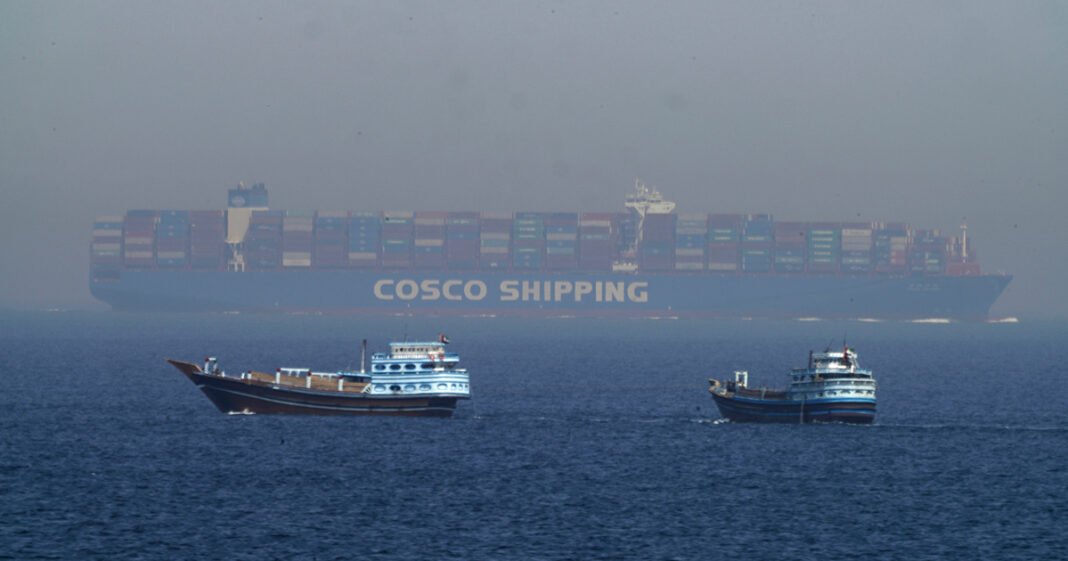

Two traditional dhows sail by a Cosco containership in the Strait of Hormuz in May 2023. (Jon Gambrell/Associated Press)
March 2, 2026 3:13 PM, EST
Key Takeaways:
- Major container carriers suspended bookings, rerouted ships and added conflict surcharges as fighting involving the U.S., Israel and Iran disrupted freight routes in the Persian Gulf.
- The measures affect hazardous, refrigerated and general cargo across Gulf nations, with firms citing safety risks and imposing surcharges up to $2,000 per container.
- Carriers say they will monitor conditions, assess voyages individually and resume normal operations or designate alternatives once security in the region improves.
The world’s biggest container shipping companies are revising their sailing schedules as the U.S. and Israel’s war with Iran threatens to disrupt ocean freight in the Persian Gulf region — a vital supply-chain hub for dozens of big American and European manufacturers.
Some carriers are canceling bookings temporarily, skipping some port calls, warning of delays and implementing surcharges to transport containers through the conflict zone.
Here’s a rundown of the top six on March 2:
MSC
The No. 1 container line said March 1 it’s suspending all bookings for global cargo to the Middle East “until further notice.” The Geneva-based company will keep monitoring the situation and “is working with relevant authorities to ensure the safety of its operations.” Bookings will resume when the security situation improves, it said.
Mediterranean Shipping Co. ranks No. 9 on the Transport Topics Top 50 list of the largest global freight carriers.
Maersk
The Copenhagen-based company said March 2 it’s suspending refrigerated and dangerous shipments into and out of the United Arab Emirates, Oman, Iraq, Kuwait, Qatar, Bahrain and Saudi Arabia until further notice. Also effective immediately is the suspension of all new bookings between the Indian subcontinent and several Gulf states. Maersk previously said it’ll avoid the Strait of Hormuz and suspended Red Sea transits. Its shares surged March 2 to the highest since 2022.
RELATED: Maersk Ground Freight to Open Up to 7 More Facilities in 2026
Maersk ranks No. 7 on the global freight TT50.
CMA CGM
On March 2, the Marseille, France-based carrier said it’s suspending hazardous cargo bookings immediately to Iraq, Bahrain, Kuwait, Yemen, Qatar, Oman, the UAE, Saudi Arabia, Jordan, Egypt’s Port of Ain Sokhna, Djibouti, Sudan and Eritrea. CMA CGM said March 1 it’s stopped refrigerated cargo bookings in the Gulf region, and it also suspended trips through the Suez Canal. It imposed an “emergency conflict surcharge” of $2,000 per 20-foot container.
CMA CGM ranks No. 6 on the global freight TT50.
Cosco
China’s biggest carrier said March 1 vessels that entered the Gulf and completed operations there “have been instructed to proceed to safe waters to hover or anchor.” Ships headed to the region were advised to “prioritize navigational safety, with measures including speed reduction, proceeding to safe waters, or awaiting further instructions at designated sheltered anchorages.”
Cosco ranks No. 11 on the global freight TT50.
Hapag-Lloyd
The Hamburg, Germany-based firm joined Maersk in stopping Hormuz crossings and rerouting ships away from the Red Sea. As of March 2, Hapag-Lloyd said there were “no alternative discharge ports have been designated at this stage” and “delivery timelines may therefore be extended.” The company also instituted a “war risk surcharge” of $1,500 per 20-foot container.
Hapag-Lloyd ranks No. 17 on the global freight TT50.
Ocean Network Express
The Singapore-based company said March 1 it’s immediately and temporarily “suspend acceptance of new bookings for cargo moving both to and from the Persian Gulf until further notice.” For goods that are currently in transit or planned, “we are closely assessing the situation voyage by voyage,” it said.
Ocean Network Express ranks No. 24 on the global freight TT50.

