
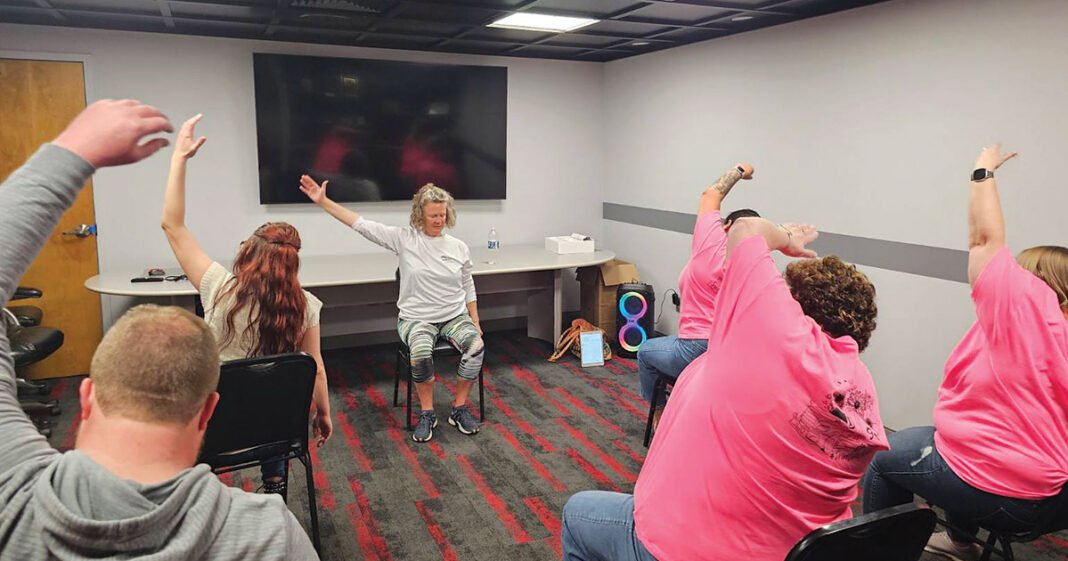

Garner Trucking offers wellness programs such as chair yoga during its Lunch ‘n Learn events. (Garner Trucking)
March 30, 2026 9:00 AM, EDT
Key Takeaways:
- Fleets are increasingly utilizing wellness programs and technology to prioritize their drivers’ health and wellness, in efforts to improve driver morale, performance and retention.
- Wellness resources, digital health platforms and apps, and community-engagement programs and events are becoming commonplace for a growing number of carriers.
- Some carriers are finding that these commitments are helping their drivers to be “a lot happier, more productive and safer.”
When she began her career as a commercial truck driver at age 50, Gina Jones’ biggest fear was gaining weight. She had entered a profession where factors such as an unhealthy diet and sedentary lifestyle too often lead to health risks such as obesity, diabetes and hypertension.
When Jones, a driver for truckload carrier Werner Enterprises, started to notice some weight gain, she and her husband, Steve, with whom she drives as a team, started making lifestyle changes. Through daily exercise and healthier meals, Jones, now 64, has lost 34 pounds since starting her fitness journey.
She credits her achievement to using Offshift, a digital health platform for truck drivers. Project 61, a nonprofit dedicated to driver health, acquired the app last year.
Jones, who is also an America’s Road Team Captain, and her husband use Offshift for making nutritious food choices, getting specific exercise ideas and completing a weekly check-in with a health coach.
“We’re rolling out this free solution to carriers across the country and tying that to a different monthly set of challenges that go a long way to improving engagement,” said Jeremy Reymer, Project 61’s founder.
In their efforts to stay healthy, Jones and her husband walk at least two miles daily, exercise in and out of the truck, drink a lot of water, prepare and log their meals and make good choices at truck stops. They are even able to get some steps in while they are waiting for their load.
Jones said she’s so happy about how she feels that it encourages her to keep going and spread the word to other drivers.
“By being healthier, it makes the job easier. From loading, unloading, tarping a load to just passing [Department of Transportation] physicals, this alone increases a driver’s longevity in the industry,” Jones said. “Programs like Project 61 [and] Offshift teach drivers how a few simple changes to their diet and exercise can have remarkable benefits to their lifestyle and mental health.”
Project 61’s Offshift app helps drivers track their health and fitness. (Project 61)
Fleet Support and Incentives
Although there is widespread awareness of the industrywide health issues drivers often face, many fleet operators are falling short in providing solutions, Reymer said. That’s because the nature of the industry can make it challenging for drivers to fully participate, making some fleets less inclined to commit the resources it takes to make these programs successful.
Recognizing the ebb and flow of trucker engagement, Garner Trucking offers financial incentives to participate, such as paying for a health club membership.
The Findlay, Ohio-based motor carrier also offers free on-site wellness examinations. Participants, along with those who enter a smoking cessation program, earn a reduced employee contribution on their health insurance.
“We also have a free exercise pack that we will give to a driver: things they can use in the truck to stay fit, like stretch bands and weights,” said Tim Chrulski, Garner’s chief operations officer.
An in-house wellness committee establishes programs such as walking competitions and a company cookbook with recipes that can be prepared in the truck.
“It’s constant education,” Chrulski said. “We have a monthly newsletter and weekly email that includes health and wellness tips.”
Other fleets, such as Averitt Express, have established wellness programs that include preventive care reminders, free annual health screenings and gym membership discounts with immediate on-site feedback, said Elise Leeson, vice president of human resources at the less-than-truckload carrier.
Free annual health screenings are one of the benefits included in Averitt’s wellness program. (Averitt Express)
“We have professional individual health coaching available at no cost and 24/7 telehealth and behavioral health services,” she said. “We also provide a tobacco cessation program, weight loss support, chronic condition management and virtual physical therapy services.”
Leeson said Averitt also works with its health coaching partner to offer resources such as a catalog of on-demand webinars that cover grocery shopping, exercise and time management skills.
Flatbed carrier Melton Truck Lines offers several in-house options, such as an on-site, third-party clinic, an on-site gym and gym reimbursement.
“We offer quarterly health challenges, like workout challenges, calorie count challenges, an Olympic competition where drivers can participate, like basketball tournaments, and a designated Facebook wellness page that all employees can be a part of,” said Lisa Mason, Melton’s vice president of safety and human resources.
Truck Stop Wellness
Truck stops across the country also are recognizing the need to provide wellness facilities and amenities for its customers.
“Truck stops are adapting to serve as the ‘one-stop shop’ solution that drivers need to maintain and improve their well-being,” said Tiffany Wlazlowski Neuman, vice president of public affairs for NATSO, which represents the nation’s truck stops.
“Today, customers might find a medical clinic, chiropractor or dentist at a truck stop,” she said. “In addition to exercise rooms, truck stops have added walking trails and bicycle paths or dog parks. This also includes responding to customer demand for healthier, more versatile and fresher food options.”
For food choices, Neuman said that many professional drivers are seeking out food that is both fast and healthy, and in response, there is a concerted effort by truck stops to offer healthier food options, from edamame and kale salads to fresh fruit, yogurt, and natural and organic drinks, even at small truck stops.
Although grab-and-go food is often labeled unhealthy, some truck stops are aiming to change that association.
Love’s Travel Stops recently launched its Culinary Innovation Center on its corporate campus in Oklahoma City, where new, quick food options are constantly being created and tested.
“Love’s Fresh Kitchen also offers healthier options such as sandwiches, salads, wraps, fresh cut fruit and more prepared on-site daily,” said Greg Ekman, senior director of Fresh Kitchen strategy and growth. “Love’s private label includes high-protein options such as protein cookies, trail mixes, and beef jerky. Other recent additions include Love’s cold pressed juice options.”
Driver Health and Retention
More fleets are prioritizing their drivers’ health, but it remains to be seen whether that commitment influences driver retention.
Garner Trucking’s Chrulski does think it plays a role, but beyond that, he feels there has been a boost in morale.
“These types of things are pulling us all together, to learn about our health and wellness and learn how to choose better things, to compete in some of the competitions we do throughout the year,” he said. “Financial incentives don’t hurt either.”
(Connor D. Wolf/Transport Topics and Getty Images)
Melton Truck Lines’ Mason said she could not directly tie health and wellness initiatives to turnover rates.
However, she said: “What we do find is if we can provide them with the tools, they are a lot happier, more productive and safer.”
But Averitt’s Leeson suggested there is a correlation, noting the fleet’s benefits package.
“They really like our no-cost telehealth option because they can access care on the road instead of having to miss work for every doctor’s appointment,” she said. “It means a lot to them that Averitt is concerned about their complete health and offers services that protect them and their families.”
Garner’s Chrulski said it is the responsibility of the company to look after the health and wellness of its drivers.
“As a matter of practicality, if not humanity, you’ve got to be able to take care of those individuals and show them a better way of living,” he said. “We want those individuals to continue to be behind the wheel and have their dietary needs met so they can continue to do their jobs, take care of their families, and to take care of themselves.”

