
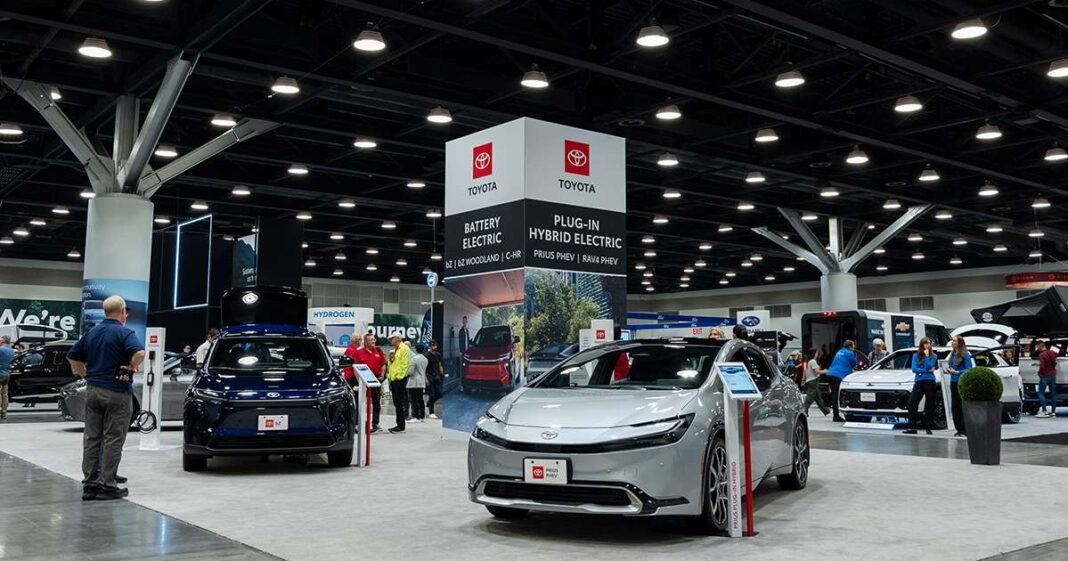

Toyota electric vehicles at the Everything Electric show in Vancouver in September. (Paige Taylor White/Bloomberg)
February 5, 2026 9:09 AM, EST
| Updated: February 5, 2026 12:59 PM, EST
Prime Minister Mark Carney’s government plans to change its tariff system to create a stronger financial incentive for automakers to invest in Canada, resisting U.S. efforts to lure factory jobs away.
The government is keeping the counter-tariffs it imposed on U.S.-made cars and trucks last year as retaliation for President Donald Trump’s own levies. But it’s launching consultations on a new “import credit” scheme that would help auto companies lower their tariff bill.
Companies that still make vehicles in Canada, such as Toyota Motor Corp. and General Motors Co., will be able to earn those credits based on their production. They can use them to wipe out tariffs on their U.S.-made products they import into Canada, or sell them to other car companies that want to import vehicles for sale.
The proposed new tariff system is part of a batch of reforms Carney announced Feb. 5 to try to bolster an automotive sector that was already under pressure before Trump came in with a tariff policy that seeks to reduce U.S. automotive imports.
Most of Canada’s production is shipped to the U.S. — vehicles and auto parts are among its largest exports. Canada also imports large volumes of cars and trucks from its southern neighbor, the result of an integrated supply chain that has evolved over decades, which Trump is now trying to upend.
“Our objective is to remove all tariffs in the auto sector to build the strongest North American auto sector,” Carney said at a car parts plant in the Toronto region. “But we recognize that is not the current objective of the U.S. administration. Their approach has changed — it’s their right. So we have to prepare for all possibilities.”
Two Japanese manufacturers, Toyota and Honda Motor Co., have large factories in the province of Ontario that were responsible for about three-quarters of Canadian automotive production last year, according to calculations by the Trillium Network for Advanced Manufacturing. GM and Stellantis NV had the rest. Ford Motor Co. has one Canadian assembly plant that’s currently out of production because it’s being retooled to make pickup trucks.
Some U.S. auto executives have jumped into the debate to argue the U.S.-Mexico-Canada Agreement is vital to the industry and worth saving as it comes up for review this year. “We built our entire vehicle business as an industry between Canada, Mexico, and the U.S.,” Ford CEO Jim Farley said last month in a Bloomberg Television interview. “We have to get this revised.”
Carney and Industry Minister Melanie Joly also announced a new system of fuel-efficiency standards for cars and trucks, replacing an electric vehicle mandate that was hated by the auto industry.
The previous EV rules required carmakers to ensure that at least 20% of sales were zero-emission vehicles in the near term, with a target of 100% by 2035. Instead, the government is set to introduce new greenhouse gas emission standards, with a goal of having electric vehicles represent 90% of new auto sales by 2040.
Carney’s government is also bringing back incentives for consumers who purchase or lease EVs. The C$2.3 billion ($1.7 billion) program gives incentives of as much as C$5,000 for battery electric and fuel-cell EVs and C$2,500 for plug-in hybrids. It applies only to autos made in countries with which Canada has a free-trade agreement.
Transport Topics reporters Eugene Mulero and Keiron Greenhalgh examine the critical trends that will define freight transportation in the year ahead. Tune in above or by going to RoadSigns.ttnews.com.
Carney recently said the government is open to Chinese companies assembling vehicles in Canada for the first time. That would be under restrictions that might include using Canadian software and creating joint ventures with domestic firms, another government official told Bloomberg News last month.
The auto industry directly employed more than 125,000 people in Canada in 2024, according to the government.
Carney struck a deal with China in January to allow Chinese automakers to export 49,000 EVs to Canada at a reduced 6.1% tariff rate.

