
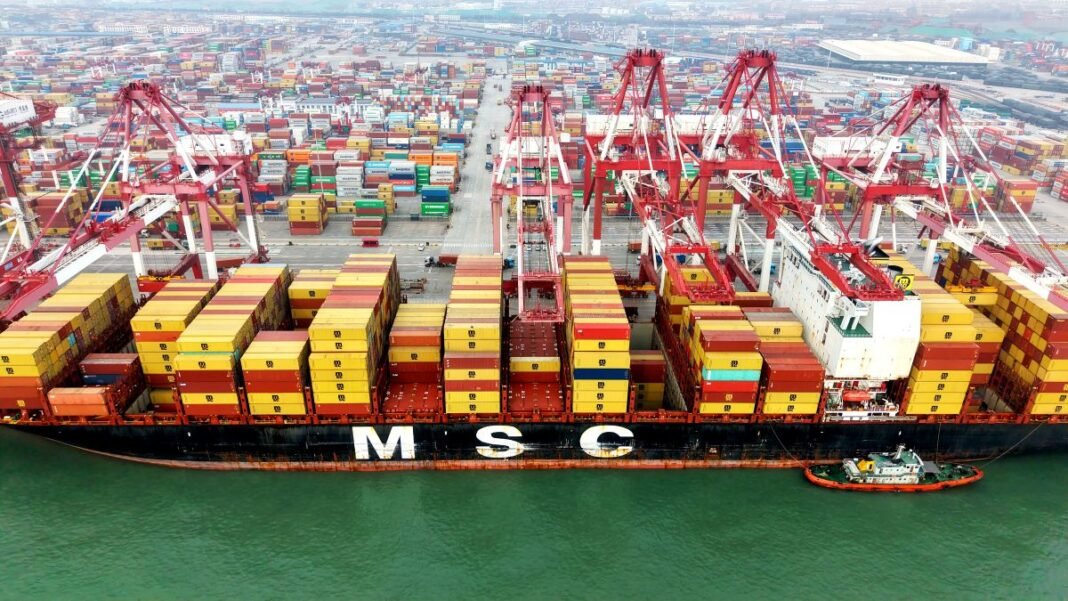

The European Commission has called for EU unity as it enters a crucial year of talks over tackling the huge climate impact of the global shipping industry, and as Athens announced it was breaking ranks to join a US-led alliance opposed to a net-zero agreement.
Greece is joining Saudi Arabia and the US in negotiations within the International Maritime Organisation (IMO). The three countries are united by their commitment to using natural gas to power ships, a position opposed by the EU, which seeks to promote the adoption of low-carbon alternatives to fossil fuels.
Greece is effectively ramping up its reversal of last October, when both Athens and Nicosia abstained from a vote on a new Net-Zero Framework for global shipping, for which a unanimous EU position had been agreed.
At the time, US President Donald Trump threatened to personally sanction any officials who voted to adopt the provisional agreement to decarbonise the shipping industry. The IMO session ended in disarray, with an agreement to reconvene a year later.
Standing firm
There are now serious doubts as to whether the bloc can present a unified front in time for a November showdown in London.
“We continue to stand firmly behind the shared objective of putting global shipping on a net-zero emission path towards 2025,” a European Commission spokesperson said on Friday.
“It’s very important that all EU Member States stay united,” the official added. “We are looking into the news, and we are in contact with all member states and the relevant authorities.”
The Greek defection, reminiscent of Italy signing up to China’s Belt-and-Road initiative in 2019 without the say-so of its EU neighbours, is adding to the troubles of the net-zero shipping framework, a global initiative provisionally agreed last April.
A Greek government source told Euractiv that Athens intends to work with all relevant stakeholders to reach an agreement that serves both the US and Europe.
“We are not abandoning the EU position or the green transition targets, but we need to find a way out of the stalemate,” the source said.
Still, some argue that internal divisions have left the EU impotent in the face of White House pressure.
“Rather than having their voice heard within the EU, this announcement places Greece into a minority of oil-exporting petrostates,” said Felix Klann, a shipping policy officer at the organisation Transport and Environment.
Lukas Leppert, a representative of the German environmental organisation NABU, said the Greek decision to side with the US and Saudi Arabia “displays their continued deviation.”
“It is an attack on an agreed compromise,” Leppert said.
(rh, cm)

