

Renters, flat owners, households without driveways and businesses across the UK will be able to save up to £500 on the installation of electric vehicle (EV) charge points, following a major increase in Government grant support announced on Wednesday 25 February.
The charge point grant has risen by more than 40 per cent, meaning eligible applicants can now receive up to £500 per socket, compared with the previous £350. The uplift will cover almost half the cost of a typical installation until March 2027, making home and workplace charging significantly more affordable.
The move is designed to break down one of the biggest barriers to EV adoption: access to convenient and cost-effective charging. With domestic electricity rates, drivers can power their car for as little as 2p per mile – the equivalent of travelling from London to Birmingham for around £3.50. Latest figures suggest EV drivers can save up to £1,400 a year in running costs compared with a similar petrol model when using cheaper home tariffs.
The announcement forms part of a wider package of measures aimed at tackling both upfront vehicle costs and charging concerns. More than 55,000 drivers have already benefited from the Government’s £2 billion Electric Car Grant, which offers savings of up to £3,750 on selected new electric cars. The scheme supports major manufacturers operating in the UK, including production of the Nissan Leaf at Nissan’s Sunderland plant.
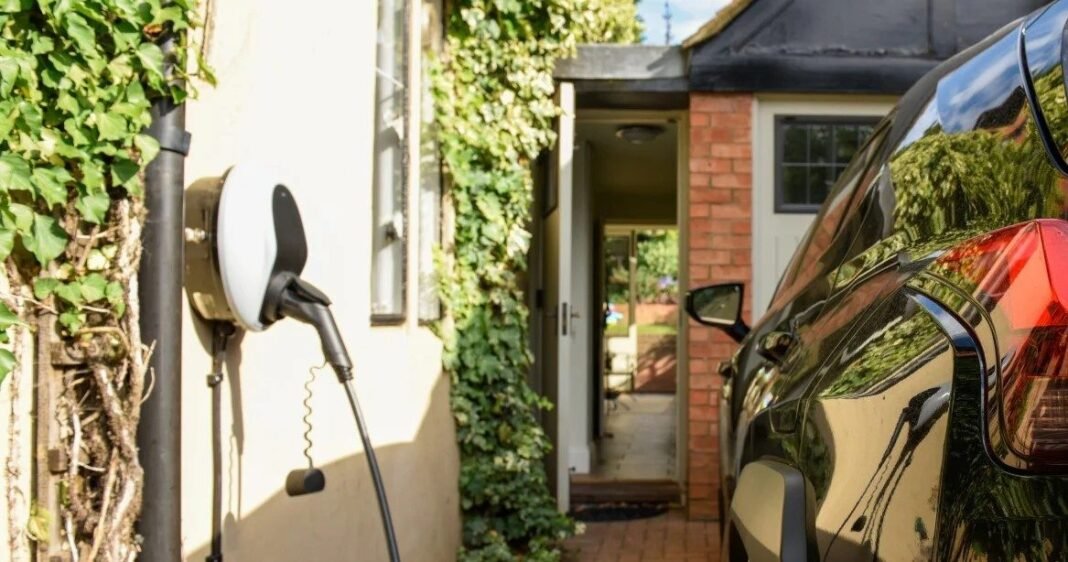
Work place charge point. Image: My Green Power
Aviation, Maritime and Decarbonisation Minister Keir Mather said: “We’re taking action to make EV ownership the affordable choice for everyone – not just those with driveways. Bigger grants mean families, flat owners, renters and small businesses can now install a charger for almost half the usual cost, with home charging costing as little as 2p a mile.
“Combined with our Electric Car Grant which has saved over 55,000 drivers thousands off the price of a new EV whilst boosting sales for carmakers, and record funding for our national public charging network, we’re backing the EV revolution for drivers, businesses, and industry.”
From 1 April 2026, the higher £500 grant will be available to people living in rented accommodation, flat owners, residential landlords, households with on-street parking and businesses. Schools will also benefit, becoming eligible for grants of up to £2,000 per socket, building on the 3,700 sockets already installed to date.
The Government is also simplifying the support landscape by reducing eight existing EV charge point grant schemes to five, making it easier for applicants to understand and access the right funding.
In addition, a £25 million scheme launched last year continues to help residents without driveways install home chargers via local authorities. The initiative supports discreet, embedded pavement channels for properties with on-street parking. This funding sits alongside the expanded charge point grant, meaning eligible households may receive support both for the charger itself and the cross-pavement channel installation.
Public charging infrastructure is also expanding rapidly. The UK now has more than 88,500 public charge points, with £600 million announced last year to accelerate rollout. This builds on plans to help councils install a further 100,000 chargers in the coming years. Local authorities will receive funding over the next three years to strengthen local charging networks, supported by a Government-funded advisory service to ensure installations meet community needs.
The Department for Transport recently launched its ‘Get that electric feeling’ campaign to highlight the financial and environmental benefits of switching to electric, including potential savings of up to £1,400 a year on running costs.
Industry leaders have welcomed the changes. Tina McKenzie, Policy Chair at the Federation of Small Businesses, said: “Many small businesses want to switch to electric vehicles, with half of small businesses (51%) saying that more charging infrastructure would incentivise them to make the switch.
“Small firms want to cut their emissions and reduce their fuel bills and removing or lowering the barriers which currently tip the scales against electric vehicle adoption can only be a good thing – for small businesses, for the economy, and for the planet.”
Ben Beadle, Chief Executive of the National Residential Landlords Association, added: “Almost nine in ten landlords with a suitable property would install EV charge points if a tenant asks them to undertake this work.
“Given the extent of landlords’ willingness to provide them, we welcome the Government’s plans to encourage more widespread installation of these points across the sector.
“We urge landlords to make best use of the grants now available where it is feasible for them to do so”.
Jarrod Birch, Head of Policy at ChargeUK, said: “This is a welcome boost for EV drivers, combined with the Electric Car Grant it shows what’s possible when drivers can access affordable energy – low running costs that make EVs the obvious choice. Most drivers use a blend of home and public charging, so the UK’s 88,500-strong public network is a vital part of the EV driving puzzle. But policy-driven costs mean public charging is more expensive than it needs be, with standing charges alone rising by 462% since 2021.
“The Government’s review into the cost of public charging is the opportunity to address this by levelling VAT with home and tackling the soaring charges that have increased prices. Making driving an EV affordable for all is the route to keeping the transition on track.”
With higher EV charge point grants, expanded public infrastructure and continued vehicle subsidies, the Government is seeking to accelerate the UK’s transition to electric mobility while ensuring the benefits are accessible to households, landlords, schools and businesses alike.

