
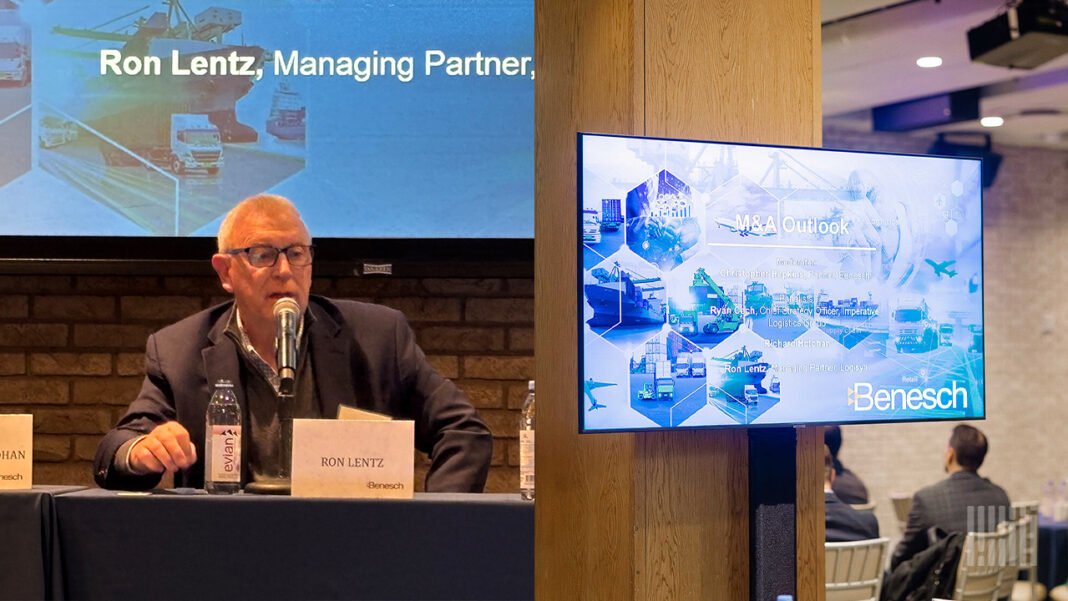

New York–Ron Lentz is the managing partner of Logisyn Advisors, a logistics merger and acquisition advisory firm. And he recently had two widely divergent views of the year that is about to end and the one that is coming up.
At the annual Benesch Investing in the Transportation & Logistics Industry Conference here earlier this month, Logisyn said of 2025, “I almost can’t give away asset-based trucking companies this year. It’s been a very, very, very difficult year for asset-based trucking, and that doesn’t make a difference if it’s asset-based trucking with transportation brokerage along with it. I can’t do it.”
Lentz did talk about various strong points in the logistics M&A market this year. But it was looking toward 2026 that the talk of a “very, very, very difficult” market turned far more positive.
“I think it’s going to be a banner year,” Lentz said on the Benesch panel entitled M&A Outlook 2026. “There’s way too much capital out there.”
Lentz noted that the room at the conference, sponsored by the transportation practice at the Benesch law firm, was populated with people who “have either just raised a new fund or are in the process of raising a fund. So from the sponsor point of view, there’s a ton of capital and they’ve got to spend that capital.”
The one-day conference, always held in New York in early December, isn’t lengthy; it starts not long before lunch and ends before a round of evening libations. But if a person is a mover and shaker in the logistics M&A field, he or she is likely to be in attendance.
Lentz was likely the most optimistic voice heard from the stage about the M&S outlook next year. Besides private equity raising funds for acquisitions, Lentz said, “strategic” buyers, who often are publicly-traded companies, “have a ton of cash sitting on their balance sheet.”
(A similar theme was heard at the 2024 edition of the conference).
Organic growth next to impossible
And he noted another sobering factor in a market well into another year of freight recession: growing a business is a challenge. “It is next to impossible to grow your business organically, so the next best option is through acquisitions,” Lentz said.
The size of multiples in deals that are getting done, he said, are “inching” up. “They’re not going to dramatically go up,” he said, adding that “I think the activity is there.”
Richard Holohan, on the same panel as Lentz, said the freight recession had made reaching a consensus on company valuations a tough task. “But I think in the last six to nine months, we’ve kind of gotten past a lot of those dislocations, and that’s unleashed a lot of activity,” he said.
Tariffs make one type of brokerage a desired acquisition
Both Lentz and Ryan Cech, the chief strategy officer of the Imperative Logistics Group, said customs brokerages and freight forwarders have been hot items in the logistics M&A landscape, as they are designed to help importers or exporters work their way through the tariffs maze.
“We spent a lot of time in the last year looking at customs brokers,” Cech said on the same panel as Lentz. “They’re certainly having a moment in that tariff environment.” Their skills, Cech said, enable an importer to “appropriately classify import documentations,” which can often result in lower tariffs. “That’s a value added service these days and can solve a very acute pain point for shippers,” Cech said.
While the fog of tariffs may have helped customs brokerage and similar areas of expertise, Cech made clear it has not been a boon overall to the logistics M&A field.
“There were some investment committees that were hesitant to deploy capital in such an uncertain environment,” Cech said. The worst of that has probably passed, he said. But that doesn’t mean there won’t be an impact.
“Once the dust settles, it will just be different,” Cech said.
If the dust has settled, Cech said he sees an industry that might be ready to see heavy M&A action.
Benesch co-chair of the transportation group Marc Blubaugh kicks off the conference.
NYCCORPORATEEVENTPHOTOGRAPHER.COM | LANA DUBKOVA
On the sell side, he said, are owners and founders who have been waiting several years for a freight market to turn around. But it hasn’t, and it may not happen next year. Their conclusion, Cech said, might be to say “you know what, now is the time” and go ahead with a sale.
Holohan expressed a similar sentiment. “Some transactions are often driven by something more powerful than the market cycle,” he said. “It’s often succession.”
If it’s a family business being sold, “those drivers of that type of transaction typically outweigh where the spot rate for truckload at this very moment, so that part of the market has been fairly stable.”
On the buy side, Cech echoed Lentz in that the inability to grow organically may be a spur to more deals. “The financials have been flat for the last three years,” he said. “So you have buyers that have had lackluster growth and they are seeking to pursue M&A as a growth alternative.”
Now what?
If some of those sellers are founders, it can present a separate set of issues. The post-acquisition landscape was discussed in a separate panel that asked the question “Now What?” following the consummation of a deal.
Rebecca White, executive vice president of strategy and corporate development at KAG, said about three-quarters of the transactions the company does “are with owners who say the reason for the sale is they are retiring.” (KAG describes itself on its website as the “largest tank truck transporter and logistics provider in North America.”)
“We like for them to stick around for a transition,” White said. That period is usually six to 12 months, she added, “and they are usually very open to doing that.”
Sometimes the temporary bridging period works out better than expected. Those founders, White said, might say “things are going pretty well. I think I’m really going to stick around.” She added that “it’s been an interesting aspect” of some acquisitions.
But that’s the founder. Spencer Tenney, president of the Tenney Group, a merger & acquisitions advisory group, said the management team of an acquired company also is a concern. He discussed a recent recapitalization of a company steered by the Tenney Group that also allowed the simultaneous promotion of four managers.
“Every employee wants to know, how is this going to affect me, good or bad?” Tenney said. But in the transaction he discussed, Tenney said the steps taken by the private equity company involved in the deal to elevate the four executives “set up that transaction for a generation of success.”
Given that any sort of sale always comes with the fear of layoffs and job losses, Tenney said it’s notable that he’s been seeing “a little bit more restraint as it relates to eliminating some of the head count.”
“Rather than just taking a machete to it all, I think buyers are just taking a few extra months to understand who’s actually doing the work, what should we actually eliminate, and who are some of the best players that we want to be part of the future,” Tenney said. “They’re being a bit more long-term focused on how they integrated to maximize success.”
More articles by John Kingston
As dealmakers gather in New York, logistics merger activity holding up
Strange bedfellows as states say brokers not protected under ‘safety exception’
Logistics startup founder loses appeal on conviction, 20-year sentence

